Wednesday, July 20, 2022

National Moth Week - 2022

July 23-31, 2022 is National Moth Week, a time to see and appreciate nocturnal nature.

Moths are widespread and very diverse with possibly 500,000 species worldwide (no one actually knows because new species are constantly being discovered and described); there are somewhere around 10,000 species in North America. Some moths are brightly colored while others are extremely well camouflaged; some species are so tiny they’re difficult to see while others are the size of my hand.

It doesn’t matter if you live in the city or the suburbs or the country, if you leave the outside lights burning for a while on these summer evenings you’ll attract moths. Some types of lightbulbs produce a light that’s more attractive to moths; bulbs marked 3600K or higher will attract a variety of moths as will older incandescent bulbs.

Here are a few moths that I've photographed this year –


Only a few moths cause economic impacts but many species (especially in their caterpillar stage) are eaten by songbirds or other insects. Hopefully you’ll enjoy the moths in your neighborhood, we certainly find fascinating and beautiful moths here.

Wednesday, July 13, 2022

Autumn Olive

Autumn olive (Elaeagnus umbellata ) is a shrub native to northeastern Asia and Japan that grows up to 20 feet tall. It has been widely planted in the northeastern U.S. for erosion control, wildlife habitat and, because it fixes nitrogen on its roots, for rehabilitation of disturbed sites like strip mines. Although it’s often confused with and even called Russian olive, Russian olive is a different species – a small tree.

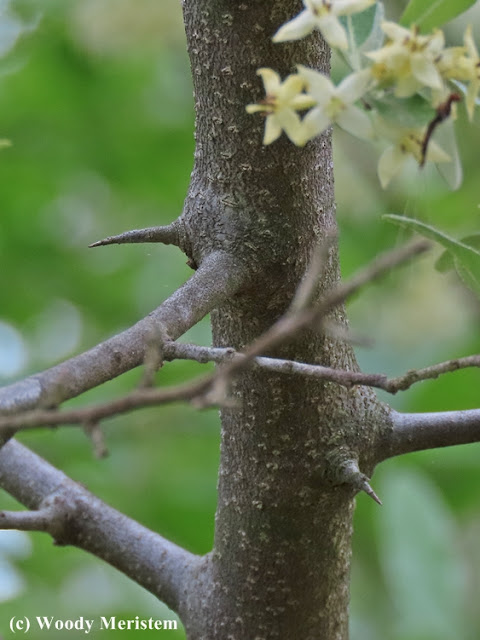
Smaller stems and twigs of autumn olive bear short sharp-pointed stems that can produce a nasty puncture wound and are occasionally able to puncture vehicle tires –

The leaves of autumn olive are one to two inches long with smooth edges and small silver-colored scales on the lower surface –


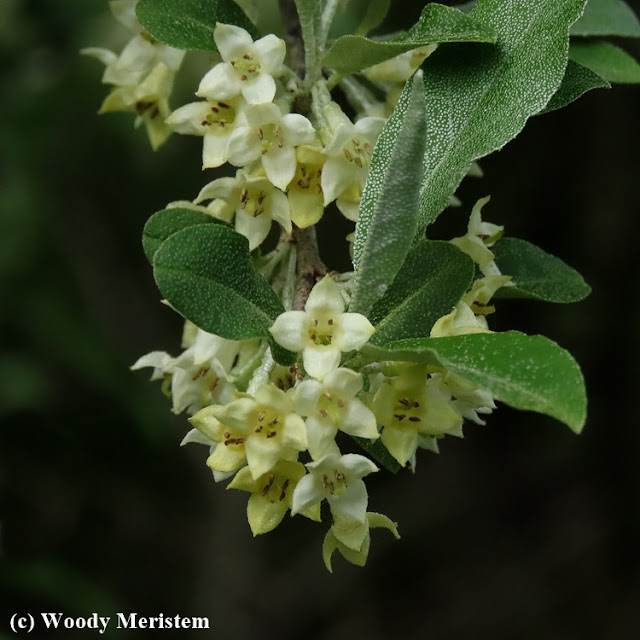
In spring the plants have an abundance of small pale yellow trumpet-shaped flowers that have a wonderful aroma –


Those flowers are the precursors to small red fruits that also bear small silvery scales –


The fruit contains a large seed (pit) and has a tart taste, I like the flavor but many people do not. However the fruit is readily eaten by the many species of birds that typically feed on fruit –


Wild turkeys go to great lengths to feed on autumn olive fruit –

Mice and chipmunks devour the seeds, black bears tear the shrubs apart to get at the fruit and deer browse the twigs –


Autumn olive is widely considered an invasive exotic species: its leaves emerge earlier in the spring and last longer in the fall than those of many native species, the nitrogen it fixes allows it to grow on infertile sites and it can therefore out-compete most native plants.

Vast sums have been spent on efforts to eradicate invasive exotic plants, including autumn olive. So far, except in comparatively small areas, all of that money and effort have led to naught; is it time to accept that those species are here to stay – just asking.

Wednesday, July 6, 2022

Surprise !!!

It was an evening in mid-June, warm but not hot, I’d gone out to take down the bird feeders – we do that each evening to avoid having the neighborhood black bears do it for us.

Going along the front walk I was brought up short by a yellow-phase timber rattlesnake basking in the light of the setting sun against the base of the front stoop. Having worked in rattlesnake territory for well over 50 years, I’ve never been afraid of timber rattlesnakes but respect them and have also developed an automatic reaction to stop whenever one is in my field of view even if I hadn't realized it was there – no thought necessary, it’s an automatic reaction.

We’ve lived here on the side of this ridge for 51 years and, although we regularly see garter snakes on the lawn or in the flower gardens –


We’ve never seen a rattlesnake here – nor heard that any neighbors have encountered one.

I saw the snake, the snake saw me; it moved its head slightly backward and I backed up. OK, what to do now? We wouldn’t want a rattlesnake around the house but rattlesnakes are a species of concern in Pennsylvania and in any case I really didn’t want to kill it.

To the garage I went to get one of my snake sticks and a five-gallon pail, then back to get the snake which hadn't moved. Timber rattlesnakes are quite docile; using the snake stick I got it into the pail – which was much too shallow to contain the 3½ - 4 foot long snake, so out it came and quickly crawled into the dense flower planting.

I called H and she brought our steel garbage can. By that time the snake had emerged from the planting onto the lawn in an effort to flee and I used the stick to get it in the steel can – on went the lid. Unfortunately, I didn't take photos although in retrospect I very much wish I’d taken a photograph of the snake against the stoop.

Now what???? Nope, I wasn’t about to kill the snake nor take it back up the ridge to possibly return again. So, in the car went the can with the snake and the two of us and off we went to release the snake in suitable habitat far from dwellings. By the time we got to the release site the sun was slipping below the horizon and it was quite dark in the woods.

At a spot where an old timber sale road left a forest road the can came out of the car, the lid came off and the snake came out. As soon as the snake hit the ground it headed for thick cover –


Once there it coiled in a defensive position –


Through all of this the snake never coiled until it got into the thick cover, and never once made any attempt to strike. As I said, they're quite docile and they ain't out to get ya.

We wished it well and headed for home.

Timber rattlesnakes have two color phases with many gradations in between: yellow like the one we had just released –


And black -


This was a fairly young snake but quite large, still growing as indicated by its tapered rattles (a new segment is added at each shedding, perhaps three or four a year). Timber rattlesnakes usually become mature when they're five to ten years old, males earlier than females.


As compared to an older snake with rattles of uniform width, indicating it's completed its growth, and the tapered segments have been lost –


Timber rattlesnakes use dens below frost level during the winter, typically a number of snakes den together in a site they use winter after winter. The dens usually don't look like the rocky open areas that most people call snake dens, those places are basking areas. The den entrances often resemble a chipmunk hole in the woods, usually within a few hundred yards of a basking area.  

Male timber rattlesnakes may travel a couple of miles from their dens, females not as far; I didn't check to see if the snake by the stoop was male or female. Where was it's den, where are the others from that den, how long was the snake around the house? We'll never know.

We released the snake, hopefully it will survive in its new home and not try to return – in which case it may succumb to predation, or a malicious human, or a vehicle as it crosses a road, or the cold of winter if it can’t find a den below frost line.

Wednesday, June 29, 2022

From Winter to Summer at the Log Bridge

Several years ago a medium-sized hemlock tree fell across a small stream in the Big Woods. The stream isn’t very large and at the shallower riffles the water’s only three or four inches deep for most of the year. Nonetheless there are animals that use such log bridges to cross streams wherever one is available.

One of my camera traps was placed so it could capture videos of the animals and birds using this log bridge. There were high hopes of getting a video of a bobcat crossing the log and perhaps an eastern coyote or black bear doing the same.

Here are six months of videos from the log bridge – minus hundreds of videos of gray squirrels running back and forth.

Well, no bobcat crossed the log bridge – nor did a black bear or eastern coyote although the camera trap caught the last two after they crossed the stream just beyond the log. Never before has one of my camera traps caught a video of a belted kingfisher. The camera trap will stay there watching the log bridge – here’s hoping that a bobcat will pass its way.

Wednesday, June 22, 2022

Gypsy Moth

The last couple of times I’ve walked in the Big Woods the forest has looked like this –


That wasn’t November it was early June and a view of the hillsides revealed that extensive areas were bare of leaves –


The cause was these caterpillars –


Not just one caterpillar but many thousands, perhaps millions, to each and every acre – here climbing the trunk of a white oak in search of additional leaves to eat –


They’re the caterpillars of the gypsy moth (Lymantria dispar) an insect native to Europe and accidentally released in Massachusetts in 1869, from there it has spread extensively wherever its favored food species (oak, aspen, apple and others) are abundant.

In 2021 the Entomological Society of America (ESA) decided to change the insect’s name from gypsy moth to spongy moth since the name, gypsy, could be considered offensive to the Roma people (often called Gypsies). Gypsy moth has been the insect’s name for over 150 years and so it will remain here until the ESA changes any other moth names that could be offensive to someone (e.g. The German Cousin, The Hebrew, Finnish Dart, the Setaceous Hebrew Character, a large group called Quakers and others).

Back to the Big Woods: There are gypsy moth caterpillars of many sizes, some almost ready to pupate and others needing more time to feed and grow. The younger caterpillars may well starve as most of the trees’ leaves have already been eaten or fallen to the ground as scraps –


Larger, older caterpillars will soon enter their pupal stage where they will transform into adults –


Adult females are white moths, flightless due to the heavy masses of eggs they carry and will soon lay as tan spongy masses –

Male gypsy moths are tan and fly about searching for females with which to mate. They find females by the scent (pheromone) the females emit and is detected by the males’ feathery antennae –


The tan egg masses contain the eggs that will produce next year’s caterpillars. A number of tiny wasps parasitize the gypsy moth eggs, helping to control the population. The few species of birds that eat hairy caterpillars feed on those of the gypsy moth as do white-footed mice. The larvae of several introduced species of parasitic flies feed on gypsy moth caterpillars as does an introduced fungus; caterpillars killed by the fungus hang in a characteristic “J” shape –


But the parasites, predators and diseases don’t always keep gypsy moth populations in check, every 10-20 years there’s an explosive population increase such as we’ve seen this year. What of the trees that have been stripped of their leaves? Almost all will survive and grow new leaves in the next several months; if the trees are defoliated next year, roughly 30% will die; a third year of defoliation will probably kill 60% of the trees. But perhaps the predators, parasites and diseases will succeed in killing enough gypsy moths that the trees will not be defoliated for a second or third year – time will tell.


Note – Introduction of several species of flies to control the gypsy moth has had an unintended consequence,

they also parasitize our most beautiful large moths (including the luna, polyphemus and promethia) with devastating consequences to their populations.


Wednesday, June 15, 2022

National Bald Eagle Day

June 20 is National Bald Eagle Day, known to many as National American Eagle Day. The actual name for the bird is “bald eagle”, the name used by the U. S. Fish and Wildlife Service, and so that’s the name for the day used on In Forest and Field. The bald eagle was adopted as the symbol of the United States in 1782, an image of the bald eagle has adorned the Great Seal of the U. S., flags, statues, buildings, currency, and military patches, as well as an abundance of un-official objects.

Ironically, the bald eagle was on the verge of extinction in the 1950s and 60s, primarily due to the widespread use of DDT which caused such eggshell thinning that the eggs broke and never hatched.

In the 1980s there were only three active nests in Pennsylvania, now there are over 300 with more being found each year. The use of DDT has been curtailed and over time the species has recovered.

In celebration of the bald eagle’s recovery from the brink of extinction here are a few photographs I've taken of the majestic bird –


How fortunate we are to be able to see eagles in the sky.

Wednesday, June 8, 2022

Diggin' for Dinner

Pileated woodpeckers are usually considered birds of extensive woodlands although they can also be found in forested parks and wooded suburbs.

Here I was, in town, driving through a section with few large trees, indeed with few trees at all. In a tree lawn, that narrow strip between sidewalk and street where shade trees are often planted, there was something red moving. Curiosity aroused, I slowed down and then came to a quick stop. That moving red thing was the crest of a pileated woodpecker chiseling, chopping away next to the rotten stump of a tree that had been removed 10-15 years ago.

I’d stopped against the curb directly across the street from the stump and the woodpecker. Down went the window, out came the camera – it quickly became apparent that what I’d seen was a female pileated woodpecker –


She seemed to ignore the car and the human within as she continued working, not on the stump but in the soil next to the stump –


In the soil she certainly was – frequently her entire head and neck disappeared into the hole –


The woodpecker would chop in the depths of the hole a few times, raise her head to look around and then resume work –


Suddenly she extracted a large beetle larva, and quickly swallowed it as a starling looked on –


Occasionally cars and pick-up trucks passed and still she worked. I’d watched her working for well over five minutes and switched from taking photographs to recording a short video –

The passing of a city bus caused her startled reaction; but, as you saw, she rapidly resumed her excavation. She gave no indication of finishing her work any time soon, so after about ten more minutes I went on my way.

The larvae she extracted, presumably from a large root below ground, appeared to be the larvae of stag beetles or some other large beetle whose immature stage feeds on decaying wood.

The presence of this pileated woodpecker in such atypical habitat raises a number of questions:

  • What caused this woodpecker to leave her usual habitat and visit this isolated stump in the midst of pavement and closely-spaced houses?

  • Does she regularly visit such a built-up area?

  • Do pileated woodpeckers examine every decayed stump they see?

  • The stump, in which the homeowner had planted pansies, was quite rotten but showed no sign of recent woodpecker activity, had she visited this stump in the past and come back again?

  • Woodpeckers usually seem to locate beetle larvae and carpenter ants by sound, can pileated woodpeckers detect beetle larvae beneath almost a foot of soil?

  • Did she locate the larvae in some other way?

Wednesday, June 1, 2022

Ruby

Ruby is a male ruby-throated hummingbird – giving individual human names to wild creatures is not something of which I normally approve, but ... Yeah I know Ruby is usually considered a feminine name, but he doesn’t seem to mind and it’s an appropriate name for a bird of this species.

He was the first hummingbird that visited the feeder hanging outside our kitchen window this spring. From the feeder he’d go to a nearby dead twig to survey his domain. I realize we hold the deed to this property, but several other species also claim the same piece of the world. We don’t mind in the least; they, actually their predecessors, were here first. We hope they don’t mind us too much – although I know some of them would be more comfortable if we, and all other humans, disappeared.

Ruby visited the feeder one evening and then headed to the dead twig to rest and preen before heading back to the feeder. Fortunately the camera was on the tripod awaiting some interesting development, these photos may give you a brief glimpse into the life of a ruby-throated hummingbird. The throat feathers depend on reflected light for their brilliant red color, hence his throat appears black unless the light is just right – 


The next day a female ruby-throated hummingbird showed up at the feeder, a mate for Ruby perhaps. Ruby-throats depend on often scarce and widely scattered flowers and so they usually don't graciously share feeders, nor are they faithful to their mates. Ruby may soon begin chasing the female away from his food.