Thursday, February 27, 2014

Dang Cats


In 2013 the camera traps at the edge of the woods behind the house caught several different house cats – some only once, others quite regularly. We don’t have a cat, nor do any of our immediate neighbors and none of the cats wore a collar; so where did these cats come from?
https://blogger.googleusercontent.com/img/b/R29vZ2xl/AVvXsEiAxZtqHfrc2-HBsdYBy-dZrLuAclI17fc1UHYmSH-Wx6jwBzC6nNEAAhCAsZ8t5GZm4i1qmysipfMrX-B9sy2QgcXQvOkOqY6avZNfhVxLLyF0L8KqI0CWlaTBBui7VngsBY_Woqg10NI/s1600/House+Cat+2-4-2013.jpg                                
https://blogger.googleusercontent.com/img/b/R29vZ2xl/AVvXsEibIxNlBSnTdgnzKn4W8V7U2wXWobSIgDiAXaBXHOazERQ69yQ_AM0zYxpMtMKsUyQcxVxvhH3KgVAJZE8eVLM2rtJ7amg8vzgG4cHyMf4FbMMMIQv1Cg20So3e_fy9BouCnXtlxcp1B8k/s1600/House+Cat+4-20-2013.jpg                              
https://blogger.googleusercontent.com/img/b/R29vZ2xl/AVvXsEj8_9MQxfwM_J-O9h3wgW8RS4rn4s5F0q7n9Obdqg-VzkMqevBHwua5oheY288DY7WuUS0l6-Es34XaopCLLDD26GR2s3Zz1W0xlSrxgrhv_SUGXF9qhLZBgFJPsMu1EMppoSXEhc9GTVU/s1600/House+Cat+9-5-2013.jpg
https://blogger.googleusercontent.com/img/b/R29vZ2xl/AVvXsEjoHdKGrSm7DjJabJbOzeM1aOI9LQK-dEjPkdBRkeAMu1LL3KK7EzdMHmXkJrhhEYxjNtjSGMftnXxDf9rMJrmN4bX9wrbWNJrPA6cfQWNE5Dr6aHhjP7OBpwxP50dJjgju-71crW9E5xg/s1600/House+Cat+4-28-2013.jpg     
                                  https://blogger.googleusercontent.com/img/b/R29vZ2xl/AVvXsEj7xZPQpOsnXtv1_v84NbykC_BvbOwXA3ktVZpiFr7Qi7TDWV2bE0IrL4a-yA9RKeSPuF4PkdzvJVHg-Cc16maRuyD2M8meiitcB7-gSoaqPY8V8QVyQrcMn1VZ9UaEnE7bfq6FbD2ysig/s1600/House+Cat+9-25-2013.jpg
The University of Illinois, in 2011, reported on a two-year study of free roaming house cats that yielded surprising results. Radio collars were placed on 42 adult cats, both feral (un-owned) and pet cats that were allowed out to roam. One of the feral cats had a home range of over 1,350 acres. The pet cats were relative homebodies with an average home range of about five acres.
Now I’m a fan of predators – coyotes, bobcats, foxes, weasels, shrews, hawks and owls are much more interesting to me than their prey. But, I’m no fan of free roaming house cats! Most of those cats are, to some degree, fed by people, either their owners or kind-hearted souls who put out food for the feral cats in their neighborhoods. Those well fed cats continue to kill, not to eat but to fulfill their predatory instinct.

Some may argue that house cats merely take the place of wild predators in developed areas. But the population density of house cats, feral and roaming pets combined, is typically far higher than the populations of the wild predators they’ve supposedly replaced.

According to ScienceNews (February 2013), a team of biologists associated with the Smithsonian Conservation Biology Institute estimates that cats kill between 1.3 billion and 4 billion birds and between 6.3 billion and 22.3 billion small mammals each year in the United States. That’s billion – with a “B”. The bird kill is estimated to be about 15% of all the birds in the U.S.

Birds and small mammals have high mortality rates for a wide variety of reasons, from predation to disease to vehicles and pesticides. But the additional mortality due to house cats almost certainly pushes some species of wildlife over the brink in certain landscapes.

Unfortunately, many cat lovers don’t realize or won’t acknowledge the havoc that house cats cause to populations of native wildlife – or maybe they just don’t care.

Signs of Spring

February 17 – It was 9° at the house this morning, but the sky was a brilliant blue without a cloud. On the telephone cable along the road a male cardinal was singing away. This wasn’t the short weak song we typically hear on pleasant winter days – it was a full-throated territorial song typical of spring.
https://blogger.googleusercontent.com/img/b/R29vZ2xl/AVvXsEioewgCM1xjJP26hG5gpOhizIN0a_bjZSiB6DvvpryxIOhnDXKZnP13yL-saFAE6Eq_Wu5V4Nb-KQTOobNXiXsrtsvJCNbXytVcyNqBh-ea6MeJOcar_8m8GZE1QMKmWpUTPL3fhJ54EgU/s1600/Cardinal.JPG
Cardinals are year-round residents and maintain their territories (although not too vigorously) throughout the winter. Earlier in the winter three different pairs of cardinals visited our feeders, but since the days of cold and snow have arrived there’s been but one pair here. Did the other birds succumb to the weather or did the dominant pair drive them away?

Further down the road a small flock of robins fed on the shriveled fruits of an ornamental crabapple.
https://blogger.googleusercontent.com/img/b/R29vZ2xl/AVvXsEh-VDX5dpgbXb_-TmBCb2bgEAYc3Tx4FB7hXCwbuUJHaVVOWtIe5rTCSlCnPnsivEoMDnTtO2-syFY64YKBrK0jeYYp-5iuR3mF0O0Dd-IqtKiDOFNkOR7nFx6ZQAn4j5f_v-lvL_UIyhw/s1600/Robin+(m)+-+a.JPG
Most years a few robins winter in the lowlands and wetlands near the river. But, these birds weren’t near the river and it appeared that all were males. Perhaps they were birds that have been wintering in the area. Or, perhaps in spite of the snow and cold the most adventurous male robins are heading north already. That would give them a chance to claim the best territories, but also put them at risk of perishing in a late winter storm – some years these early birds would win, some years they’d lose.

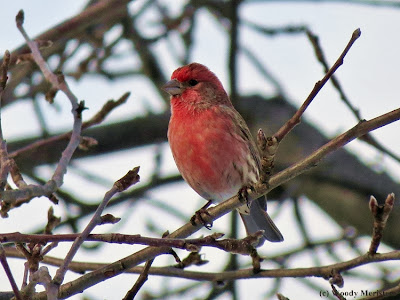
February 18 – A male house finch in the apple tree displayed his bright breeding color and was accompanied by a female, the only house finch to be seen near the house this day.

For a few years many of the house finch we saw had conjunctivitis that affected their eyes to the point that they couldn’t see well if at all – it’s doubtful if any of those birds survived. But for the past two years we’ve not seen a house finch with conjunctivitis. Presumably the birds that were very susceptible to the disease were eliminated from the population and birds that had some resistance remained to produce subsequent generations. Survival of the fittest on display.
                                https://blogger.googleusercontent.com/img/b/R29vZ2xl/AVvXsEgKZjDUNnwvH1D0qo7sNNhQmDKCBm8pKVIyQZhU5MEwuhbG53ybn4EfNNIsmOgcoaqnzcDGtrHvyBpScE5f-6RrSw3Sol_Yb4tN3A3dRGh2PuHrOoepdgK3ieWGxJ9YUQHtUEymv9QS5R4/s1600/House+Finch+(m).JPG


February 20 – The flock of robins appeared at the house today, picking the fruits from an ornamental holly at the corner of the house.
https://blogger.googleusercontent.com/img/b/R29vZ2xl/AVvXsEg-VWKvbpkVsTD9SuBTFrtCLwD6k061lmIyB7YzoknfRlVsV0In4a1rNaIOPurhXgAARdWmItPKDn1pEgVZBinv8e-eXBPU5BZvgEvr889bY_jE6KmWsBMafv_DklbLD2c9USD6HiQg21M/s1600/Robin+(7).jpg 


Some of them perched in a small white pine, seeming to bask in the sunlight. They’re making the rounds of the neighborhood, feeding on any remaining fruit they can find. The temperature was well over 40° F this afternoon melting several inches of snow; but there’s still well over 15 inches of snow on the ground. Will the snow melt before the fruit is gone?

https://blogger.googleusercontent.com/img/b/R29vZ2xl/AVvXsEg9h5NI7HZmdshvxkdExINPQ4oHAEkpgsjUq26ka1r8iCfigFclN4XGJQ92v1zLaY1Mv83gR92hF_YSFmAUwug949uL_Gr5Uk8v-QH2L-iaNtgnnMZYt-ESu184KhZG62JZ3NtN4c3FJuM/s1600/Coopers+Hawk+(1).JPG 

February 21 – Down along the river, in addition to the cold rain typical of early spring, there were even more signs of spring: An immature Coopers hawk sat on a limb, looking rather bedraggled in the rain. I’d prefer a lower temperature and falling snow to rain at 36°, would the bird?


In the river there were some early migrants: a lone horned grebe –
https://blogger.googleusercontent.com/img/b/R29vZ2xl/AVvXsEgU8yDIkX_3Q5JuWeXRi1Gp3QvmYAAYG_9Lu_JHNKbaWoFBPD7ymQmC2ZpGS2zKayW8jjceh8MkH9vzg51CxTO8XZzKiMJbFKdMaVT70Pb1JK5opBe7tBhru70EpnADG7lUJCdFY38BdQg/s1600/Horned+Grebe+(2).JPG
And several pairs of hooded mergansers –
https://blogger.googleusercontent.com/img/b/R29vZ2xl/AVvXsEiRIlPKaoI-30NKDa5KSSaQ-t6nzl_nCzR1kJkHEGNlcl7Se10BPMalGEyvF_nAB9T72qTCFBmeHqVs0HdYJn0k0WJ4tXZtVlQdhgbL3eyY7DoOikWHbmxiNTJg6tkn-DqEQsI3U0rLnIQ/s1600/Hooded+Merganser+(1).JPG
https://blogger.googleusercontent.com/img/b/R29vZ2xl/AVvXsEgoc9bBUEShUVCgKhmCYlaPmu3IajwZqSqLqzdHHPCk6XUSDixOlTpPQPXdTKccwGTkr3CaGWS9uulrGK1jfDtIsgAKfQwfV7m88CPwHk97Ta3E21CoApBkp_erCddEkg55kswYIXZcQ-w/s1600/Silver+Maple+Buds+(1).JPG


The flower buds on the silver maples are swelling, ready to burst into bloom. They're the first trees to flower in the northeast, and do so long before their leaf buds open.


The signs of spring will be appearing more rapidly now, and even though we may well have more snow and low temperatures, the lengthening days are triggering changes in plants and animals that prepare them for the arrival of another season.

36 Hours


This week a span of 36 hours gave us a good taste of winter.

Two days ago it was  -4˚ F in the morning, clear with only a few clouds in a brilliant blue sky, just a very slight breeze and 8-10 inches of snow on the ground – a great day for a walk along the river, where the slack-water sections were frozen bank to bank with only a few small areas of open water. But the riffles were unfrozen as were portions of the river just below those sections of fast-flowing water. It’s still winter but faint stirrings of spring are becoming apparent. 

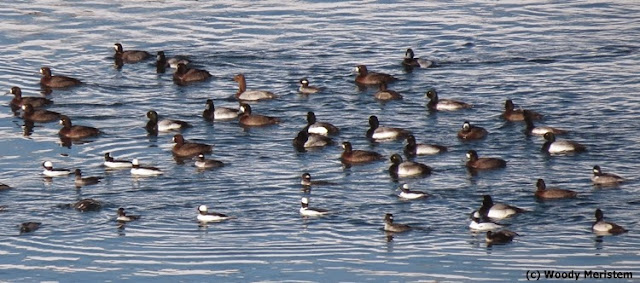
In one section of open water there was a small raft of diving ducks, migrants in all probability since they seldom winter here:

Lesser scaup – https://blogger.googleusercontent.com/img/b/R29vZ2xl/AVvXsEgsLeTMIGYCz8sNgyIvUx-tigifjCXc7pEhbpykbB9Lcan4qGV2i_2MKSDDzTDPro04ErMwWn4eg6P0Odmuc_my2FM2wjr4gHXJ-kQZ0nkA-7LZbaoJuFGxyMu2fJZBz0Gs47YWzWnDEZ8/s1600/Waterfowl.JPGAnd perky buffleheads, my wife’s favorites –
https://blogger.googleusercontent.com/img/b/R29vZ2xl/AVvXsEjV9pumD7Z_1RKFpp3Ey_G3KG2927veF30XBrnD9tUQGB7poIbweE52sFEQO458b84gKPi7vaIb0JaC3thCd89ZJM-WIuWfYltfF2D3igezAKxOCamTChu9o8-_XsK1udNC_EkQGYponkI/s1600/Bufflehead.jpg
And a few male canvasbacks showing the brilliant white backs from which their name is derived –
https://blogger.googleusercontent.com/img/b/R29vZ2xl/AVvXsEjj1os2gqKOiX14jDIbjPKQB_EPLallO-KCBueykPxcheWbaYDHtCTyAnacWZ83Tz-hN6nUPsUjZI_d8__qDNpK2Uu_NaE8oN9vQ1LTxb7UUUbHHmcGJHlGw_1Dv116iV8DPD1N1r1U1lo/s1600/Canvasback.JPG
They may be rushing the season to be this far north and on an inland river, but here they were.

An unusual visitor to the river was a male white-winged scoter clearly showing the white feathers that gave the species its name. This bird was so far out in the river that even a 1,200-millimeter lens didn’t yield a crisp photo. Scoters occasionally show up on our larger lakes, but are seldom seen on this section of the river –
https://blogger.googleusercontent.com/img/b/R29vZ2xl/AVvXsEgnCdIoxMVbIfrZXSOGM5CSf8ESefc8QHshDmyByZvsnZyWnz2848eRlW5uIO7WEUsFxJFzcyPw8Rr4BZMS9Icrb1E1vYdkc3rY10QGeFDyLWNhyNOF51AOCci1CvG2vaq9AONCYIPQTdI/s1600/White-winged+Scoter+(2).JPG

https://blogger.googleusercontent.com/img/b/R29vZ2xl/AVvXsEhyf9wkghku0Du8Gm3JfIBWyH704hULQ64JSclbE1VuSSBJVLr2MbSbWwoW_e5CRL7RM-vSdvGtQYMDEfuXCf823r9yUcdRS3dj5Igu40sqtXxmayN-abT6XELXsVdKTJVVgBkVlqlv2VE/s1600/White-winged+Scoter+%281%29.JPG
  
https://blogger.googleusercontent.com/img/b/R29vZ2xl/AVvXsEhUjMpIRakcfYCmfwAbxvumBL9MeV2FxgsJkHbSHOp8HDXUrXPGJ61OEhDaJufOmy7RFGv2soldTh4TlHgAEyQ5DXpZg3eNcCERhIhAsL-bZhOgBO3duVxL6jI04NAChC-IxWZYbBiZRV0/s1600/Bald+EagleJPG.JPG


Overlooking all the waterfowl was an adult bald eagle in riverside tree.


So far this has almost been an old-fashioned winter; cold enough, but with much less snow than we used to get in the olden days – that is, until yesterday morning. Woke up to temperatures in the low 20s and falling snow that continued until after sunset. By the time it stopped we had 7 ½ inches of new snow at the house and a total of about 17 inches on the ground. South and east of us more snow fell and some folks were having real problems. While I happen to like cold weather and snow, many people dread winter and avoid leaving the comforts of a heated house, car, office or store. That’s too bad since they’re missing out on the pleasures of a beautiful time of year.

As snow continued to fall late yesterday afternoon the conifers were covered with the new snow –
 https://blogger.googleusercontent.com/img/b/R29vZ2xl/AVvXsEiyQnRVeoDWEfQmvDGwmS5YGRXz_X67kA-_tmf2ur1yuXDaeiB0JXaKoevhCt8bi-Ftw6NqQAmObYSjSph5lGQm_0skPV2QLIgPdv_QuFwMWcySwUNooZc9GY9QTMa2pD4HFx52xg7f92w/s1600/IMG_9749.JPG
 https://blogger.googleusercontent.com/img/b/R29vZ2xl/AVvXsEh7ReyjesNdQe2RLVy8Yh9fL2MhWo4vSLFovXGvDD5viimaiBLdK27h6ibdzBL_3sMcR96LCaAJ_hcQizEYB4ndumDGi2F1eUCMCGEaqgKGAQUg1hofApHTtX6MoLwUIqvTvt0pN3QEneo/s1600/IMG_9764.JPG
And in a brushy area where some buckthorn fruit still hung from the twigs a few bluebirds could be seen -
https://blogger.googleusercontent.com/img/b/R29vZ2xl/AVvXsEgh8FO28a5IompyKVCUfkNV0U8OFXwEQAM9ey0BABXvj2NRsNPQzIZlnx2YacydBA4RXO0ppJ33_bEduU_wbP1Ig9oyYSoYUh-g2w__aTphyWlS1Hq4usZXQz-IF9-WQ99_l9i3yQC-4C4/s1600/Bluebird.JPG
In 36 hours northcentral Pennsylvania had seen two faces of winter, each different and each beautiful. Now winter is gradually drawing to a close; more waterfowl will be heading north and the bluebirds will be looking for a suitable cavity in which to nest.

Saturday, February 8, 2014

It Was a Good Day to Ski


Yes indeed, it was a good day to ski.
In recent years there really hasn’t been adequate snow in the Big Woods to make it worthwhile to even put skis on. Last winter my one excursion there was greeted by less than four inches of snow on the ground, with rocks and sticks exposed. With our warming climate conditions like that will certainly become more common.
This winter has been a bit of an anomaly in the recent warming trend, with low temperatures keeping what snow has fallen on the ground instead of quickly melting as the snow has done in recent winters. Although plenty of folks complain about winter weather, those of us who like to cross-country ski find joy in chilly days and fallen snow.

So with 10-12 inches of snow on the ground, crystal clear sky, and a temperature of 6° F at the house, I got out the skis and headed for the woods. It was early and no one else was there, but someone apparently had skied yesterday, or perhaps even by moonlight, and broken trail on the old road. Whoever it was has my gratitude since in places a bit of a crust was on the snow and the broken trail made the skiing easy.

There were a few tracks to be seen - of deer and gray squirrels as well as the track of one coyote crossing the old road. It’s always interesting to see tracks and try to discern what and when.
The snow was just about perfect for skiing and the forest of mixed hardwoods and conifers with its blanket of white was peaceful and beautiful.

At a fork in the old road the ski tracks I’d been following diverged from the route I’d planned so it was time to break trail back to the car.

A great way to spend a morning!
 

Wednesday, February 5, 2014

Wounded Buck and Fox Fight

With a forecast of "heavy" snow and the possibility that my low-mounted camera traps behind the house might be covered with snow, I downloaded the photographs from them late yesterday. The homebrewed cameras had a lot of photographs and the commercial camera had finally captured a video of the wounded buck --
A few days after the video was taken, the commercial camera had been relocated to a spot that the deer seemed to walk past quite often in hope of getting a better video of the buck -- that didn't happen.

But in a fitting tribute to Ah Wang's old adage "Never underestimate luck" both a homebrewed still camera and the commercial infra-red camera captured a fight between two gray foxes.
Gray fox are breeding now, perhaps it can be inferred that the cameras captured a female and two rival males. It's pretty obvious that one fox didn't want to be directly involved in the fight and quickly disappeared.

Combat appears to have begun before either camera turned on and apparently continued after the animals moved out of the cameras' fields of view -- seven minutes and nine seconds later. Midway through the video it's apparent that both animals were tired, but then vigorous fighting resumed.

The "heavy" snow never materialized, we got 6 1/2 inches before it stopped snowing this morning.

Thursday, January 30, 2014

On Three Legs


At dusk last Saturday eight white-tailed deer went up through the yard. They were all does or last year’s fawns except for the last animal which was an 8-point buck. The buck had an obviously injured left front leg which flopped as he walked and on which he couldn’t put any weight. We were on the wrong side to see what the problem was, although the leg certainly appeared to be broken.
The commercial trail camera missed getting a video of the buck, although one of the other camera traps behind the house did get a photograph of the buck as he went past. The next morning when I downloaded the picture from that homebrewed camera; it showed an injury near the buck’s left shoulder.
January 25, 2014
This buck’s antlers are rather distinctive and I realized the same camera trap had gotten a photograph of him last November 19
November 19, 2013
We had never seen him and the camera traps hadn’t gotten a photo of him before that November photo. Between November 19 and January 25 we’d not seen him nor had any of the camera traps behind the house gotten a photo of him.
Several questions come to mind:
·      How was he injured? Probably wounded during hunting season.
·      Where has he been for two months?
·      And most of all, will he survive?
With an injury like that he’s prime prey for the eastern coyotes that roam the hills – or for the free ranging dogs that also kill deer (for which coyotes are all too often blamed). Or he may succumb to an infection.
He was back again last night and left the track of the foot he was dragging.

Only time will tell if this buck will survive and there’s a good chance we’ll never know. He disappeared for two months, and may do so again for an even longer time. Perhaps the scavengers may have a late winter meal and scatter his bones, or perhaps one day I’ll find his remains. 
But deer are tough critters and can survive horrendous injuries. Many years ago I photographed a doe with an arrow through her head – she survived, but was later shot and killed.


This series of photographs also shows how resilient deer can be: http://camtrapper.com/viewtopic.php?f=7&t=8152&sid=9dd750e3253d4390b7bb3d7c8bac4c49
So, will the broken-legged buck survive? Maybe he’ll have his photo taken again, or we’ll see him walking through the yard. Maybe we’ll never know.

Thursday, January 23, 2014

Seven Days


Not every week provides something interesting every day – but once in a while this old guy gets lucky. A recent seven day period let me see some great things:


First Day – Walking on a recreational path along one of the larger nearby
streams, I looked across a small back channel and saw a mink working its way along the far shore. Often, a few squeaks will bring predators to investigate potential prey; in this case, the mink heard the squeaks, entered the water, swam to the near bank and disappeared – never did I see it again. Maybe it entered a muskrat hole, maybe it followed the bank, maybe …?
Day Two – At the lower end of some fast water in the river there was group of 10-15 male common mergansers and one female. They rode the tossing waves easily, and occasionally one would go underwater in search of fish. Suddenly there was a great commotion among the mergansers, with the whole group in splashing pursuit of one individual. At first I thought the males might be rushing the season and attempting to mate with the female. Wrong! As the photo shows, they were chasing a bird that had been successful in catching a large fish.

Day Three – At the beginning of a walk in the Big Woods I was heading down a seldom-used road when something walked out in the road. Although it was too far away and happened too fast for a photo, it was still exciting to see a bobcat cross the road and disappear into the adjacent old field now occupied by shrubs and small trees.


Fourth Day – As I walked along the river a pair of adult bald eagles flew upstream and landed on a large electric transmission tower. This wasn’t the first time I’d seen an eagle on the tower, but it was the first time there had been two birds.


This tower is the highest perch anywhere in the area and overlooks a shallow river section where the fishing is easy. Contact with transmission lines has historically been a major cause of eagle mortality. Fortunately the design of this tower makes it extremely unlikely that an eagle would contact both a hot line and the tower.


Day Five – Got home after sunset, but before dark, to find the tall trees in the yard filled with crows, several hundred, in fact. But, those crows were only a small fraction of the thousands in surrounding trees and flying nearby. I’ve seen this happen before, just not so near the house. The crows were staging before flying to the roost where they spend the night. They appear to assemble after sunset, wait until it’s darker, and then fly to the roost in a patch of large trees several miles away along the river. Interestingly, there’s a significant crow roost among shade trees in downtown Williamsport, Pennsylvania – adjacent to the tall building where a peregrine falcon frequently spends the night on a ledge.


Day Six – This was a pretty evening with an almost full moon showing through high thin clouds. Around the moon was a beautiful halo showing the full spectrum of colors typical of a rainbow. The first thing that came to mind was, “That’s a pretty moonbow.” But a moonbow is actually a “rainbow” caused by bright moonlight, typically seen at a waterfall, but also possible with passing rain. This halo was a corona caused by moonlight passing through high thin clouds, where the ice crystals act as prisms to separate the light into its different wavelengths. By the time I’d gone in the house, gotten a camera and got back outside, conditions had changed and the moon was obscured by thicker clouds.
Seventh Day – Changed the memory cards and batteries in the camera traps behind the house. Between the three cameras there were 495 photos and a few videos from the commercial trail camera. There were photos of gray squirrels, dark-eyed juncos, cottontail rabbit, a roaming house cat, opossum, raccoon, white-tailed deer and many of the neighborhood gray fox. The fox spent quite a bit of time wandering around in front of the commercial camera while it took an infrared video of the fox marking its territory three different times. While our deed to the property is recorded at the county courthouse, a lot of other species also lay claim to this spot on the side of the hill where, years ago, we built our house.

My lady and I consider ourselves extremely fortunate to have spent more than 40 years living in northcentral Pennsylvania where we’ve seen so many of the wonders of the natural world – many of them right out our back door.

Wednesday, January 15, 2014

The Eastern Coyote: Coyote+Wolf = Coywolf


My camera traps repeatedly pick up photos of the coyotes that roam our forests and fields. Coyotes, coydogs, brush wolves, they go by many different names, but what are they really? A lot of folks call them coydogs, believing they’re half-coyote, half domestic dog hybrids. But breeding biology and other factors make it extremely unlikely that these hybrids would survive in the wild. So, what are they? Curiosity (mine and my friends’) aroused, I set out to find out just what they are – here’s a synopsis:
For decades people have recognized a wild canine in the northeast that they have called eastern coyotes. However, the large size of the animals – bigger than western coyotes, but smaller than wolves – has confused people about what they really are. DNA studies have now shown that eastern coyotes are a mixture of coyote (Canis latrans) and the eastern (or Algonquin) wolf (Canis lycaon), but primarily coyote. A study published in Northeastern Naturalist made the case that eastern coyotes should more accurately be called "coywolves". Apparently these coywolves originated in southern Ontario, in or near Algonquin Provincial Park, when coyotes moving in from the west bred with eastern wolves.


These coyote/wolf hybrids subsequently spread south and east through New England and New York to occupy a range that had been empty of large wild canines since the 1800s. Just when this movement occurred is open to question: there are photos from Pennsylvania taken in the 1930s showing animals that appear identical to the animals we see now. Some scientists currently recognize the coywolf as one of four wild canine species in North America, the others being gray wolves (C. lupus) in the western states and Canadian provinces, eastern wolves (C. lycaon) in eastern Canada and formerly in the eastern U.S., and western coyotes (C. latrans).
Coywolves are larger in overall body size than western coyotes; have larger, stronger jaws and bigger skulls, allowing them to hunt white-tailed deer. Like western coyotes – but unlike wolves – coywolves can adapt to and survive near humans, thriving in the country, in suburbs and in cities – including within parts of New York City.
An analysis of coyote weights throughout their range found that coywolves are heavier than the coyotes found in the states of the midwest. Coywolf males are heavier than females, and coywolves are so large that females from the northeast average over 20 percent heavier than male coyotes from elsewhere. Most of the studies in the northeast found numerous coywolves weighing more than 40 pounds; coyotes of that weight are rare in other parts of the country.
Ecologically, coywolves have a larger home range than most western coyotes (but at about 10 square miles, smaller than that of wolves); travel long distances (10–15 miles) daily; eat a variety of food including deer but mainly medium and small prey (rabbits, mice and voles) plus carrion; and often live in family groups of up to five or six. The coywolf has characteristics (and DNA) that can be seen as a blending of coyote and wolf.
Even though the term “coywolf ” may be appropriate for this hybrid creature, “eastern coyote” rolls off the tongue more easily, and genetically they seem to be about 80-90% coyote – so I’ll probably continue to call them eastern coyotes.