Wednesday, May 24, 2023

Wandering for Wildflowers

It’s later in the spring but wildflowers have still been in bloom and I just can’t pass up an opportunity to look at them and take some photographs. This time it’s not to the Big Woods I went, but to other woodland near and far. Near because some wildflowers bloom later than those in the earlier post. Far because some of these species don’t grow nearby, or at least I’ve not found them here.

There’s a long woodland road that H and I drive in spring to enjoy its abundance of spring wildflowers. So one day in May we hopped in the car and slowly drove down the road, sampling the beautiful flowers that bloom in northeastern North America as spring progresses.

We found several painted trillium, many people think it's the most beautiful of all species of trillium –


Much, much more common is the purple trillium, but only a tiny fraction are its yellow variety, which we were fortunate to find –


Never have we seen such an abundance of squirrel-corn –


 A few spring-beauties still bloomed –


Another white flower blooming by the side of the road was the white variety of sharp-lobed hepatica –


Still another white flower came into view
when we saw several large patches of wood anemone –


Don’t like white flowers, how about the yellow of large-flowered bellwort –

Or perhaps the magenta of fringed polygala, also sometimes called little gay-wings or the little airplane –


We also found large patches of wild geranium in bloom –


And several violets: long spurred –


And northern white –


Hidden among last fall’s fallen leaves were the flowers of wild ginger, although the leaves were quite obvious –


Everywhere we looked there was an abundance of foamflower in bloom –


On one of which was a tiny, tiny fly –


The most exciting flower of the day was one I'd never found before, rose twisted-stalk –


There were still other flowers, as well as flowering shrubs, more than there’s room for in this post. Soon the trees’ leaves will be fully developed and the spring wildflowers will be done until next year, and then we’ll be back.

Wednesday, May 17, 2023

Snags and Swallows

Beaver ponds are superb places to see and photograph wildlife, the ponds and the large rodents that build them have a soft place in this naturalist’s heart. I have a few favorite ponds that I visit regularly and each of them has provided rewards larger than their relatively small size.

One of the finest stands of red oak I’ve ever seen occupied a few acres surrounding a couple of spring seeps – until the tornado of May 1985 blew through and knocked down or broke off most of the trees. The spring seeps had drained through a culvert under a little-used road; shortly after the tornado struck beavers moved in and blocked the culvert in what became a ready-made dam. Over the years the culvert was replaced, and the beavers have come and gone several times, but the new culvert was higher than the old one and the pond has remained.

The few trees that survived the tornado were drowned in the pond, now after 38 years only a few snags and a handful of old stumps remain. Those snags are an important resource for the wildlife that uses the pond. Woodpeckers have excavated holes in which to nest, and there are decayed knotholes that serve the same function.

In spring tree swallows adopt the snags as places to rest between feeding forays over the pond and they nest in cavities in the snags.

Male tree swallows arrive before the females, find suitable habitat and nest cavities and defend them from other males –


At about the same time, a pair of Canada geese arrived at the pond –


And male red-winged blackbirds began to stake out territories in the narrow band of cattails along one side of the pond. They often call and display from the snags or stumps –


As I sat beside the pond a male pileated woodpecker landed on a snag and proceeded to explore the long-dead tree in search of a meal –


What a treasure these beaver ponds are: for wildlife and naturalists.

Wednesday, May 10, 2023

Early Spring at the Bear Wallow

If you’ve visited In Forest and Field over the past several years you’ve probably seen still photos and videos from the seasonal pool that I call the bear wallow. This pool began as a pingo scar after the last glaciation ended in northcentral Pennsylvania. This earlier post gives an explanation of pingos and the scars they leave.


Here we see the wildlife that used the bear wallow in March and April of this year. No black bears as yet, but the pool was heavily used by wood ducks and the bobcat that was hoping to have a dinner of duck. Speaking of getting a meal at the pool, a red-shouldered hawk made repeated visits to hunt wood frogs during the frogs’ breeding season –

Although the bear wallow isn’t as attractive to wildlife as a beaver pond, it still attracts a good variety of critters.

Wednesday, May 3, 2023

A Fish Dinner is Served

Last year a post focused on a bald eagle nest in a sycamore growing on a steep bank above the Susquehanna River. The post ended with the single chick in the nest having grown to an age where it was almost ready to leave and begin a life in the sky above the river.


This year I returned to the nest on a beautiful spring morning and, instead of standing on the outside of the guiderail above the steep sidehill, stood tight between the guiderail and the road as the traffic swished past. The narrow path on the outside of the guiderail had been posted against trespassing by the landowner; although the path is probably within the road’s right-of-way, I chose to avoid a potential confrontation. Neither spot is a particularly safe place to stand, so I didn’t stay long.

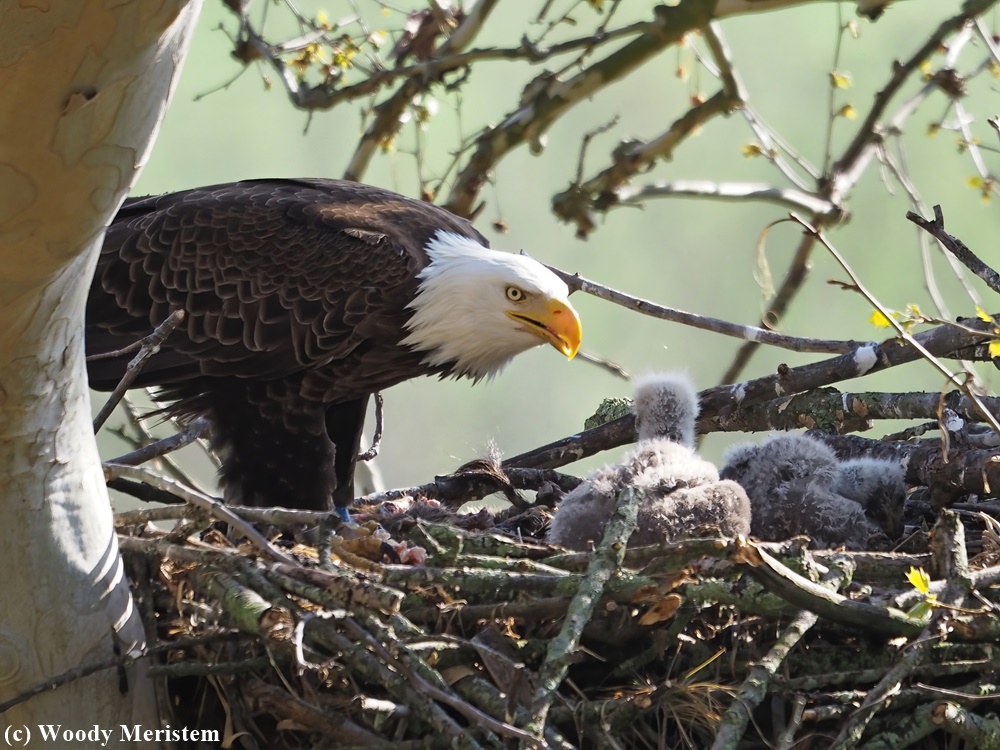
The female eagle was feeding two young chicks a fish dinner, offering each young bird morsels of food. From my spot it wasn’t possible to determine which was the older, more dominant eaglet but my best guess was that the nearest one was the older.

Dinner is served –


When neither eaglet took the final morsel, the adult swallowed it herself.

Last year I didn't get any photographs that showed the adult’s lower leg, so there was no way to determine if it was banded. This year it was obvious the adult was banded, but the numbers couldn’t be read and so there’s no way to tell the bird’s age or origin.

I may return to photograph the eaglets as they grow, but the road’s berm is very narrow and the road is a major thoroughfare so ...