Wednesday, February 1, 2023

A Goose and A Raven

There were reports of a Ross’s goose, a real rarity in northcentral Pennsylvania, feeding in cornfields with a flock of Canada geese. Ross’s geese breed on the tundra of far northern Canada and winter in the southern Great Plains, the Gulf coast and California but are seldom seen in this area.

This was too good a sighting to pass up so off we went in search of the goose. We drove a local road through the large cornfields along the Susquehanna River east of Lock Haven – no geese to be seen. But there’s another road that follows the river for a short way just off the riverbank, so we tried that. Trees and Japanese knotweed grow between the road and river but there were gaps through which the far-distant bank was visible.

It was through those gaps that we could see hundreds and hundreds of Canada geese and H saw a couple of white birds landing. Those turned out to be a pair of snow geese, but near them was another white goose – smaller, with a small beak that was blueish-gray toward the base. The Ross’s goose!


The snow geese soon left and the Ross’s goose moved along the shore. It preened and stretched its wings as I took photos, none of which were good due to the distance –


We watched it for quite a while in hopes that it might cross the river to our side as some of the Canada geese were doing, but it showed no sign of doing so. Tiring of the wait, we decided to take a leisurely ride home and check a bald eagle nest for any sign of activity.

No eagles, but on the far side of another valley we saw a common raven land in a tree. It payed us no mind when we stopped; out came the camera to rest on a beanbag placed on the car’s window ledge. The raven was feeding on something, holding it between its feet as it pulled off pieces to swallow.

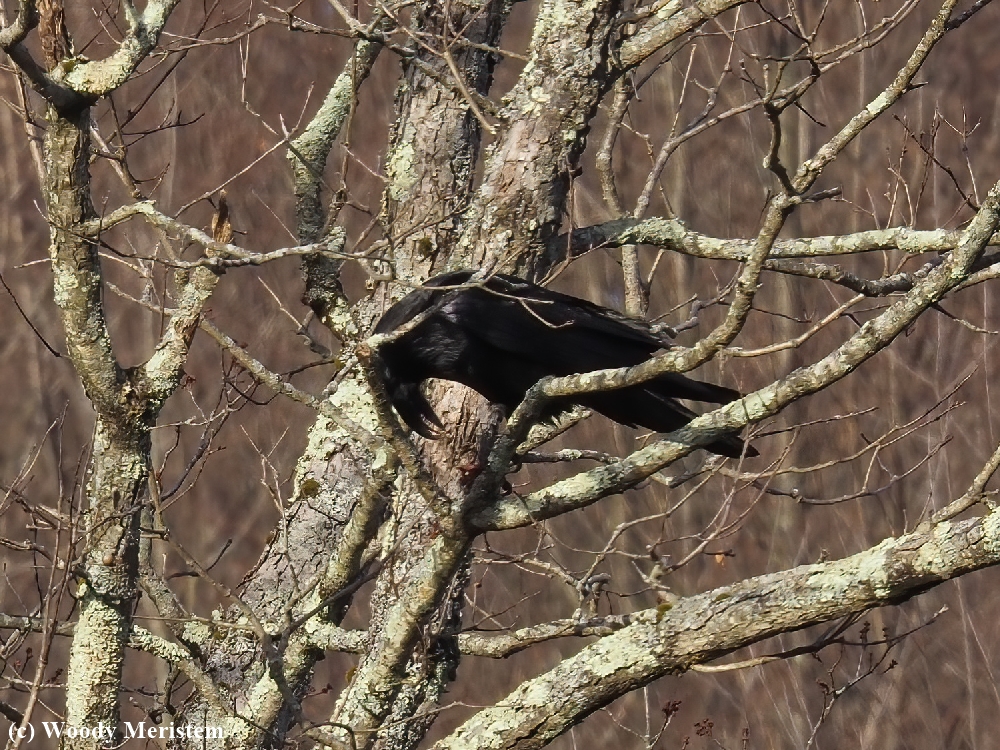


After a short while it flew to another tree carrying a yellowish object in its beak; that yellow object was an apple. The bird placed its treasure in the crotch of a branch – ravens frequently cache food and have been known to use objects as tools. They’re among the most intelligent of birds and there’s some evidence that their intellect is comparable to that of dogs. Then it alerted as another raven flew over, took its apple and flew off –


Thus ended an interesting day.

Wednesday, January 25, 2023

More Cats on the Rim

If you’re a regular reader of In Forest and Field you may have seen this post from January 2019.

Bobcats frequent the rim of the Allegheny Plateau in this portion of northcentral Pennsylvania. The rim gives them access to habitat in two different forest types, oak-hickory with an understory of mountain laurel on the plateau and hemlock-birch-maple with a scattering of oak on the steep rocky slope into the valley below.

Bobcats travel widely in search of prey but also act as ambush predators, lying in wait until prey comes near enough to be caught with a quick rush. Their prey is composed chiefly of small mammals (mice, voles, squirrels and chipmunks) and birds (songbirds, grouse and even wild turkeys); bobcats will also occasionally eat carrion if it’s not too old.

Breeding in late-winter/early-spring the female selects a den in which to give birth to her kittens two months later. The kittens stay with their mother for a number of months. During the past couple of months it seems that a female bobcat and her two almost-grown kittens have frequented this section of the rim. The camera trap I’ve had there for several years captured a number of videos of them as they traveled past and played –

We’ll say good-bye to the bobcats for now, hopefully we’ll see them again.

Wednesday, January 18, 2023

Walking Along the Run in Another Season

Pennsylvania has an abundance of streams and an abundance of names for the kind of flowing water that are collectively called streams: run, lick, creek, brook, crick, kill, branch and – surprise – stream. One of my favorite streams has a trail along the bottom of its steep-sided narrow valley, but shall remain nameless since it’s a rather fragile ecosystem and already has far too many visitors, although in absolute numbers there are not many.

The trail began life as a road to haul wagonloads of hemlock bark to a tannery about four and a half miles away as the crow flies, but much longer by the primitive roads of the day. For a number of years I worked with a fellow whose family had, generations ago, owned and logged the valley in which the stream flows.

In the intervening years the forest has recovered and there’s a population of native brook trout in the stream, none of which are much more than six inches long. The forest is beginning to take on the characteristics of an old growth forest: large standing dead trees, fallen trees, and several layers of vegetation from small plants to shrubs, small trees to large older trees.


Here, in order, are some of the things I saw on a late-summer day during a three-hour walk up the trail and back down –

A few small yellow mushrooms, yellow waxycaps I believe, glowed against the dark brown of a decaying log –


Just beyond another clump of mushrooms had sprung from a decaying root, these were (I believe) ringless honey mushrooms –


As in most of Pennsylvania, the white ash trees in the valley have died from the emerald ash borer. In an opening created when several trees died grew a number of plants of bee-balm in full bloom –


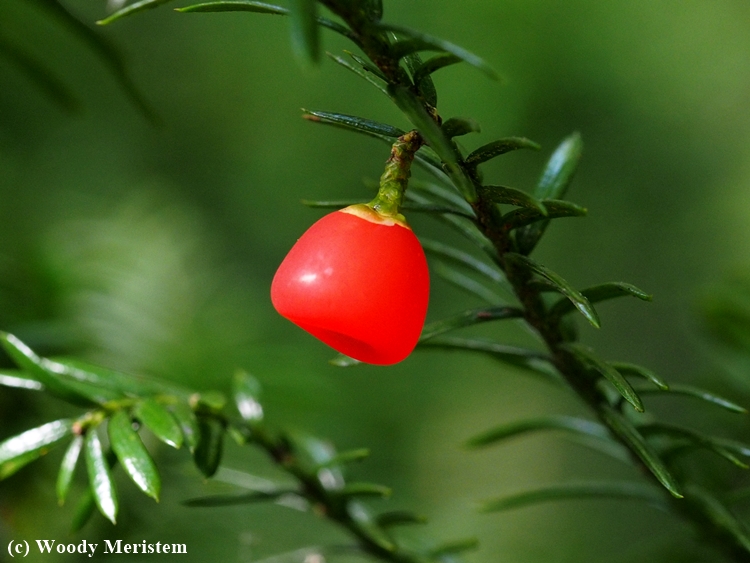
Further up the stream there are several large patches of Canada yew, a low-growing shrub that has been eliminated from most the limited areas of suitable habitat by browsing white-tailed deer. There was little sign of these having been extensively browsed and there were even a few translucent red fruits hanging from the branches –


More dead trees and fallen limbs bearing fungus, one interesting but defying identification and many tinder fungus on most of the dead birch trees –


In some of the shadiest moist spots grew colonies of common wood-sorrel, long past blooming –


On the edge of the opening grew a few small white flowers, white avens –


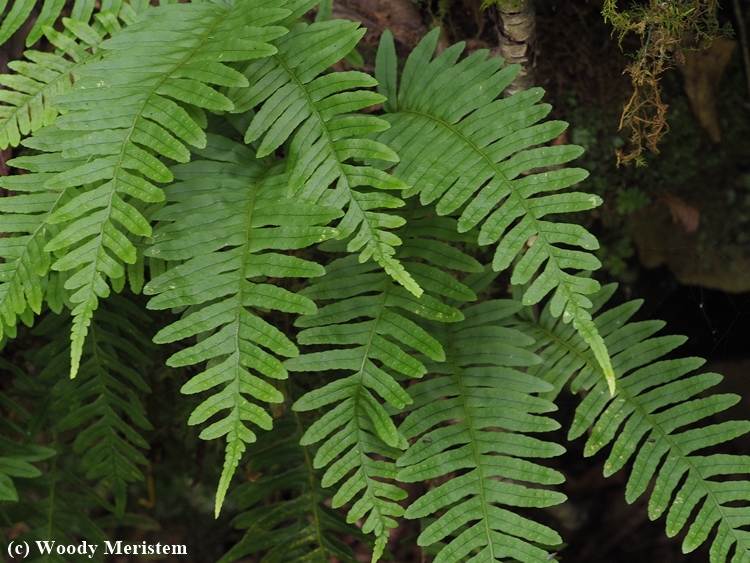
Here and there are large rocks that, in ages past, fell or slid from the steep slopes above. Many of those rocks, boulders if you will, are capped by a colony of rock polypody ferns which seldom grow anywhere but on shaded rock –


All along the way the trail parallels the run which in summer doesn’t carry much water but displays its maze of moss-covered stones and tiny cascades –


Indian-pipes with their ghostly white stems and flowers were in bloom. Indian-pipes aren't fungi; they're parasitic flowering plants, lacking chlorophyll, that derive their food from the roots of trees –

In several places along the trail stinging nettles grew in the moist soil. Stinging nettle is a non-native plant from Europe that is now widespread in moist woodland. It’s a plant to be avoided since it lives up to its name; brush against the plant and you’ll be treated to a sample of its sharp “hairs” that penetrate the skin and sting for a while –


Back down the trail I went, passing a large white pine that’s the largest tree I've found in the valley –

Back to the car and to run some errands before heading for home.

Wednesday, January 11, 2023

Six Months at a Mossy Log

Fallen logs are great spots for a camera trap. This log fell quite a few years ago and is now covered with moss, it’s gradually decaying and will eventually be gone. For now it provides wildlife with a travel lane, a place to hunt for food, a spot to scent mark, a scratching post and an obstacle for easy movement.

A camera trap was at this log for all of 2022, but camera traps lead a hard life as they’re exposed to a myriad of hazards – black bears and raccoons bite and maul them, batteries go dead in cold weather, the cases leak, the electronics in the cameras and their controls go bad, … The camera at this spot didn’t get any usable videos in the first six months of the year thanks to dead batteries and user error – the videos from the second six months were dominated by black bears until the coming of winter sent them to their dens.


Early in the winter high winds snapped a large aspen tree which fell next to the mossy log; unfortunately, the camera trap didn’t get a video of the tree as it fell, but fortunately it missed the camera. Here are the best of the videos from the camera trap

Forests are dynamic places – every living thing in them is born, lives and dies. As the mossy log continues to decay the fallen aspen will replace it as a travel lane, an obstacle and a place to find food.

Wednesday, January 4, 2023

Why a Free Ride?

I’m a wildlife watcher and photographer, a hiker and enjoy paddling a canoe. It’s been over 50 years since I bought a hunting license and almost as long since I had a fishing license. H and I contribute to a number of conservation organizations, both local and national. And yet, in many ways I’m getting a free ride – how? why?

Both the Pennsylvania Game Commission and the Pennsylvania Fish and Boat Commission are primarily funded by the sale of hunting and fishing licenses.


Both agencies have the responsibility of managing all of the state’s wildlife – mammals and birds by the Game Commission, cold-blooded creatures by the F&BC. The Game Commission has funded the restoration of the bald eagle and peregrine falcon, the F&BC has funded research on timber rattlesnakes and hellbenders.

Excise taxes on firearms, ammunition and fishing tackle provide the agencies with additional funding for wildlife management. Those taxes are taxes that we who are wildlife watchers and photographers don’t pay.

Folks like me who watch birds or photograph salamanders or … have, in large measure, gotten a free ride from the agencies and those who financially support them we use their lands and waters and enjoy seeing eagles and dragonflies without contributing financially.


And why have we gotten a free ride? Partially tradition, partially the agencies’ reluctance to answer to another very different constituency, partially because we all like getting something for nothing. The percent of the population who hunt and fish has been slowly diminishing for years. An increasingly urbanized population values wildlife differently, placing increased emphasis on non-consumptive activities. Both agencies are having some degree of financial difficulty and have been seeking additional funding.

And so it’s time for those of us who have been enjoying a free ride courtesy of others to pay for the management of the wildlife we profess to love. Be it a user fee, an excise tax (on nature guides, bird feed, binoculars, cameras and telephoto lenses); a combination of the two or some other mechanism, we have an obligation to provide funding to wildlife management agencies just as they have an obligation to manage for songbirds and salamanders.

This is an addendum (rant if you will) prompted by the second comment to this post:

The management of wildlife in Pennsylvania is not, with minimal exceptions, funded by general tax revenue. In many other states wildlife management is funded by all taxpayers, here the management agencies are for all practical purposes funded solely by those who purchase hunting and fishing licenses.

The Pennsylvania Game Commission owns and manages over 1,000,000 acres throughout the state. The Fish and Boat Commission owns and manages lakes and does much on-the-ground enforcement of clean water regulations. The land and lakes are open to all – to watch birds, photograph butterflies, hike or walk the dog. Without the hunters and fishers those 1,000,000 acres and those lakes would be privately owned and not available to everyone as they are now.

Should the agencies receive funding from all the citizens of the state? Certainly, but do we really want that funding dependent on the whims of the legislature? If we want land managed for golden-winged warblers or efforts made to protect the clean water that salamanders require it’s only reasonable for birders and photographers to contribute to the funds that those endeavors require. The longer we fail to do that, the more likely it is that the agencies will stop devoting a portion of their dwindling resources to non-game species.

I'm tired of being a freeloader and want someone who shares my interests to have a seat at the table when management decisions are made -- how about you?

Wednesday, December 28, 2022

At the Cave #2

This could, and perhaps should, have been titled A Year at the Cave or Cats at the Cave since bobcats are the stars of the videos from the first eleven months of 2022. Videos from the cave have appeared before, most recently a bit over a year ago


It appears that, along with a porcupine, an opossum and possibly a raccoon, a female bobcat may have taken up residence in the cave on at least a part-time basis. Not only did a bobcat repeatedly use the cave during the winter but, as you will see, it scent marked the camera including the lens. Later in the year two bobcat kittens appeared and spent time in front of the camera.

The bobcat kittens honed their hunting skills by playing with a dead white-footed mouse. There’s no way of telling whether a kitten caught and killed the mouse or if the adult had provided the mouse. Hopefully the kittens have become adept enough at catching their own food to live long lives here on the edge of the Allegheny Plateau.

Wednesday, December 21, 2022

Feathers and Wedges

We all know what feathers are – they cover the skin of birds; as for wedges, those are used to split firewood. OK, but what on earth do they have to do with each other – if anything?

We’re not going to talk about birds’ feathers or splitting a winter fuel supply. Here we’re going to talk about the things also known as plugs and wedges, wedges and shims and pins and feathers. Confused now?

Feathers and wedges are ancient tools (still available from a number of dealers) used to split stone.


Ancient they may be, but they’re still one of the easiest and simplest way to shape stone. They were used to shape the stone used in Europe’s cathedrals, to cut the flagstone for American city sidewalks and in the production of millions of gravestones in cemeteries.

To cut stone using feathers and wedges the first step is to drill a series of holes about six inches apart in a straight line. In olden times a star drill and hammer were used to drill the holes, now a powered drill is used. Following that, two feathers and a wedge are inserted in each hole.

Once all the feathers and wedges are in place they are gently struck with a hammer, one after another and the process repeated until the stone splits (the beginning of the split can be seen in the photo above).


Stones cut by feathers and wedges often show the telltale holes drilled in the process as seen in some of the stones in this bridge abutment –


In the Big Woods there’s a large boulder which someone tried to split with feathers and wedges, someone who apparently had heard about the technique but didn’t know enough. The drilled holes were too far apart to produce a straight cut.


And, because the holes are too far apart to effectively split the stone or even split it at all, several sets of feathers and wedges are stuck in the holes and have been there for many decades.


These tools and their use have been handed down through the ages and are still very effective – when they’re used correctly.

Wednesday, December 14, 2022

Felsenmeer - a "sea of rock"

Felsenmeer is a German term meaning “sea of rock” and is used to describe blockfields that formed during glacial epochs when temperatures just south of the glaciers fluctuated frequently. Repeated freezing and thawing of water trapped in small cracks in the bedrock broke the rock into angular boulder-sized rocks. 

At that time there was little vegetation on the ground and what there was resembled the vegetation now growing in the high arctic.

Two of Pennsylvania's best known felsenmeers are the Hickory Run Boulder Field in Hickory Run State Park and the River of Rocks in Hawk Mountain Sanctuary. Felsenmeers occur throughout much of Pennsylvania’s Ridge and Valley Region, some fairly small and some quite large. Little of the Ridge and Valley Region in central Pennsylvania was glaciated in either the most recent glacial era or the preceding one. But most or all of the region had the tundra-like conditions in which these block fields were created.

Now, thousands of years later, these areas of broken rock remain, some on steep hillsides and some on fairly flat areas.


The blockfields, as barren as they appear, do provide habitat for a few species of wildlife. Turkey vultures raise their young in voids between the rocks and Allegheny wood rats build their bulky nests in narrow spaces between the boulders. Unfortunately, Allegheny wood rats are considered threatened in Pennsylvania as their populations have fallen drastically due to the raccoon roundworm, an internal parasite. Here's a photo of the only one I’ve ever seen – in a felsenmeer. 


A number of years ago members of our hiking group explored a rather large felsenmeer on a steep hillside –


Over time vegetation is gradually creeping into the felsenmeers as the spaces between the boulders accumulate decayed vegetation –


But the felsenmeers will still be gracing the Ridge and Valley Region for thousands of years. 


Wednesday, December 7, 2022

Summer and Fall on the Log Bridge

For those of us who operate camera traps fallen logs are the gift that keeps on giving. The best logs are those that span an obstacle: a rock ledge, steep bank or stream. In this post we see videos of the critters that used a log bridge across a small stream during the summer and fall.

This log bridge was once a fairly large eastern hemlock that, when it fell, created a route for mammals to cross the stream without getting wet feet; birds also use the log bridge as a perch with clear flight lines in an area of dense shrubs. Earlier videos from the log bridge were posted here 

Several species new to videos from this spot appeared, the most impressive being a juvenile great horned owl –

Here they are, the best videos from the summer and fall at the log bridge –

Unfortunately, the videos from November consisted of over 500 clips, taken in less than 48 hours, of three blades of grass blowing in the breeze and nothing else; the grass can be seen in the last few clips in the video. Those 500 clips filled the camera’s memory card and the camera was then removed in anticipation of hunting seasons.

Try, try again in late winter.