Thursday, August 21, 2014

More From The Bear Wallow


Checked my camera trap at the bear wallow in the Big Woods and immediately noticed mud smeared all over the sensor’s lens and the glass covering the camera lens. A small piece of old bedsheet dampened with water and white vinegar is always in an old film canister in the pack to clean lenses and it really came in handy this time. Should have taken a photo of the mess, but I didn’t – too bad.
Got home and downloaded the photos, finding pictures of the lovely and gracious opossum –
Followed by photos of a raccoon coming toward the camera –

The raccoon climbed the tree holding the camera; great if you like pictures of a ‘coon’s belly. I figured the raccoon was the culprit that smeared the lenses; but the next photo, of a young buck, was taken through a clean lens –
Only a minute later a nice 8-point buck stepped in front of the camera –
Two days later the camera captured the first photo one of my camera traps has ever gotten of a broad-winged hawk – an immature that must have been trying for one of the wood frogs that frequent the vernal pool. 
Two more days went by before the bear wallow lived up to its name as a bear showed up to soak in the water –

When it emerged from the water it headed for the camera tree –

The guilty party is revealed as every subsequent photo was taken through the muddy smear –


Thursday, August 14, 2014

Gerald


Gerald and I first met when he was in his early 80s. Although he lived on the family farm, Gerald did not farm, perhaps due to a disability with which he was born. Whenever anyone asked what he had done, Gerald would modestly say that he worked in local industry.

In every way a gentleman, Gerald never married but had several loves. Gerald loved his land, loved trees and loved bluebirds. He spoke of his forebearers clearing the fields and providing room and board to the itinerant wall builders who constructed the extensive and beautiful stone walls that encircle the farm’s fields.


Gerald loved his land enough to forever protect it from subdivision and development. The fields are covered by a conservation easement held by the county’s agricultural preservation program. But the bulk of Gerald’s property is woodland that is protected by conservation easements held by a regional land trust. In addition to his home farm, Gerald protected hundreds of wooded acres he owned on a nearby mountain. Those mountain acres had once been farms, but the farmers had abandoned their land in the early 1900s, after which Gerald acquired the properties. 

As a young man Gerald planted trees on some of those mountain acres as well as a number of marginal acres on the home farm. Into his 90s Gerald was still planting trees on the farm, a living example of “He who plants trees loves others beside himself.”

A devout Catholic, Gerald nonetheless read the entire Koran – twice – to better understand another of the world’s major religions. 


Anyone driving past Gerald’s farm couldn’t help notice the white-painted birdboxes along the edges of the fields. A walk around the property would reveal even more boxes, places for Gerald’s favorites, eastern bluebirds, to raise their young. But, not just bluebirds used Gerald’s handcrafted boxes; tree swallows, chickadees, titmice, nuthatches, flying squirrels and white-footed mice made use of the boxes as well.

Even when he was 90 Gerald heated his house with wood that he cut and split himself and burned in a stove that he had fabricated and welded himself. Since he truly loved trees, Gerald didn’t cut live trees, instead he salvaged trees that were already dead or had blown down. Once when he was in his late 80s I stopped to see him and got no answer to my knock at the door. Since he knew I was coming, when he didn’t answer I became concerned. And then, from beyond the shop behind the house came the sound of a motor starting up. There was Gerald splitting firewood with a hydraulic wood splitter he had constructed years before.  

It was in the shop behind the house where Gerald built the birdboxes and crafted home furnishings for his extended family, friends and his own home.

Anyone who knew Gerald liked and admired him – I’m a lucky guy to have met him and to have known this special person. Gerald is gone now, but he lives on in the memories of those of us who knew him and in the hundreds of acres he cared for so deeply.

Friday, August 8, 2014

Pingo Scars


Pingo scars – what on earth is a pingo scar?

On earth is just what it is, an earthform . Years ago a friend who was a geologist took several of us to see an array of water-filled pingo scars in the Big Woods and explained how they were formed:

During the last 1 ½ million years a succession of glaciers formed in the northern reaches of Canada and gradually spread southward covering parts of Pennsylvania until conditions changed and they began melting and retreated northward. The last of these glaciations is called the Wisconsinan and was present in Pennsylvania from 22,000 years ago until 17,000 years ago.
Adapted from Keystone.edu
South of the glacier arctic-like conditions prevailed for even longer; the vegetation resembled that of extreme northern Canada and Alaska and the soil was perpetually frozen in a condition called permafrost. 
When the soil froze, perhaps to a depth of as much as 25 feet, it increased pressure on the groundwater below. Due to the increased pressure, warm groundwater was forced upward into the permafrost, freezing as it encountered colder temperatures, and created scattered mounds of ice. As these mounds grew, they would push the overlying soil up, some of which would slide to the sides. When the ice melted, it left a depression, surrounded by a small mound. The process is shown here –
By Janet Stone USGS

Go far enough north and you could still find active pingos. Here, pingos melted as the glaciers retreated and now, 10-15,000 years later we have the pingo scars. They’re shallow saucer-like depressions typically 50-150 feet in diameter and 3-15 feet deep and usually have a low rim.


Many, probably most, of the vernal pools in the Big Woods are pingo scars – breeding places for wood frogs and many species of salamanders because they usually dry up in late summer and theref0re can’t support fish populations.
Spotted Salamander
Wood Frog

Friday, August 1, 2014

The Bear Wallow


In the Big Woods within 25 miles of here there are several clusters of vernal pools that local folks have usually called “bear wallows”. In normal years these pools fill with water in late fall, then in the spring serve as breeding sites for frogs, toads and salamanders and typically dry up late in the summer. Because they dry up and can’t support fish populations, amphibians can successfully breed there. Virtually all of the pools appear to be what a geologist friend calls pingo scars. What’s a pingo scar? – That’s for the next  post.
Because these pools attract all sorts of wildlife from fairy shrimp to black bears I decided to place a camera trap beside one of the pools that retains water longer than most. In one week the camera captured a good sample of the visiting wildlife.
This pool usually contains some wood frogs and green frogs – the frogs drew an opossum and a raccoon that were both looking for a meal.

The pools edge is always tracked up by deer, although they seldom seem to actually enter the water.


And, the vernal pool lived up to its other name when a bear came to soak in the water –


That’s just one week’s yield from the camera trap at the bear wallow.

Saturday, July 26, 2014

The Berry Farm


We took our youngest granddaughter down to the berry farm along the river to pick blueberries. To me, blueberries are one of the finest fruits – blueberry pancakes, blueberry cake, blueberry muffins, blueberries in a salad, blueberry preserves, blueberries by the handful – whatever form, they’re yummy.


At the berry farm there are strawberry, red and black raspberry and blueberry plants galore, but this day we were after blueberries. Since it promised to be a hot day, we went fairly early in the morning and in just over an hour picked 20 pounds of blueberries.


Some of the berries went home to Mom and Dad, but most went into our freezer to supply blueberries for pancakes, muffins and cakes. We’ll have to go back to get more before picking time is over or we won’t have enough blueberries to last the winter.


It’s a pleasure to buy locally grown food and support nearby farmers who, in turn, support local businesses when they purchase supplies and equipment. Buying from local farmers gives them an economic incentive not to sell their land to have it turned into habitat for McMansions or parking lots for big box stores. One of the area’s supermarkets also buys fruit and produce locally, supporting local agriculture and keeping their own transportation costs down.


How much better to purchase locally grown food rather than blueberries flown up from Chile or lettuce trucked across the country from irrigated fields in drought-stricken California. Unfortunately, some of the finest agricultural land in the area has already been put under roof or pavement. “There ought to be a law” say some – but there ain’t.

Saturday, July 19, 2014

Bucks and More


Wildlife activity seems to have been pretty low lately – hot humid weather has the same effect on wildlife as it does on us. It hasn’t been extremely hot, but for many days the humidity has been truly oppressive, so I checked my camera traps in the cool of the morning.

Had a couple of photos of a bear –


and an opossum, but surprisingly most of the photos were of bucks, from a young one with small antlers –

To bucks with larger antlers –


The buck in the last picture was even caught in what would have been a regal pose, except he chews with his mouth open.


A few miles away, a camera trap caught a buck that looks almost identical. But it’s not the same deer; even if distance didn’t preclude them from being the same animal, a look at the brow tine on the right antler shows they are different bucks.

The camera trap also caught another buck; this time it was one that was probably less than a month old standing beside his mother.


By zooming in on the photo the tiny buck’s diminutive pedicles can be seen.


Saturday, July 12, 2014

Mink!


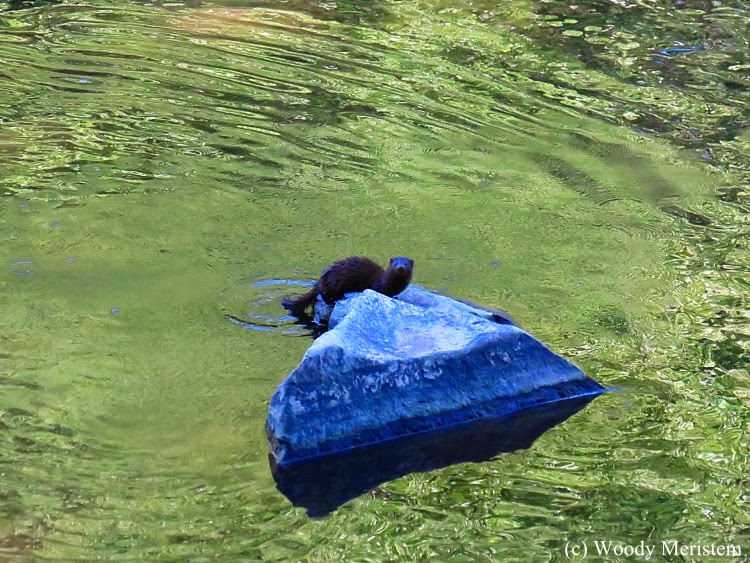
‘Twas a beautiful day, temperature in the 60s, crystal clear, with a gentle breeze and we were riding our bikes on the Pine Creek Rail Trail. There are a few benches along the trail at irregular intervals, some with good views of the surrounding hills or overlooking the stream. We were sitting on one of the benches, taking a break, when my wife saw a mink in the water.
The mink was swimming and diving like a small otter; then it would climb out onto a rock, dive back into the water and occasionally swim into the patches of emergent vegetation along the shore.

It spent the majority of its time swimming rapidly underwater seemingly at random, but probably in pursuit of small fish. Once it emerged with something dark in its jaws, probably a crayfish, but ate it so quickly that we couldn’t tell what it was.
 
It eventually climbed onto a rock long enough for me to get a few photos before it dove back into the water, swam rapidly downstream and disappeared


Whenever it was on the surface I tried squeaking like an injured small animal in an effort to get the mink to hold still for a moment or even to come closer  - to no avail.
Other mink have been much more cooperative and reacted to squeaks. This one even came closer in spite of the fact that it was already carrying prey –

Or this one that crossed our son’s partially frozen pond in response to my squeaking –


Saturday, July 5, 2014

Shed Antlers

A few weeks ago on a gray blustery day with some mist in the air I walked through L’s woodland to see what I could see. In places the tall trees were festooned with grapevines that must have had a good crop of grapes last fall – turkeys had scratched beneath each tree where grapes grew.
When I stopped to look around a bit, something on the ground that was lighter than even the palest fallen leaf caught my eye; it was a tine from a white-tailed deer’s antler. I went over to look and it turned out to be an antler shed last winter. A nice 4-point but not heavy or large, so it was probably from a buck that was two and a half years old last fall.
The antler showed no evidence of gnawing by squirrels, chipmunks or mice, unlike many I’ve found over the years. Rodents usually find shed antlers quickly and gnaw on them both for their mineral content and to keep their own ever-growing incisor teeth worn down.

In the many years I’ve spent in the woods I’ve found a number of shed antlers - 


Once, while looking at a large property I stopped to take a short break, looked between my feet and there lay a shed antler –

and less than 24 inches away was its mate –

It’s the only matched set of antlers I’ve ever found and they now hang in the house to remind me that any day spent in the outdoors can yield a treasure –

I’m not a shed hunter, only gathering sheds that I come across by accident, but some folks are active shed hunters and spend hours afield as soon as the snow melts looking for them. An acquaintance has an extensive collection of sheds that he's found over the years. Many of them are of impressive size – truly significant since each of the bucks that bore those antlers survived the previous hunting season. Actually, the bucks must have survived multiple hunting seasons in order to grow some of the large antlers in the collection.


Saturday, June 28, 2014

Big Guys

Yesterday I checked several of my camera traps in the Big Woods. Two of the cameras had photos of bears. The first camera I checked had a photo of two bears, both adults. The animal closest to the camera seemed to be interested in or annoyed by the camera – a reaction that camera traps elicit from many bears.


Here in northcentral Pennsylvania late June is the peak of breeding season for black bears. In this case the camera may have been an annoying distraction from the bear’s amorous interest in the other animal.

Two days later, on a morning when it was raining fairly hard, the same camera again took a photo of two bears. Unfortunately, there was rain on the lens – how much better the photo would have been if the lens had been dry. This time the following animal was a large male, the other was obviously smaller and almost certainly a female.

That evening, while it was still raining, a second camera about one-quarter mile away took a photo of a large male bear. 

Although at first I thought the two cameras photographed the same large male, but when the photos are side by side it appears they were two different bears.

What do you think?