It’s
quite a skill to be able to photograph a falling leaf, a skill that
takes many years and excellent eye/hand coordination to master.
Although
the most advanced cameras can lock focus on a flying bird or a
running mammal’s eye, none are designed to photograph falling
leaves and success is largely dependent on a photographer’s skill.
Fall
is the time to catch leaves as they gently drop to the ground after
the corky abscission layer that forms in the fall between the leaf’s petiole (stem) and
the twig has
broken.
Here
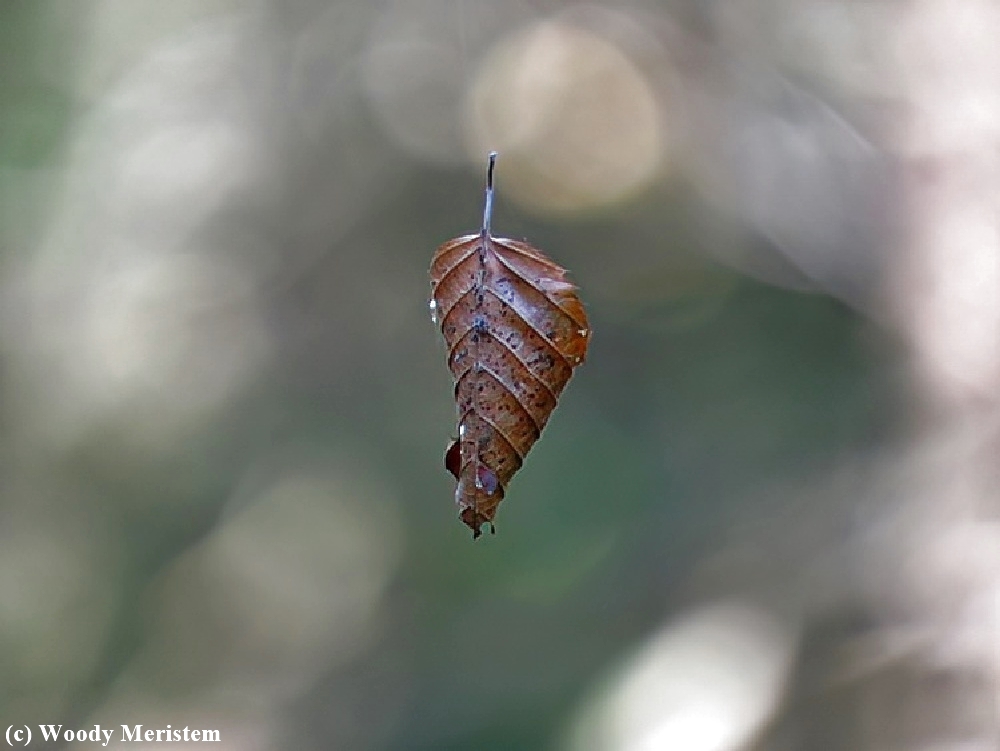
are some leaves, and basswood fruit, caught in mid-air as they fell from their trees –
Unfortunately
the skill necessary to photograph a leaf drifting in the breeze isn’t
one I possess. These were caught in mid-air
by a single strand of
spider silk
which had
made photographing them easy – were you fooled?
Before you jump to conclusions: No,
I did not fall in the bear wallow!
Rain
had fallen for about 36 hours but turned to little more than a drizzle
just after noon so I decided to head for the Big Woods. The hunting
seasons for bear and deer are but weeks away and hunters are
starting to head out, scouting for a good spot to search for their
quarry. So it was time to retrieve the camera trap I’ve had at the
bear wallow before some-less-than-honest person might come across it.
On
the way to the bear wallow I got absolutely soaked (my boots would
spend the night on the boot drier). Although many of the trees’
leaves graced the forest floor, there was still fall color to be
seen: bright yellow on the tulip-poplar amid the oaks’ browning
leaves which will be the last to fall –
Closer
at hand some small beech amid the oaks –
And
a scattering of fallen tulip-poplar leaves –
Although
most of the American hornbeam leaves were yellow, some of their
fallen leaves were a rich red –
Also
showing a bit of red were the leaves of a small scarlet oak (although
the leaves weren’t what I’d call scarlet) –
Closer
to scarlet were the fallen leaves of the red maples –
By
that time I was almost at the bear wallow – suddenly a woodcock,
that had been less than 15 feet away, flushed and disappeared
behind a clump of small white pine. Woodcock usually don’t fly far,
but this one couldn’t be found again.
At
the bear wallow the camera trap, its protective steel box and cable
lock went in my pack and off I went: homeward bound. On the way I
stopped to photograph some false turkey-tail fungus –
And
more bright red, the leaves on a blackberry cane –
The
topping the day’s cake was a 6-point white-tail buck that stood and
watched me approach before turning and heading into thick cover –
At
home I changed out of the wet clothes, then the camera trap’s memory card went into the computer to download
the videos it contained, here are the best from October at the bear wallow –
I’ve
visited bear wallow for at least 30 years and have had a camera trap
there for nine years, never has there been so much vegetation in and
around the pool. Is this a one time occurrence or a portent of things
to come and a sign of our changing world?
It’s
fall and the colors have arrived, the myriad colors of fall. The
Rocky Mountains have their aspen groves that turn the mountainsides
into a beautiful tapestry of gold and green. But northeastern North
America has the grandest colors of all – yellow, orange, red of
various shades; pink and port wine, gold and tan and green.
Trees
and shrubs, wildflowers and fungi – in the northeast colors are
everywhere at this time of year. Here are just a few –
Now the colors are fading, the leaves are falling and our world is turning
to the grays and browns, black and white and greens of winter. Enjoy
the colors of fall while they’re here.




.JPG)
.JPG)
.JPG)
.JPG)
.JPG)
.JPG)
.JPG)
.JPG)
.JPG)
.JPG)
.JPG)

.JPG)


.JPG)
.JPG)
%20-%20red%20maple.JPG)
.JPG)
.JPG)
.JPG)
.jpg)
.jpg)
%20-%20pignut%20hickory.JPG)
.JPG)
%20-%20pignut%20hickory.JPG)
.JPG)
.JPG)
.JPG)
.JPG)
.JPG)
.JPG)
.JPG)
.JPG)
.JPG)
a.JPG)
.JPG)
.JPG)
.JPG)
.JPG)
.JPG)
.JPG)