Over the years many people have asked
about the “tent caterpillars” that appear on hardwood trees in the late summer
and fall. I’ve explained to them that these aren’t eastern tent caterpillars
but are instead the webs of the fall webworm (Hyphantria cunea)
that have both a very different life history
and very different impact on the trees they inhabit than do tent
caterpillars.
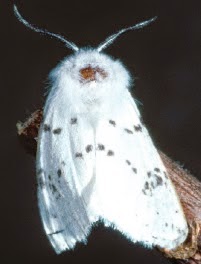 |
| From Bugwood.org |
The webs we see
on hardwood trees in the fall are formed by the caterpillars of an insect that
as an adult is a non-nondescript white moth having a wingspan of about
three-quarters of an inch. Fall webworm caterpillars hatch from eggs that
the female moth lays on the underside of leaves in early summer. Newly
hatched larvae begin to spin a web to enclose the branch-tip leaves on which
they feed. As the caterpillars grow they enlarge the web to cover more and more
leaves and eventually the webs become large enough to attract the attention of the
people who ask about the “tent caterpillars”.

The webs are quite tough and easily defeat the efforts of most birds and small mammals that
would otherwise prey on the caterpillars. If the web is breached, the
caterpillars immediately drop from the web. Those that fall to the ground have
little chance of survival, but if they merely fall to a lower branch they have
a remote chance of returning to the web or creating a new web on the host tree.

As the days
shorten and the caterpillars mature they emerge from the webs, drop to the
ground and pupate over winter in the leaf litter on the ground or in the soil.
The adults emerge in late spring or early summer, mate, lay eggs and die.
Because fall
webworm caterpillars only feed in late summer and fall, their impact on host
trees is minimal. The trees have already formed the leaf and flower buds for
next year and have manufactured virtually all of the sugars they need to
survive the winter and grow the following spring. However, the webs sure are
ugly and often hang on the trees all winter – their impact on aesthetics can be
significant.
Just as
invasive exotic species are a problem in our forests, fall webworms have become
invasive in Europe and Asia after their accidental introductions in Europe and
Japan during the 1940s.
So how do fall
webworms differ from the eastern tent caterpillars with which they are so often
confused? Tent caterpillars build their tents in the spring; fall webworms,
true to their name, are active in the fall. Tent caterpillars can defoliate
entire trees and even kill small trees; fall webworms seldom do either. Tent
caterpillars typically use their webs to hide from predators but leave their
webs to feed; fall webworms feed within their webs. Tent caterpillar webs are
in the crotches of trees –

Fall webworm
webs are on the tips of branches –
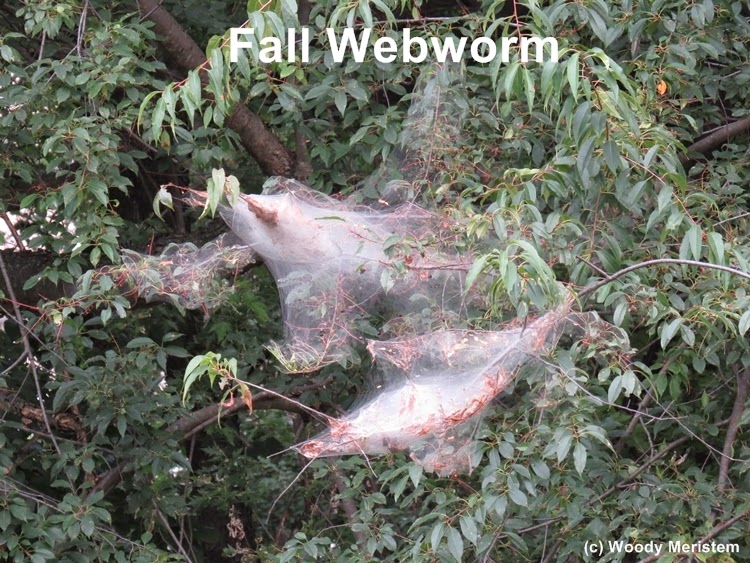


.JPG)
.JPG)
.JPG)
.JPG)
.JPG)
.JPG)
.JPG)
.JPG)