Thursday, May 22, 2014

Yellow Lady's Slippers


Trilliums or lady’s-slippers, lady’s-slippers or trilliums – which are my favorite wildflowers? I’ve never been able to decide. But certainly one that’s near the top of the list is the orchid called yellow lady’s-slipper (Cypripedium parviflorum).


In this area there were three populations of which I was aware, two in the Big Woods and one about 15 miles to the east in a large patch of woodland surrounded by farms and spreading development. Unfortunately, in the 40 years since I first saw them, two of the populations have disappeared. In both cases the habitat appears to be unchanged, but white-tailed deer seem to find the plants quite palatable and are probably the cause of the disappearance.

During a 1970s visit to the third population I counted 72 plants in bloom. They were accompanied by an uncounted number of plants that were not bearing flowers. A more recent trip to see those plants was cause for alarm, as there was but a handful of blooms and only a few non-blooming plants. This spring I went back, fearing that the plants would be gone. 

Happy day! There were 34 plants to be seen, 26 of which were in bloom –


This population of yellow-lady’s-slippers is (and has been since I first saw them) confined within a radius of about 150 feet in an old field that was abandoned during or shortly after World War I. The stonerows along the edges of the old field consist only of large stones, so the field was almost certainly not plowed, but was instead used to grow hay. The old field reverted to a forest of white pine, red maple and black birch with an understory of invasive Japanese barberry. Perhaps the thorny and unpalatable barberry has protected the lady’s-slippers from deer. 

What’s different about this small area of a much larger old field, or similar areas along the same hillside, that has made it hospitable for yellow lady’s-slippers? To human eyes it looks the same as many other acres – maybe it’s the soil’s pH or texture, the degree of shade, or mere chance, or … 

Here’s hoping that for years to come this population of yellow lady’s-slippers will be there to brighten the day of folks who come upon them.


Friday, May 16, 2014

Bear’s Reaction to Castoreum II


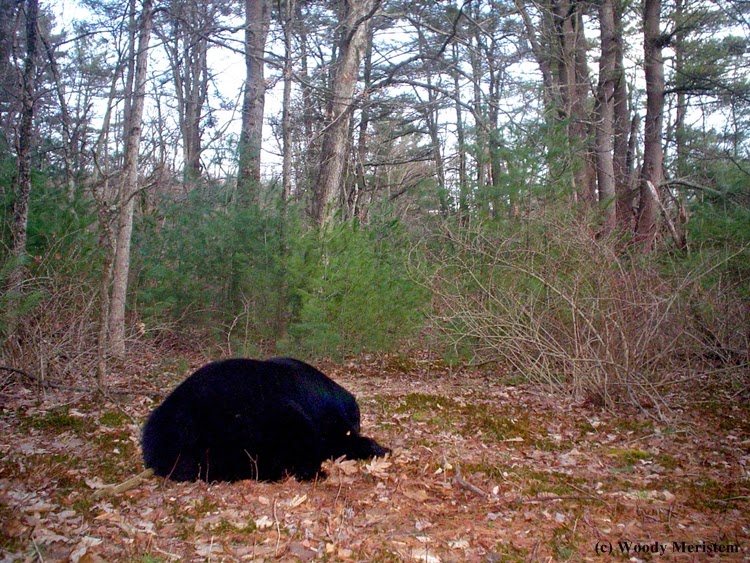
An April post was photos of a black bear reacting to the scent of beaver castoreum placed on a stick on the ground. Recently I checked another camera trap in the Big Woods and found 25 photos of a bear rolling and laying on a fallen branch on which I’d painted a bit of beaver castoreum.

This was a different bear, a different stick, in a different place than shown in the first post – and this time the bear’s reaction was even more interesting –


After the last photo in the video, the bear departed, walking past another camera trap about 50 feet away.


Thursday, May 8, 2014

Pileated Behind A Rock

It was a cool morning when I left the house headed for the Big Woods, but after walking for about a mile with a bright sun beating down through the still leafless trees it was time to shed the vest beneath my light camouflage jacket. Camo clothing really makes a difference in the amount of wildlife seen and how close I can get before they flee. It even makes a difference when walking at a normal rate. Birds and mammals obviously see the movement, but apparently have a great deal of difficulty in determining what they’re seeing.

On this day I stopped, shed my pack and put it down, got a water bottle from the pack, took a long drink and put the bottle back in the pack – then a slight movement off to the side caught my eye. The movement was the head of a female pileated woodpecker repeatedly popping up from behind a rock about 30 feet away (females have a black stripe from the base of the bill, males’ stripe is red) –


As I watched the head repeatedly popped up and disappeared. The bird raised its head to look around after each blow it delivered, and frequently chips flew. At about 20 seconds into the video it can be seen swallowing something that can’t be identified, but is probably the larva of a stag beetle (they normally inhabit rotten wood).


I watched for quite a while and the bird never deviated from its methodical hammering and looking around. Eventually I slowly moved to the side to get a better view around the rock. With that, she moved on the small fallen tree where she had been working and continued feeding –


Subsequently she flew to a nearby small tree –


Eventually the bird flew about 15 feet directly over my head and off through the forest. 

Pileated woodpeckers are typically very wary birds and don’t allow a close approach. While walking it’s not unusual to hear the alarm calls of four or five birds for each one I see. Was this bird unusually unwary or preoccupied as it fed? Or was it the camouflage that kept it from perceiving me as a threat?


Thursday, May 1, 2014

Loon in the River


Common loons don’t breed in Northcentral Pennsylvania, although occasionally one will spend the summer in the area. Those are typically either first-year birds that aren’t ready to breed or ill birds, usually suffering from lead or mercury poisoning. This bird in non-breeding plumage was here in July.
July 3, 2012

More common are birds that are passing through on their way north to breed or, in the fall, on their way to spend the winter on the ocean or saltwater bays.

Walking along the river I saw a loon in full breeding plumage in the middle of the stream. It repeatedly dove and finally made its way closer to shore where the camera could capture decent images. A loons often do, it would swim for a while with its head submerged as it sought prey – 

Loons can control their buoyancy, enabling them to sink below the surface without any visible movement – which it did as a helicopter passed overhead –


The bird slowly swam further out in the river –

 And dove pursuing something to eat –


When it finally resurfaced, it was so far out from shore that it was indistinct.
Years ago a friend and I drove around the largest lake in the area during the first week of May and counted 106 loons on the 300 acre lake. The birds were diving and resurfacing frequently which made it hard to get a precise count, but we both felt that 106 was reasonably accurate. There were certainly loons so far from shore that, even though we were using binoculars, we wouldn’t have been able to distinguish them from the rolling waves on the water. 
Many years ago I spent a summer on a lake in New York’s Adirondack Mountains; there were several pairs of breeding loons on the lake and their haunting calls echoed across the lake day and night. Thus began my fondness for the common loon, a fondness shared by many folks across the northcountry of the U.S. and Canada. The loon symbolizes wild country and clean water, things that a lot of us do not want to do without.


Thursday, April 24, 2014

Spring's First Wildflowers


This week the first of the spring wildflowers appeared in woodlands that are on moist fertile soils. These are the ephemeral spring wildflowers that briefly appear and bloom before the leaves of the hardwood trees emerge. The plants are not especially tolerant of shade, so they must grow and produce enough sugars and starches to last the year before the forest floor is shaded. They are some of the Northeast’s most beloved wildflowers and familiar sights, even if their names are not, to any observant person who spends time in the woods during the early spring. 
First the aptly named spring beauty appeared – 
As did bloodroot, named for the blood-red color of its root’s interior –


Growing in the same forests is Dutchmen’s-breeches; the individual flowers resemble a pair of upside-down pantaloons, hence the name –

With the coming of trout season the aptly named trout lily blooms –

A number of years ago a friend guided me to a population of white trout lily (a different, but closely related, species) that's worth frequent return visits –

To walk through the forest and see the ground covered with these wildflowers is truly one of the joys of spring.

Thursday, April 17, 2014

These Old Boots


Years ago I bought two pairs of “Bean Boots” (more properly called “Maine Hunting Shoes”) from L.L. Bean of Freeport, Maine. These are the original style rubber bottom-leather topped boots that were first sold in 1912 – No, the boots I own are not 1912 vintage, I’m not that old – and were purchased in the 1970s. They’re ideal for wear in wet or muddy conditions, although a friend and coworker wore his Bean Boots almost every day he was outdoors, all year round.


The original chain pattern soles on these boots didn’t provide the best traction and wore out fairly quickly, so I had the bottoms replaced. Back then the company offered an option to replace the original rubber bottoms with new ones that had Vibram soles. Over a decade and many, many miles later, when those Vibram soles had worn down, both pairs of boots went back to Bean’s for a second set of new bottoms with Vibram soles, some re-stitching and a couple of leather patches. Unfortunately, L.L. Bean no longer offers the option of Vibram soles when the boots are sent in for new bottoms.


Although my Bean Boots aren’t insulated, I’ve worn them at 25° below zero with two or three pairs of woolen socks. With old style 10-point crampons on, they’ve helped me make my way up frozen waterfalls and climb above timberline on glare ice to the top of some Adirondack High Peaks. They’ve been on my feet as I crawled to the top of one of those High Peaks when the sustained wind speed was so high that it was impossible to stand upright much less walk. They’ve been in mud to and beyond their top eyelets in wetlands and newly constructed roads; and they’ve occasionally been coated in manure. The bindings on my snowshoes fit them perfectly because, when we’ve had enough snow to need snowshoes, the Bean Boots were the only ones I wore. They’ve been on my feet on long hikes and daily walks.

One pair just went to the local boot repair shop to have some torn stitching repaired, and the other will follow suit. Both pairs of boots still provide good service – in winter snow and the mud time of spring; in the dew of autumn and on days of rain – they’re on my feet whenever it’s wet and I venture into forest and field.
No, this isn’t an ad for Bean Boots or a non-celebrity endorsement, it’s just a token of affection for the old boots (and the folks who made them) that have accompanied me at work and at play and carried me to some beautiful places and grand experiences.

Friday, April 11, 2014

Sad Day - and some good too


Fifteen years ago on a steep, rocky hillside I found a small patch of old growth hemlock, white pine and oak. Following that discovery I made several return trips, but haven’t been back in over a decade. Presumably the old time loggers didn’t cut the trees because a good teamster would have been careful not to take his horses into terrain where the risk of injury to them was high – they were his livelihood. This spot is near the mouth of a tributary to one of the largest streams in the area, where floating the logs to any of several sawmills eight to ten miles downstream would have been easy.
The lower slopes of this hillside were logged at least 150 years ago as shown by several old skid trails that were used to move the logs down to the stream.


Yesterday, one of the skid trails made for a pleasant hike uphill through a second growth forest that now, after all these years, has many large trees that many would consider “mature”. The skid trail ends well below the old growth; to see the large old trees then requires a scramble over moss-covered rocks and logs and clambering over or around fallen trees – on steep hillsides such as this, many trees succumb not to old age or loggers but to the force of gravity.

 
When I got to the old growth it was painfully obvious that all of the hemlock was dead or dying; the result of feeding by the invasive hemlock wooly adelgid. The hemlock wooly adelgid is a tiny insect that feeds by sucking sap from young twigs on hemlock. It has been killing eastern hemlock for many years, but has only been impacting hemlock in northcentral Pennsylvania for about a decade.


On the lower slopes, presumably due to more moisture, better soils and the younger more vigorous trees, most of the hemlock looked much healthier, even though adelgid can be found on most trees.


A short drive and a walk of about one and a half miles led to Jacoby Falls a pretty, although not spectacular, waterfall.


Friday, April 4, 2014

Bear's Reaction to Castoreum


Changed the batteries and memory card in one of my camera traps in the Big Woods earlier this week. Previously I had put some beaver castoreum on a short piece of a dead branch lying in front of the camera.
Castoreum is produced by beaver’s anal scent glands and is used by the animals to mark their territory. Castoreum smells somewhat like vanilla extract, but much stronger and not particularly pleasant; it's been used in perfumes and colognes, particularly ones that have a leather-like aroma. Castoreum has also been used as a food flavoring and, in previous centuries, in medicines. As an attractant for furbearers castoreum is the lure of choice for many trappers, so I’ve recently begun using it in front of some of my camera traps. 
One camera trap, which seems to always have something interesting on the card, had quite a few photos of a good sized male bear that stopped to smell the castoreum. The bear didn’t just stop to take a whiff – first it walked up to the camera and examined it closely, having its picture taken five times. It then turned and walked back to the piece of dead limb with the castoreum – smelled the castoreum, then lay down on the dead branch, got up and lay down again, and finally it apparently rubbed against the stick as a dog would rub and roll on something with a strong odor.
From the first photo to the last, he spent eight minutes in front of the camera.