Wednesday, April 27, 2022

Winter at the Running Log

Winter’s a hard time for most resident mammals and birds; the abundant food of summer and fall is slowly disappearing, eaten or lost to decay. Insects spend the winter as eggs, pupae or in hibernation; most birds migrate to warmer climes where the living is easy (sort of) and some mammals hibernate (bears, woodchucks, jumping mice). Small mammals such as shrews, voles and mice spend the winter in the subnivean zone below the snow where the temperatures are higher and they’re somewhat hidden from their many predators.

The winter of 2021/2022 was warmer than in years past, a portent of winters to come, and the snow cover came and went repeatedly. Activity on the running log was less than at times in the past and with fewer species – but interesting nonetheless.

The stars of the show were a pair of gray fox that made repeated visits. One characteristic of gray fox is that mated pairs often hunt together –

Come and re-visit winter at the running log –

It’s spring now and things have changed, the next video from the running log will be quite a bit different.

Wednesday, April 20, 2022

A Fine Spring Morning

White clouds were sailing across a bright blue sky on a fine morning in early April as I headed for a walk in the Big Woods. There’s always the chance of seeing a bear or a bobcat or … in the Big Woods. This wasn’t to be one of those days, but it turned out to be a fine morning nonetheless.

It wasn’t long after H dropped me off on the ridgetop that something gold caught my eye. That gold thing turned out to be the backlit pupal case of one of the many gypsy moths that defoliated the ridgetop last year. There wasn’t just one bit of gold, there were two hanging from the branches of a small tree –


An old, old road leads from the ridgetop to the valley below. Along the road’s cutbank grow an interesting mix of mosses and lichens, one especially interesting one was the pink earth lichen growing on a patch of dry infertile soil –


A bit further along a mourning cloak butterfly flew up from the side of the old road, only the second I’d seen this year, roused from hibernation by the warm spring sun –


Further along, down into the valley now, I passed a large dead white ash tree that had lost most of its limbs and bark. On the trunk were the tracks of the feeding galleries of the emerald ash borer, an invasive insect that is responsible for the death of 98 percent of the ash in the area.


Where the bark was missing on one of the fallen limbs the strands of shoestring root rot fungus were obvious –

Both the insect and the fungus kill trees, either one might have been responsible for killing what had been a fine tree.

Not all fungi kill trees, some are actually beneficial to trees and others decompose dead woody material. I couldn’t identify this rather attractive bracket fungus that grew on another fallen branch last year, but the lower side indicated it was a polypore –


Something else caught my eye, a moss-covered stump upon which lay some feathers – feathers from a downy woodpecker that a hawk or owl had caught and plucked while perched on the stump


Then it was past the foundations of an 1800s homestead and farm; the crevices between the stones would have been a fine place for the mourning cloak to have spent the winter –


Now we’re down in the valley’s bottom where the soils are moist and fertile and produce an abundance of wildflowers. At the base of a cluster of overwintering leaves of round-lobed hepatica a flower bud was unfurling, protected by a profusion of “hairs” that trap warm air and help keep the bud from freezing –


The old road’s now on flatter ground where a roadside ditch held clusters of wood frog eggs covered by beneficial algae, the embryos within plainly visible –


A stream parallels the old road, more correctly the road parallels the stream for it was here first – by several thousand years –


The stream is home to a heritage strain of brook trout, one of which repeatedly rose to snatch small midges –


What’s on that log, a butterfly? Nope, a fungus that by happenstance resembled a butterfly –


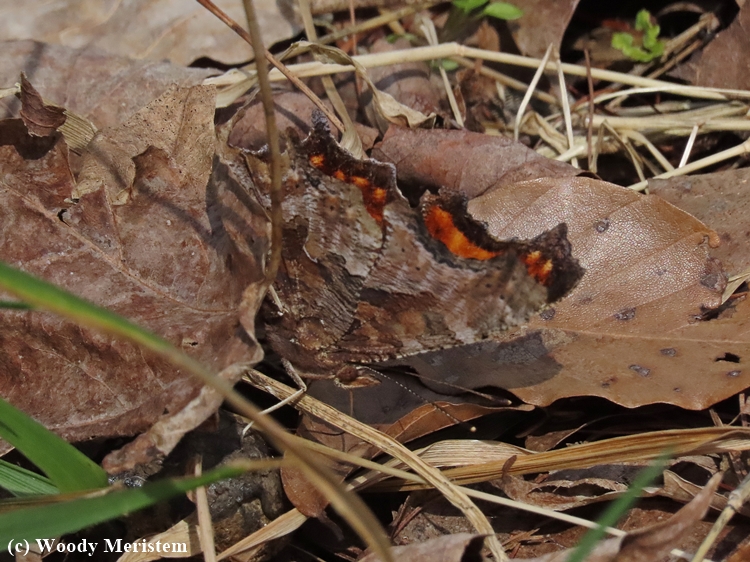
It wasn’t long before a real butterfly fluttered into view, a comma butterfly that, like the mourning cloak, had overwintered as an adult in a rocky crevice or beneath loose bark –


The butterfly repeatedly flew to one spot on the ground, it took me a while to discern the object of its interest – another comma with its wings almost totally closed, this must have been a female and his interest was almost certainly on making more commas –


Almost back to my car now and along the old road was an American hazelnut shrub, its male flowers almost all spent, but the small female flowers were still bright red. They’re tiny and require a really close look to find –


Well, there were no bears or bobcats or fishers to be seen, maybe next time. But there was a lot to see and I certainly missed more than I saw. The bright sunlight made it difficult to get good photos other than in the shade.

Not a bad way to spend three hours of a fine spring morning.

Wednesday, April 13, 2022

Caught in the Boil

Low head dams are small dams that span streams or rivers. These dams are extremely common throughout North America – and they’re extremely dangerous to boaters, people fishing and swimmers. An earlier post used their common name – drowning machines


There’s a low head dam on the river, the slack water above the dam is a good place to see waterfowl during migration so I often walk a path along the shore looking for ducks and gulls that are seen in our area only during migration.

It was on one of those shoreline walks when I saw a small flock of buffleheads on the water. The birds would float slowly downstream on the flat water, diving and feeding as they went, until they got close to the dam and then they'd fly back upstream to repeat the process.


When I arrived at the dam I saw that one of the female buffleheads had been swept over the dam and was caught in the boil –


People frequently drown at low head dams, but even waterfowl that spend the winter on large bays or the ocean and make their living by diving for food can be victims of the drowning machine.

Wednesday, April 6, 2022

Old Growth Logging II

The subject of the last post on In Forest and Field was a movie made in 1926 which documented the logging of old growth forest in northwestern Pennsylvania. The post and movie have raised a number of questions among viewers, questions that I’ll attempt to answer here.

The Central Pennsylvania Lumber Company was a subsidiary of the U. S. Leather Company, a combine of a number of smaller leather companies that apparently joined to reduce competition and set prices – typical of many similar monopolies that formed in the late 1800s.

At the time leather was tanned using tannic acid derived from tree bark, primarily the bark of hemlocks. To ensure a steady supply of bark most tanneries purchased large tracts of woodland containing hemlock forests; when the smaller tanneries combined to form the U. S. Leather Company, ownership of most of the land was transferred to the new company. U. S. Leather had a number of tanneries throughout northern Pennsylvania, all of which depended on a steady supply of bark.

Initially U. S. Leather contracted for cutting of the trees and delivering bark to their tanneries. The hemlock bark was loaded on modified log cars or wagons for transport to the tanneries where it was stored until needed.


Contrary to popular opinion, the peeled hemlock logs were NOT left in the woods to rot. Because the bark could only be peeled for a short portion of the year, the logs were transported to mills later in the year when the loggers were not peeling bark.

The contractors who did the cutting initially sawed the logs and sold the lumber. Realizing the profit to be made from sawing and selling lumber, in 1903 U. S. Leather terminated the contracts and took over production of lumber from its lands.

Given the amount of time devoted to the “Bull Dozer” in the movie, it must have been the company’s pride and joy. Bulldozers were first produced commercially in 1923, so CPL was an early adopter; it would have replaced a large crew of men and horses devoted to leveling log landings and constructing railroad grades.

CPL, like almost all of the large logging operators in the late 1800s and early 1900s, used logging railroads to transport logs from the woods to the sawmill. The railroads were often steep and crooked, requiring the use of geared locomotives of which there were three major manufacturers, CPL used locomotives from all three. The most common was the Shay


Climax locomotives were also frequently used


The Heisler locomotive was the last geared locomotive to be developed and is the one seen in the movie


Now for the loggers’ tools that may require some explanation, in order of their appearance in the film:

Most people are familiar with the double-bitted axe that has two cutting edges. The heads usually weighed 3½ or 4 pounds, occasionally more, and were mounted (hung) on a hickory or ash handle.

Two man crosscut saws were of various styles in different areas; the saws were sharpened differently depending on whether they were used to cut softwoods or hardwoods or even the season of the year.

Bark spuds of a variety of designs were used to lever bark off the underlying wood. Bark is only loose enough to peel in late-spring and very early-summer.

A string of logs was hooked together end-to-end with log grabs enabling the logs to be skidded to a landing behind a team of draft horses.


A log skip's blunt end was used to drive the points of grabs into logs, at the landing the pointed end was used to easily remove the grab from a log. New skips are still available, this one needs a wooden handle.


Logs were branded on the ends to show which jobber did the actual logging in the woods. The brand's symbols were stamped into the logs' ends, not burned as with cattle brands. Brands were typically recorded in the county courthouse.

Peaveys have a spike on the end to push logs and a hook to turn and roll logs. The peavey was developed by, and named for, a Maine logger of the same name.


Once logs were in the log pond they had to be moved around, for this the pike pole was ideal. They’re a long wooden pole with a spike and hook at the end, very similar to the medieval weapon called a pike.

The mill at Sheffield actually had what were in effect two sawmills in one – they were called “the long side” and “the short side” and sawed logs of different lengths. There was another, separate, sawmill to produce hardwood lumber.

Many of the old sawmill towns also had ancillary facilities, usually owned by independent companies – kindling wood factories that made bundles of scrap wood to start the fire in old cook stoves; clothespin factories; and chemical wood plants that produced acetic acid, wood alcohol, acetone and charcoal from hardwood trees too small to be sawn into lumber.

Hopefully this will answer some questions for those not familiar with old-time logging.

Wednesday, March 30, 2022

Old Growth Logging

Back in the mid-1970s a friend of mine was in charge of cleaning out the building where he had his office before he, and the rest of the staff, moved to a new building. They were throwing away a large quantity of old unused “stuff” among which was an unlabeled film can.

As I remember, he said the can made it into the trash before he decided to see what was inside. After retrieving the metal can he opened it; inside was a reel of 16 millimeter film, again with no label. Since the office had a 16mm projector he decided to run the movie and see what it was before tossing it back in the trash.

What he found astonished him and those of us who saw it soon afterward. Apparently it was the sole existing copy of a film made in 1926 by an employee of the Central Pennsylvania Lumber Company (CPL) at Sheffield, Pennsylvania. The movie was of the entire operation from the uncut old growth forest through loading the lumber into railroad cars for shipment.

At one time CPL owned approximately 2,000,000 acres of forest, most of it old growth, in the northern part of the state; the company constructed or purchased a number of sawmills and towns throughout northcentral and northwestern Pennsylvania (Laquin, Masten, Grays Run, Jamison City, Leetonia, Norwich, Tiadaghton, Sheffield) and operated dozens of geared locomotives on hundreds of miles of logging railroads.

The sawmill at Sheffield featured in the movie was constructed in 1907-8 and operated until 1941 when the last log was sawn. It was the largest sawmill ever to operate in the state, and it’s one-day record was over 337,000 board feet (a board foot is the equivalent of a piece of wood 12 inches long, 12 inches wide and one inch thick) sawn in ten hours.

Fortunately I managed to obtain a DVD of the original movie (which was made almost 100 years ago), have been able to improve the exposure and contrast a bit, (but not much, especially the first few scenes), added some music and included the film in this post. It’s a bit over 20 minutes long, so sit back and view a piece of history –

CPL was typical of many lumber companies of its day – when the timber was cut the land was of no further use to the company and was sold. Most of the land logged to supply the mill at Sheffield became the Allegheny National Forest. In other parts of the state, hundreds of thousands of acres were added to the Pennsylvania state forest or state game land systems, some is now owned by other forest industries, and a number of tracts became large private hunting and fishing clubs.

While CPL and other companies cut vast acreages of old growth forest in Pennsylvania, there are still isolated areas that have never been logged; some are as small as 10-20 acres, others cover thousands of acres. 


If you know where they are, you can still walk amid a forest that looks like the ones the old loggers saw.

Wednesday, March 23, 2022

Waterfowl on a Beaver Pond

Snow geese kept me from checking the ice on two beaver ponds but several days later I was able to visit the ponds. One, although it had small patches of open water, was still almost completely ice covered. The other pond is much, much larger (probably about 25 acres) and, with the exception of a narrow strip in the shade of tall white pines, was unfrozen.


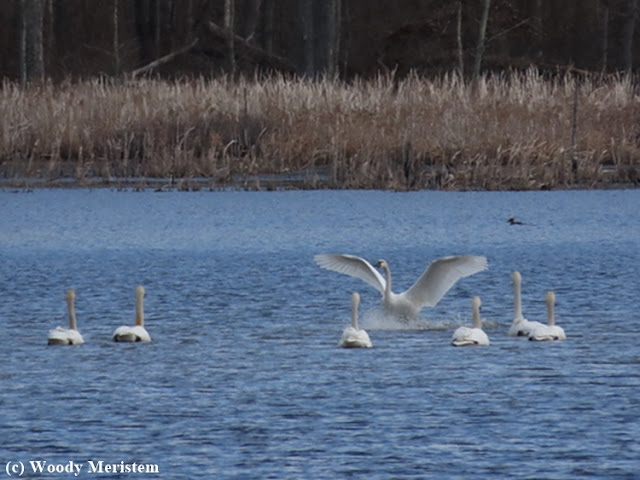
As I approached the large pond a large bright white object was visible. Closer still it became apparent that it was not one object, but rather a group of tundra swans. Amazingly they allowed a close approach and just continued with what they were doing –


In all there were over 100 Canada geese on the pond, some just single pairs and some in small groups –


And a variety of ducks: hooded mergansers –


Mallards and wood ducks –


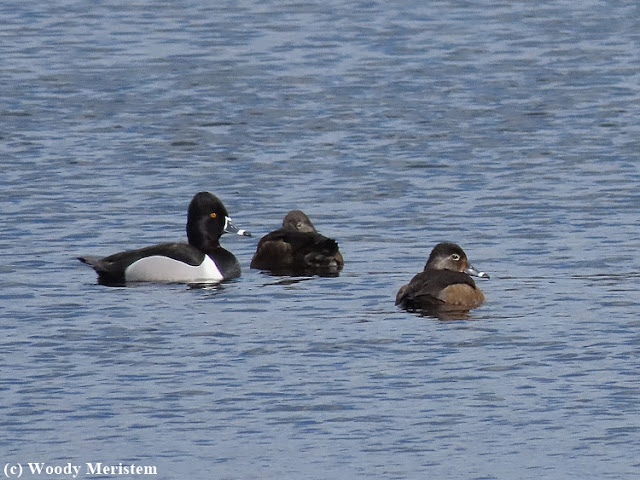
Ring-necked ducks, also sometimes called ring-billed ducks. The ring on the bill is much more obvious than the ring on the neck –


There were also two male lesser scaup, often called bluebills –


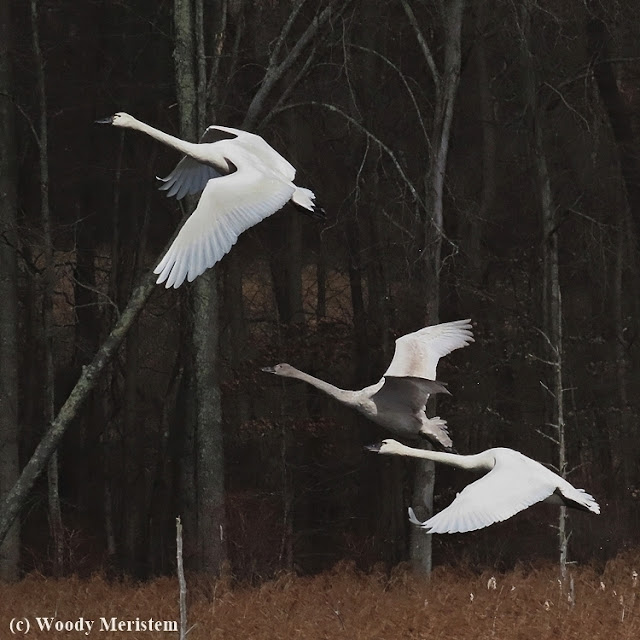
Even though they were the furthest away of any of the birds, wood ducks - being wood ducks - suddenly flushed and flew off, followed by the mergansers and mallards. That was enough for the Canada geese and off they went, as did a few of the ring-necked ducks. Lastly the tundra swans took off –


And like most of the ducks circled and landed far across the pond –


Unfortunately I’d disturbed the birds, something I wanted to avoid and which probably wouldn’t have happened but for me getting too close to the wary and skittish wood ducks.