Wednesday, November 9, 2022

Otter

Near the end of a 2½-mile loop through forest and field there’s a very large beaver pond. The lodge in the pond hasn’t shown any signs of being maintained this year and there’s no feed-bed (the beavers' winter food supply of fresh branches) in the water near the lodge. But the dam is still being maintained so the beavers may have constructed a new lodge elsewhere on the pond.

On this typically cloudy fall morning there were leaves falling from the trees and the colors of those leaves were the highlight of the morning’s walk. They were that is until I glanced at that beaver lodge, for on the lodge was what appeared to be an otter slide  


Hmm thought I, wouldn’t it be great if there were otters using the pond; 35 years ago there were no otters in northcentral Pennsylvania. A hundred feet further into my walk, out of the corner of my eye I saw a swirl in the water so I stopped and watched. Soon a head broke the surface, a beaver? No, this was no beaver – it was the head of an otter


River 0tters are very intelligent and inquisitive; the first wild otter I ever saw was about 50 years ago when H and I were canoeing near a beaver lodge on which there was an otter. It entered the water, swam toward the canoe and circled, all the while repeatedly rising high in the water to look at us. This animal did the same, swimming back and forth about 100 feet away and watching me all the time  


It too frequently rose up for a better view –


After I sat down on the dam the otter came closer as it kept a wary eye on me. It would occasionally playfully blow bubbles as it floated in the water –


After about 25 minutes it apparently realized I wasn’t a threat and relaxed enough to swim over to a good-sized stump and proceeded to climb on top –


The otter proceeded to make itself comfortable on what is called a “couch” or bed on the stump that it had constructed using water lily leaves and stems –


Apparently there was part of a fish on the stump which the otter ate as I watched –


Eventually the otter slipped back into the water and swam further out in the pond –


Otters use dens to sleep and rear their kits; the dens may be in a pile of logs and debris, in a burrow in a stream bank or in an abandoned beaver lodge perhaps this one. The next day I went back with a better telephoto lens and spent hours sitting in the same spot but the only thing of interest that appeared was a male belted kingfisher on a distant snag –

It’s a big pond and otters often travel widely, so ...

Wednesday, November 2, 2022

That's a Lot of Bull

Misty morning with a few showers and a forecast for the rain to stop around noon. So after an early lunch H and I headed west looking for opportunities to photograph elk. It's been a strange and frustrating year for this elk photographer as most of the animals seem to have deserted their usual haunts.

When we got to the elk range it was still raining occasionally; rain alternating with mist and patches of blue sky. We went to a couple of areas we’ve seldom visited to see what we could see. On one hill we came upon a small flock of turkeys, two mature hens and their almost fully-grown poults. This has been a great year for the turkey population, the dry late spring/summer meant fewer young turkeys being lost to pneumonia. These birds were in no rush to leave us behind, as they slowly moved off most would hop up on a fallen log and then go further into the forest –


Now to go search for elk. We stopped at a wide spot where we had excellent views of distant meadows and reclaimed strip mines. Well over a half mile away, on the crest of a hill, there was a dark shape; the camera’s telephoto lens revealed it was an impressive bull elk –


We could drive into the valley below and, if H would wait for me, I’d climb the hill to the bull’s level. So off we went down into the valley, then H excitedly told me to stop. In a field that had previously been out of sight she’d seen two bull elk. So I temporarily put aside thoughts of the bull on the hill in favor of viewing and photographing these two. These were probably 2½ year old animals gradually working their way uphill as they fed –


After watching those bulls for a while, I decided to try for some photographs of the large bull on the ridge. Parking near the stream in the valley I headed uphill, first on an old road, then through knee-high dripping-wet goldenrod – a light mist was coming down again. The big bull, if he was still there, was out of sight.

I worked my way diagonally uphill in an effort to stay downwind of the bull. Approaching the ridgetop, antlers came into sight, a few more feet and more of the bull was visible –


Finally I was at his level as he continued feeding –


This was an impressively large-bodied animal, especially given that the rut had recently ended. During the rut mature bulls try to amass a harem of females which they then have to defend from other bulls. The stress and the energy expended during the rut, not to mention possible injuries, exhaust the bulls which then have only a few weeks to build reserves for the coming winter.

The bull suddenly looked up and stared directly at me –


When he took a few steps in my direction the decision was made. Discretion being the better part of valor, it was time for me to leave rather than face the testosterone he had remaining from the rut –


Although the photographs may look as if I was close to the elk, I was actually several hundred feet away and using the equivalent of an 800 millimeter lens on the camera (roughly similar to 16-power binoculars) and I then cropped most of the images.

Although the day was far from pleasant, spending time with H and the elk and the turkeys was still worth the drive and getting wet feet.

Wednesday, October 26, 2022

The Waterfall Tour - Part 2

Day one of the waterfall tour was misty and rainy, day two was a sunny day and we went to a very different stream. Where day one featured a stream with a series of cascades, day two’s stream was one of chutes and potholes and a dramatic 40 foot waterfall.

We walked an old logging road that climbs along the stream; on the way passing a historic log cabin with intricately dovetailed corners –


And picturesque locks on the windows' shutters –


The old road veers away from the stream until it’s above the scenic portion, so we started there and worked our way downstream past the chutes and potholes and waterfalls. The stream enters the drops in a rush –


And then goes through a narrow slot about 15 feet deep –

Speaking of slots, there’s one that’s dry now but many years ago the stream apparently followed that route –


The stream exits the first chute over a small waterfall into a large swirling pothole –


It leaves the large pothole and continues down a deep narrow mossy gorge with mist rising –


That mist rises from a very narrow chute and a complex series of small waterfalls in and below the chute –


The bedrock here is slippery even when it’s not wet, but on this day the rock was wet and very slippery. At least seven people are reported to have died here, including one last year. Falling into the stream from just above the small cascade in the first photo on down is generally not considered survivable.

We watched a fellow who appeared to be in his mid to upper-70s, and not too steady on his sneaker-clad feet, inch ever further out on the down-sloping rock on the left side of the second of the above photos in order to take a photograph with his cell-phone. He survived – by dumb luck.

Just below that series of small waterfalls the stream goes over its largest drop –

It may not look like much from that perspective, but the waterfall is between 35 and 40 feet high and drops into a deep pool –

Unfortunately these photographs really don’t convey the full beauty of the stream, the gorge or the waterfall. Below the waterfall the stream continues in a series of cascades for about a mile.

Wednesday, October 19, 2022

The Waterfall Tour - Part I

We took a trip north during which I had a chance to visit some waterfalls. Now I’m a sucker for waterfalls, seldom passing up a chance to view and photograph a nice waterfall and repeatedly visiting some that I’ve been to before.

On a misty, rainy day we visited the first of two streams that I’ve never seen before, both of which have nice waterfalls. The streams and falls will remain nameless since both areas already receive quite a bit of use and are showing signs of that impact.

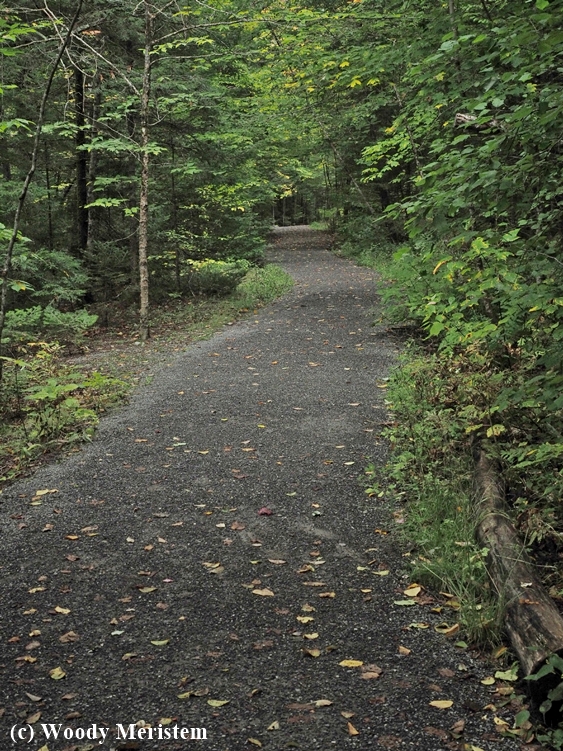
Day one was a walk on a trail that began life as an old road portions of which have recently received a topping of crushed stone and improved drainage –

The trail follows a stream with a series of beautiful cascades. How do you  differentiate between a cascade and a waterfall? I have my own criteria, yours may differ, it's very subjective on this stream –


Until we come to the first waterfall –


Past that waterfall there’s another –


And then another –


Finally the water drops over a low ledge –


Above which the stream takes on a more northerly appearance with spruce and fir and a bit of fall color –


As you can tell by its tea-like color, this stream originates in a large wetland where the decaying vegetation colors the water.