Wednesday, May 26, 2021

The Smartest Bird

Although there may be other contenders in various parts of the world, in North America there is no more intelligent bird than the common raven. While in recent decades they’ve been increasingly seen in more settled areas, these large relatives of the ubiquitous, and smaller, common crow are mainly found in places where humans are few (in my opinion a sure sign of their intelligence).


Ravens range from above the tree line in the Arctic south through the boreal forest and in the eastern mountains to northern Georgia, they’re found widely in the west south into Mexico. While ravens seem to prefer to nest on rock ledges, they’ll also nest in tall trees, especially conifers, when ledges aren’t readily available.

Those naturalist’s who live within the raven’s range have almost certainly seen and been entertained by the raven’s aerial antics. Often, especially on a windy day, I’ve watched a pair of ravens do barrel-rolls and loop-the-loops while also, and repeatedly, climbing high into the sky before going into steep dives. At the same time their vocal repertoire of croaks, knocks and squawks (33 different calls have been described) sound from on high – sometimes from so high above that the birds are beyond sight.

Last winter a turkey carcass was placed in front of one of my camera traps. Intermittently over the course of several days ravens visited to feed on the remains. On several occasions snowfalls completely covered the carcass but a pair of ravens knew where it was and repeatedly came to dig through the snow to find delectable morsels.

Ravens are known for hiding pieces of food for future use, an activity to be seen in the video. If they think another bird has seen them hide the food, they’ll move the piece to another location. They will also follow predators and hunters waiting for the scraps from a kill. During the winter in northcentral Pennsylvania ravens will frequently fly along highways below tree-top level searching for road-killed animals on which to dine – presumably they do that in other areas as well.

Ravens are fascinating birds and well worth knowing. Two of the best references on ravens are Bernd Heinrich’s Mind of the Raven and Ravens in Winter.


Wednesday, May 19, 2021

Some Days Are Diamonds

Some Days Are Diamonds (Some Days Are Stone) is the title of a song recorded by John Denver in 1981. That sentiment is certainly accurate and a dark gray day in early May was one of those diamond days.

Inside a deer resistant fence on the hill above the house are a few white trillium – descendants of several that, almost 60 years ago, I’d planted at my parents' house, then moved here after our house was built 50 years ago. The plants have to be protected from the white-tailed deer that have eliminated the species elsewhere in our part of the world.


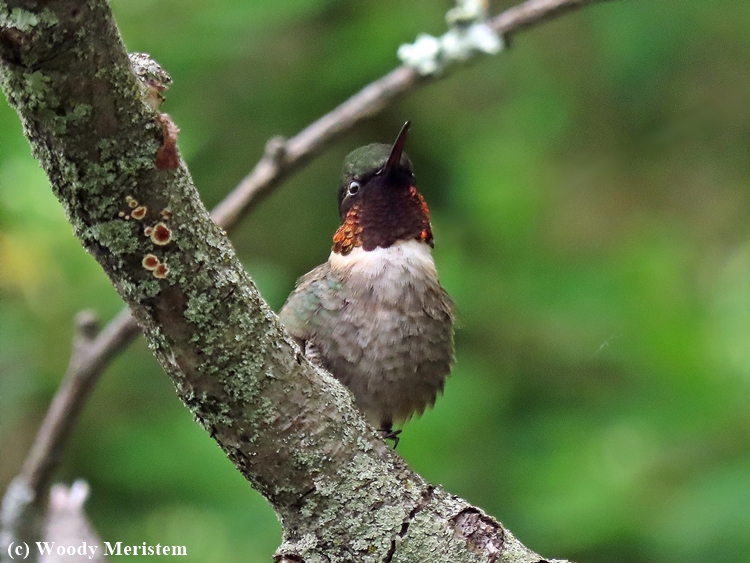
After taking a few photos of the trillium I was heading back to the house when a male ruby-throated hummingbird landed in a small dead tree. He stayed in the tree and preened, made a few short flights and returned, presenting opportunities for a number of photos. The dull gray light toned down the often brilliant ruby-red of the feathers on his throat –


A bit later I headed for the Big Woods in search of migrating warblers. Although there was an abundance of ruby-crowned kinglets, there were no warblers to be seen and only one to be heard, an ovenbird singing it’s “Teacher, teacher, teacher” in the distance.

In the afternoon I headed for the beaver pond to change the memory card in the trail camera; nearby a pinkster azalea was in bloom –


Having taken that photo, I turned around and immediately saw an eastern coyote trotting past about 50 feet away – apparently it hadn't seen or smelled my camouflage-clad figure. A few squeaks through pursed lips caught the animal’s attention and turned it my way. Just time for a few photos before it turned again and trotted off through the forest –


Later when processing the photos it became obvious that the coyote had porcupine quills in its muzzle and near its right eye. Eastern coyotes are tough animals, as are most wild creatures, this one will almost certainly survive its encounter with the quill-pig.

Thus endeth a diamond day.

Wednesday, May 12, 2021

The Deer Dinner Continues

In early January our friend Bill told of a dead deer he’d found in their woods. Apparently the doe had been struck by a vehicle on the nearby road and managed to get across a small stream and into the woods before she expired.

Great opportunity for a camera trap, too good to pass up. By the time the camera trap went up on a nearby tree, the carcass had already been opened by a scavenger, but not much had been eaten. The dead deer and those that came to dine were featured in this post.

Diners continued to come for a venison dinner as snow came and went and the season progressed. As the deer’s flesh was devoured and the last of the snow melted there was less to eat and we see some visitors just passing on by –

This time the white-footed mouse didn’t dine on the deer, it gathered hair to insulate its nest. Thus in another way the dead deer is being recycled into the world in which it lived.

Wednesday, May 5, 2021

Woodies at the Beaver Pond

Wood ducks, especially the males, are arguably the most beautiful ducks native to North America. They frequent wooded swamps and beaver ponds and traditionally nested in cavities in trees near water. As the old growth forests were cut across the U.S. and Canada, suitable nest sites disappeared; at the same time unregulated, or barely regulated, hunting reduced the wood ducks’ population.

With tighter regulation of hunting seasons and a proliferation of nest boxes erected by state and federal agencies, private organizations and individuals the wood duck population has rebounded.


A camera trap on the shore of a beaver pond has captured many species of wildlife, but this spring there have been more videos of wood ducks than any other species. Hopefully you’ll enjoy these videos of our most colorful duck –

There were many, many more videos of wood ducks on the memory card and a few more videos of the black ducks. Black ducks along with wood ducks were the primary nesting ducks in beaver ponds in the northeast, but they are now a species of concern due to hybridization with pen-raised mallards.

Just in case you missed the muskrat, at 2:45 of the video it’s in the far distant background.

The last bird in the video is a second-year bald eagle and one of the most pleasing catches I’ve had on a camera trap.

Beavers are one of the few species of wildlife that deliberately create and alter their own habitat. The ponds that beavers build create an oasis for other wildlife from invertebrates to black bears.

Wednesday, April 28, 2021

Morning at the Pond

There are worse ways for a naturalist to spend a morning than to sit at the edge of a pond, camera in hand and the rising sun at your back.

And so, on a pleasant spring morning with camera pack on my back and a small folding chair I headed for a beaver pond to sit for an hour or so to see what there was to see. On the way to the pond I passed a willow shrub that was in bloom; and the spicebush was blooming in a patch of damp forest  –


Soon after I settled in on the edge of the pond amid a few small trees, a male wood duck flew in and landed on the pond’s far side –


He then disappeared into the cattails, never to be seen again.

Soon after a great blue heron flew in and landed in a dead tree about 100 feet away. There was time for a handful of photos before it left in the direction of a marsh a half mile away –

All was quiet for a while and then, in the far, far distance there was a black spot circling in the air. One of my camera’s powerful telephoto lens revealed it was an immature bald eagle. It’s not a good photograph because the bird was a long, long way away –


Soon afterward another fish-eating raptor appeared – this time it was right over the beaver pond and spent a few minutes overhead as it looked for fish beneath the surface. Not a bald eagle, this was a migrating osprey on its way north –


After a not finding a fish, the osprey moved on and there wasn’t any activity at the pond for quite some time. Eventually a pair of hooded mergansers that had been on a nearby pond flew in to land nearby –


And climbed up on water-soaked log


Also on a fallen log in the pond was a painted turtle basking in the sun

Like the heron and osprey, the mergansers left after a short time –


Meanwhile, the tree swallows that nest in woodpecker cavities in the pond’s snags had recently returned from South America and were exploring some of those dead trees –


The last bird of the morning was a red-tailed hawk soaring over the pond –


Heading home I passed the blooming willow, it was warm enough that honey bees were busy gathering pollen –

Time spent by a beaver pond is time well spent.

Wednesday, April 21, 2021

In the Spring ...

In the spring a young wood frog’s thoughts turn to … (do frogs have thoughts or only instincts?). In the spring wood frogs emerge from their winter quarters in the leaf litter on the forest floor where they often freeze solid, their cells kept from damage by glucose that fills each cell in the fall and acts as an anti-freeze. For a more complete explanation see this site

But now it’s spring and the wood frogs have emerged to head for their breeding pools. Wood frogs breed early in the spring, often before the pools are completely ice-free. Those pools can be roadside ditches, pools formed from snowmelt or after heavy rains or the classic vernal pool. Irrespective of how the pools are formed, wood frogs seldom successfully breed in water that contains fish, for fish readily devour the products of the frogs’ mating.

Male wood frogs normally arrive at the breeding pools before the females and begin calling. The frogs’ calls sound remarkably similar to the quacking of a duck –

When the females arrive and enter the pool they are grasped by the males (a position called amplexus). Other males are often grasped since an amorous male will latch on to any nearby frog. Fertilization is external as the females release hundreds of eggs and the males release sperm.


A single female is sometimes seized by several males, which occasionally results in the female’s death –


The fertilized eggs form a gelatinous mass, which often adheres to adjacent egg masses –


Depending on temperature, the embryos develop rapidly and in a few days their heads, bodies and tails are easily distinguished –


Shortly afterwards the eggs hatch and the tadpoles swim forth to feed on algae and other vegetation –


The tadpoles will die if the pool dries before they mature and transform into frogs. Depending on temperature and the availability of food the tadpoles develop rapidly and in about 60 days metamorphose into small frogs –


The tiny froglets disperse into the surrounding woodland to feed on invertebrates until the fall when they take shelter below ground for the winter.

Wood frogs’ breeding season is short, lasting only a few days in early spring. The day after the video in this post was taken there was not a frog to be seen in the pool, the frogs had returned to the forest to spend the warm weather there. But there were many eggs in various stages of development in the pool. A few days later there were thousands of small tadpoles in the pool. Only a few of those tadpoles will live long enough to transform into frogs and fewer still will survive to return to breed next year.

Wednesday, April 14, 2021

A Week at the Beaver Pond

Today we return to the beaver pond where the encounter with the mink occurred; one of my camera traps has intermittently been on the pond's shore during the last four years. As spring progressed the remaining ice on the beaver pond almost completely melted and it was time to put a camera trap back on a shoreline tree.

A number of wood ducks flushed from the pond when I went to put the camera in place, which raised the expectation of getting videos of wood ducks as well as beaver and other wildlife.

The camera trap is aimed at a fallen log that extends from shore into the water. The log began as a tree that fell into the pond in June 2019 after the area received over five inches of rain in three days. After that much rain, the saturated soil couldn’t support the tree's weight and down it went; the descent was captured by my camera trap and shown in the video in this post

Now, two years later, I placed a camera trap to view the log and the wildlife that uses it. Here are the results from the camera’s first week at the beaver pond –

The videos of the wood ducks were a treat (at least to me) and it was quite gratifying to get several videos of a mink running the log. The plan is to leave the camera in place throughout the spring and summer to capture videos of the wildlife using the fallen log.

Wednesday, April 7, 2021

Der Waschbär

Der Waschbär is the German term for an invasive exotic reportedly brought to Germany in the 1920s and 30s to be raised in captivity for their fur. Subsequently some were released into the wild as quarry for hunters and during World War II allied bombs hit one of the fur farms allowing more animals to escape into the wild.

Now, almost 100 years after the first introductions, there are an estimated one million of the animals in Germany. There are fears that this invasive exotic will spread to occupy all suitable habitat in Europe – preying on the eggs and young of native birds and mammals, eating native reptiles and amphibians as well as crops and fruit.

Der Waschbär translates into English as “The Washing Bear” which should be a clue to its identity.

The situation is much the same in Japan where this invasive exotic is known as araiguma. There are accounts of 2,000 araiguma being imported to Japan each year in the late 1970s and 80s, as pets – although there are other reports of a number being brought to Japan as pets by G.I.s after World War II. As pets they’re cute when young but aggressive and nasty as adults – many were released when they were no longer cute. Thus most of Japan is now occupied by araiguma.

And the identity of this invasive exotic: the North American raccoon –

 
And why is it called the washing bear? Not because it actually washes its food, but because it looks as if it’s washing as it searches for food in water bodies where it finds frogs, crawfish and an occasional fish, alive or dead.


Raccoons aren’t gourmets, they’ll feast on anything remotely edible; like humans they’re omnivorous. Here are raccoons living up to their name of der Waschbär –

North America is suffering from the introduction of species from afar; but it’s a two-way street, other parts of the world are also suffering from species native to North America – Canada geese, gray squirrels, bullfrogs, American mink, fall webworm and many more – as humans gradually homogenize the world’s flora and fauna.

Wednesday, March 31, 2021

One Dead Deer - Many Diners

A township road borders a small stream; across the stream from the road is a wooded slope that blends into an abandoned pasture. Vehicles traveling the road often strike wildlife – as do vehicles on other roads throughout the land. Two years ago a raccoon had been hit on the road and got across the stream before it died; the mammals and birds that fed on the remains were the subject of this post. The road, in addition to bordering the small stream, borders property that belongs to friends of ours.

Bill called to say that their two dogs had found a dead deer in their woods. Ah-ha says I, here’s another opportunity for a camera trap. So the next day I placed one of my camera traps to capture videos of whatever came to dine.


Judging from the multitude of half-melted tracks around the snow-covered body, and since the carcass had already been opened, the deer had probably been dead for at least a few days. Without a necropsy* it was impossible to determine the cause of death, but it’s almost certain that the doe had been struck by a vehicle and managed to get across the stream and partway up the hill before she died.

The doe’s body has been feeding a variety of wildlife –


Raccoons were the principle diners; in the first several weeks there were hundreds of videos of them as they stripped most of the flesh from the carcass. Raccoons continued to feed on the carcass throughout the time these videos were taken but you certainly don't want to watch more than 875 videos of raccoons munching away.

The camera trap will remain to catch videos of those that come to eat, although the pickings will be slim now that almost all of the flesh has been consumed. And the camera trap won’t catch the many insects, other invertebrates, bacteria, fungi and different microscopic beings that will feast on what remains of the deer and recycle the nutrients of this formerly living being. Where would the world be without scavengers and decomposers?


* an autopsy performed on an animal