Wednesday, April 28, 2021

Morning at the Pond

There are worse ways for a naturalist to spend a morning than to sit at the edge of a pond, camera in hand and the rising sun at your back.

And so, on a pleasant spring morning with camera pack on my back and a small folding chair I headed for a beaver pond to sit for an hour or so to see what there was to see. On the way to the pond I passed a willow shrub that was in bloom; and the spicebush was blooming in a patch of damp forest  –


Soon after I settled in on the edge of the pond amid a few small trees, a male wood duck flew in and landed on the pond’s far side –


He then disappeared into the cattails, never to be seen again.

Soon after a great blue heron flew in and landed in a dead tree about 100 feet away. There was time for a handful of photos before it left in the direction of a marsh a half mile away –

All was quiet for a while and then, in the far, far distance there was a black spot circling in the air. One of my camera’s powerful telephoto lens revealed it was an immature bald eagle. It’s not a good photograph because the bird was a long, long way away –


Soon afterward another fish-eating raptor appeared – this time it was right over the beaver pond and spent a few minutes overhead as it looked for fish beneath the surface. Not a bald eagle, this was a migrating osprey on its way north –


After a not finding a fish, the osprey moved on and there wasn’t any activity at the pond for quite some time. Eventually a pair of hooded mergansers that had been on a nearby pond flew in to land nearby –


And climbed up on water-soaked log


Also on a fallen log in the pond was a painted turtle basking in the sun

Like the heron and osprey, the mergansers left after a short time –


Meanwhile, the tree swallows that nest in woodpecker cavities in the pond’s snags had recently returned from South America and were exploring some of those dead trees –


The last bird of the morning was a red-tailed hawk soaring over the pond –


Heading home I passed the blooming willow, it was warm enough that honey bees were busy gathering pollen –

Time spent by a beaver pond is time well spent.

Wednesday, April 21, 2021

In the Spring ...

In the spring a young wood frog’s thoughts turn to … (do frogs have thoughts or only instincts?). In the spring wood frogs emerge from their winter quarters in the leaf litter on the forest floor where they often freeze solid, their cells kept from damage by glucose that fills each cell in the fall and acts as an anti-freeze. For a more complete explanation see this site

But now it’s spring and the wood frogs have emerged to head for their breeding pools. Wood frogs breed early in the spring, often before the pools are completely ice-free. Those pools can be roadside ditches, pools formed from snowmelt or after heavy rains or the classic vernal pool. Irrespective of how the pools are formed, wood frogs seldom successfully breed in water that contains fish, for fish readily devour the products of the frogs’ mating.

Male wood frogs normally arrive at the breeding pools before the females and begin calling. The frogs’ calls sound remarkably similar to the quacking of a duck –

When the females arrive and enter the pool they are grasped by the males (a position called amplexus). Other males are often grasped since an amorous male will latch on to any nearby frog. Fertilization is external as the females release hundreds of eggs and the males release sperm.


A single female is sometimes seized by several males, which occasionally results in the female’s death –


The fertilized eggs form a gelatinous mass, which often adheres to adjacent egg masses –


Depending on temperature, the embryos develop rapidly and in a few days their heads, bodies and tails are easily distinguished –


Shortly afterwards the eggs hatch and the tadpoles swim forth to feed on algae and other vegetation –


The tadpoles will die if the pool dries before they mature and transform into frogs. Depending on temperature and the availability of food the tadpoles develop rapidly and in about 60 days metamorphose into small frogs –


The tiny froglets disperse into the surrounding woodland to feed on invertebrates until the fall when they take shelter below ground for the winter.

Wood frogs’ breeding season is short, lasting only a few days in early spring. The day after the video in this post was taken there was not a frog to be seen in the pool, the frogs had returned to the forest to spend the warm weather there. But there were many eggs in various stages of development in the pool. A few days later there were thousands of small tadpoles in the pool. Only a few of those tadpoles will live long enough to transform into frogs and fewer still will survive to return to breed next year.

Wednesday, April 14, 2021

A Week at the Beaver Pond

Today we return to the beaver pond where the encounter with the mink occurred; one of my camera traps has intermittently been on the pond's shore during the last four years. As spring progressed the remaining ice on the beaver pond almost completely melted and it was time to put a camera trap back on a shoreline tree.

A number of wood ducks flushed from the pond when I went to put the camera in place, which raised the expectation of getting videos of wood ducks as well as beaver and other wildlife.

The camera trap is aimed at a fallen log that extends from shore into the water. The log began as a tree that fell into the pond in June 2019 after the area received over five inches of rain in three days. After that much rain, the saturated soil couldn’t support the tree's weight and down it went; the descent was captured by my camera trap and shown in the video in this post

Now, two years later, I placed a camera trap to view the log and the wildlife that uses it. Here are the results from the camera’s first week at the beaver pond –

The videos of the wood ducks were a treat (at least to me) and it was quite gratifying to get several videos of a mink running the log. The plan is to leave the camera in place throughout the spring and summer to capture videos of the wildlife using the fallen log.

Wednesday, April 7, 2021

Der Waschbär

Der Waschbär is the German term for an invasive exotic reportedly brought to Germany in the 1920s and 30s to be raised in captivity for their fur. Subsequently some were released into the wild as quarry for hunters and during World War II allied bombs hit one of the fur farms allowing more animals to escape into the wild.

Now, almost 100 years after the first introductions, there are an estimated one million of the animals in Germany. There are fears that this invasive exotic will spread to occupy all suitable habitat in Europe – preying on the eggs and young of native birds and mammals, eating native reptiles and amphibians as well as crops and fruit.

Der Waschbär translates into English as “The Washing Bear” which should be a clue to its identity.

The situation is much the same in Japan where this invasive exotic is known as araiguma. There are accounts of 2,000 araiguma being imported to Japan each year in the late 1970s and 80s, as pets – although there are other reports of a number being brought to Japan as pets by G.I.s after World War II. As pets they’re cute when young but aggressive and nasty as adults – many were released when they were no longer cute. Thus most of Japan is now occupied by araiguma.

And the identity of this invasive exotic: the North American raccoon –

 
And why is it called the washing bear? Not because it actually washes its food, but because it looks as if it’s washing as it searches for food in water bodies where it finds frogs, crawfish and an occasional fish, alive or dead.


Raccoons aren’t gourmets, they’ll feast on anything remotely edible; like humans they’re omnivorous. Here are raccoons living up to their name of der Waschbär –

North America is suffering from the introduction of species from afar; but it’s a two-way street, other parts of the world are also suffering from species native to North America – Canada geese, gray squirrels, bullfrogs, American mink, fall webworm and many more – as humans gradually homogenize the world’s flora and fauna.

Wednesday, March 31, 2021

One Dead Deer - Many Diners

A township road borders a small stream; across the stream from the road is a wooded slope that blends into an abandoned pasture. Vehicles traveling the road often strike wildlife – as do vehicles on other roads throughout the land. Two years ago a raccoon had been hit on the road and got across the stream before it died; the mammals and birds that fed on the remains were the subject of this post. The road, in addition to bordering the small stream, borders property that belongs to friends of ours.

Bill called to say that their two dogs had found a dead deer in their woods. Ah-ha says I, here’s another opportunity for a camera trap. So the next day I placed one of my camera traps to capture videos of whatever came to dine.


Judging from the multitude of half-melted tracks around the snow-covered body, and since the carcass had already been opened, the deer had probably been dead for at least a few days. Without a necropsy* it was impossible to determine the cause of death, but it’s almost certain that the doe had been struck by a vehicle and managed to get across the stream and partway up the hill before she died.

The doe’s body has been feeding a variety of wildlife –


Raccoons were the principle diners; in the first several weeks there were hundreds of videos of them as they stripped most of the flesh from the carcass. Raccoons continued to feed on the carcass throughout the time these videos were taken but you certainly don't want to watch more than 875 videos of raccoons munching away.

The camera trap will remain to catch videos of those that come to eat, although the pickings will be slim now that almost all of the flesh has been consumed. And the camera trap won’t catch the many insects, other invertebrates, bacteria, fungi and different microscopic beings that will feast on what remains of the deer and recycle the nutrients of this formerly living being. Where would the world be without scavengers and decomposers?


* an autopsy performed on an animal

Wednesday, March 24, 2021

Encounter with a Mink

Several weeks ago, early in minks’ breeding season, the beaver pond was entirely ice-covered. Breeding season – that’s the reason two mink were traveling across the ice in the same general direction.


Two males on the scent of a receptive female? A male and female done with their rapid coupling and now going their separate ways? Only the mink know.

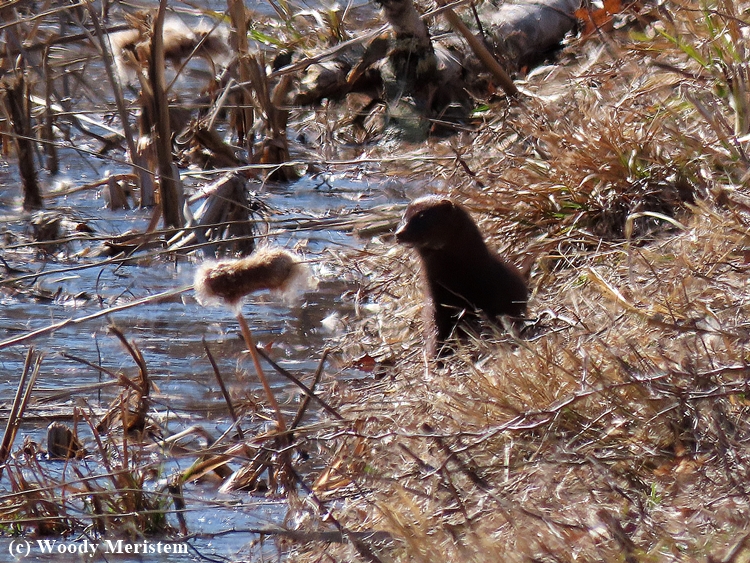
A couple of weeks later in the spring and much of the beaver pond was still partially covered in ice. A lone mink ran across the old road that borders the pond – mink don’t do anything slowly – and began exploring among the cattails and sedges edging the pond. Mink are closely tied to water (streams, ponds and wetlands) and partially webbed feet make them good swimmers. Wherever they are, mink are almost always searching for something to eat (a muskrat, small rodent, rabbit, fish, a duck, frog, crawfish, or songbird).

A few squeaks to imitate a small injured creature caught the minks’ attention and on it came. First it was on shore, then crossed a narrow strip of open water covered by a thin skim of ice and onto the sheet of ice –


It ran across the ice until WHOA, it slammed on the brakes and stuck it’s nose in the air as it caught the scent of a human


After a few seconds of smelling the air it turned tail and beat a hasty retreat across the ice until it disappeared in the cattails and fallen trees at the far end of the pond –


Other times, other mink, they show little fear of humans and may approach to within a few feet – not this time, not this mink.

Wednesday, March 17, 2021

Katy's Church

On an absolutely beautiful, but cold and very windy afternoon, H and I took a ride through an area known as the Muncy Hills. The Muncy Hills are a broken, highly eroded upland rising about 500 feet above the  lowlands lying to the north and south. The hills are mostly wooded, but in the 1800s many of the more level hilltops were cleared as farmland. The acidic shale-derived soils were soon exhausted and many of the fields reverted to woodland.

Now some of the remaining farms are growing Christmas trees; others still produce crops (after applications of lime and fertilizer); some are now State Game Lands open for hunting, fishing and hiking; and some have been subdivided as rural homesites.

As we headed toward the Muncy Hills we came upon Katy’s Church Road – an intriguing name for a road. The road was paved for a while, but as it climbs into the hills it becomes a dirt and gravel road. Up it climbs until it gains the heights whereupon a white church without a steeple comes into view across an open field.

There it is – Katy’s Church, backed by a beautiful large white oak tree (more about that tree later)


Katy’s Church sits at the four-way intersection of two roads, one side of which hadn’t been plowed all winter. Although there are a couple of fairly new houses nearby, the church seems isolated –


And appears to be very well maintained –


We pulled into a small parking area and faced the adjacent cemetery with its trees, fence and sign with that intriguing name, Katy, now including her last name – VanDine–


The cemetery has a gorgeous view, 19 miles across the valleys of Muncy Creek and its tributaries, to North Mountain which rises 1,200 – 1,500 feet above the surrounding lowlands. The cemetery wouldn't be a bad place to spend eternity


Home we went, thinking about that intriguing name and wondering why the church and cemetery were named for Katy VanDine. Had she donated the land, or …? Time for some research.

The search turned up several versions of a local legend about Katy VanDine; all relating that she met her end hanging from a tree in the church’s cemetery –

  • That she was a young unmarried woman who became pregnant, was shunned by the community and hung herself rather than live in shame.

or

  • That she was betrothed to a soldier killed in war and, in grief, hung herself in her wedding dress.

or

  • That she was the mistress of a wealthy married man; she became pregnant and he accused her of bewitching him, then local people hung her as a witch.

There isn’t a date or documentation for any of the legends and some living members of the VanDine family strongly dispute all versions of the legend. Some say that Katherine (or Catherine) VanDine lived into old age and died in 1899 when she was 86 or 87.

Whatever the truth, the stories are interesting, as is the church which was built in 1869 and officially named the Immanuel Lutheran Church. Katy’s Church is now only used for occasional services, weddings and community gatherings. Naturally, given the legends, the church and cemetery are said to be haunted.

Now about that tree –


It’s a white oak, one of the longest-lived tree species in eastern forests; I once counted the annual rings in the stump of a felled white oak and determined it was 358 years old when it was cut. The wide spreading crown and large lower limbs on the white oak at Katy’s Church reveal that it has been growing in the open with few if any adjacent trees throughout its life – which almost certainly began after the adjacent fields were cleared, perhaps even after the church was built.

If Katy was hung, was it from this tree? Unlikely, since the tree would almost certainly have been too small in the 1800s. But then perhaps Katy’s story is just a legend after all.