Thursday, July 5, 2018

It's Tiresome


“It’s tiresome; really, really tiresome.” says I.


“What is?” says he.


“Listening to all the drivel and just plain BS from each side.” says I.


“Each side, you mean the politicians?” says he.


“No, not this time. I’m talking about the extreme faction of animal rights people and the far out faction of hunters. They deserve each other and they play into each other’s hands, but the rest of us would be better off without them.” says I.


There are the animal rights people who oppose all hunting. Who harass law-abiding and ethical hunters. Who feed feral cats, cats that go on to kill millions and millions of birds and small mammals and compete with native predators. Who adamantly oppose removal of feral horses and donkeys from public lands in the west. This litany could go on and on, but you get the point.


And there are the hunters who bait their quarry. Who “hunt” at night. Who oppose any restrictions on the lead shot and bullets containing lead that poison eagles and condors and loons. Who want only the trophy head or hide and waste the rest. Who don't respect safety zones. Who think seasons and bag limits don’t apply to them. Who fight against non-hunters having any influence on wildlife agencies. Who would, if they could, eliminate all predators. Want to hear more says I?


“No” says he, “those are two sides of the same coin and it’s not even a coin you could spend.” 


Yes indeed, they play into each other’s hands. The unethical hunters produce more anti-hunters each time their activities and political impact come to light and the extremist animal rights folks make it more difficult to scientifically manage wildlife species and control feral animals.


Unfortunately, it’s wildlife and natural resources that are the big losers in this fight between the extremes – and the rest of us loose too.
Thursday, June 28, 2018

More from the Beaver Pond


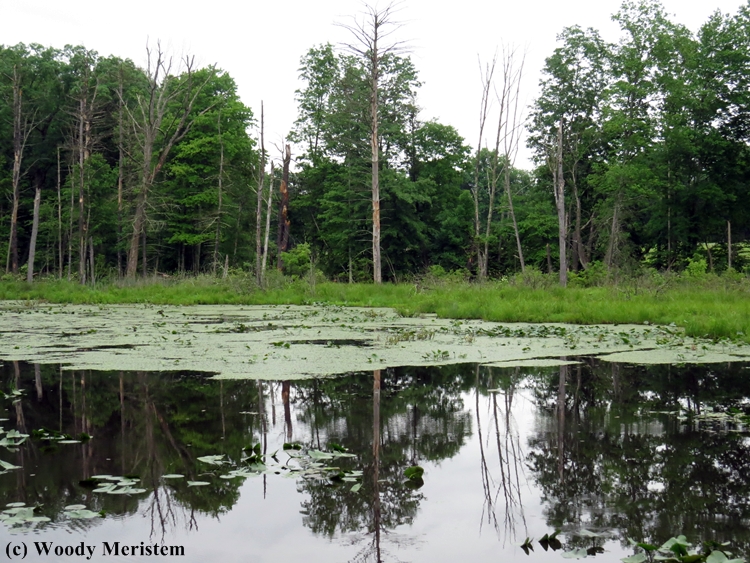
Beaver ponds are fascinating; they provide habitat for an abundance of wildlife from frogs and dragonflies to deer and bear, most of which then attract many other species as well as naturalists, fishermen, hunters and photographers.


The species in this collage are listed at the end of the post

Earlier this year I’d put a camera trap on the shore of a beaver pond near the beaver’s lodge. Photos from the camera were posted here. At the beginning of June that camera was replaced with another camera mounted on a different tree. The new camera takes videos during the day and still pictures at night.


A few weeks later the camera had yielded photos and videos. First the still photos, beaver –
Bobcat
White-tailed deer


And now for some of the best videos –


Did you see the splash from the beaver's tail slap? If not, it occurs at 55 seconds into the video and again at one minute 23 seconds.
 

What will the heat of the summer bring to the beaver pond? We’ll see.


Photographs in the collage
Bullfrog                          Spangled Skimmer Dragonfly
Snapping Turtle          Green Heron 
Muskrat                          Red-winged Blackbird
Spotted Sandpiper      White-tailed Deer

Thursday, June 21, 2018

One Week


One week, seven days – only one week among many. There was nothing really special about those seven days in May, just an average week in forest and field – a week to see and experience the natural world in northcentral Pennsylvania.

Day 1 – Walking in the rain – everything dripping wet, including me. The Big Woods were quiet except for the drip, drip, drip of the rain and the sound of a nearby brook. Next to a decaying log several sweet white violets were in bloom –


Day 2 – Still raining. In the ravine of a small stream a profusion of purple trillium were in bloom. But the flower on one of those purple trilliums wasn’t purple, it was a yellowish-white (or whitish-yellow if you prefer). A small percentage of purple trillium produce white or yellow flowers, they’re few and far between and it’s always a treat to find one.
Unfortunately, this flower was past its prime, but still a great find –


Day 3 – Walking along the border between a hayfield and woodland I came across a black rat snake; a large one, about 5 1/2 feet long, one of the largest I’ve ever seen. The snake quickly assumed a defensive posture: widening its head and body, rearing back as if to strike and rapidly vibrating its tail producing a sound resembling that of a rattlesnake. The snake crawled rapidly toward the woods and smoothly ascended the low-hanging branches of a shrub to lie on a horizontal stem.


Day 4 – Heavy rains during the last few days brought a sudden flush of fungal fruiting bodies including some interesting mushrooms. There are a number of species of mushrooms collectively lumped under the common name of “inky caps”. On this damp day there was an abundance of small inky caps in the mulch along a wooded path –


Day 5 – The rains have finally abated and in a hayfield a beautiful orange and black butterfly visited one dandelion after another. It was one of the large group of similar-appearing butterflies called fritillaries. Comparing the photographs to illustrations in a field guide revealed it to be a silver-bordered fritillary –


Day 6 – Today I walked along the edge of a small wetland where a male Carolina saddlebags dragonfly was perched on a dead plant stalk. It made periodic forays to chase off another male that was regularly encroaching on the 25-30 feet along the edge of open water it had claimed as its own. Carolina saddlebags are usually considered “flyers”, spending most of the day on the wing, but this male repeatedly returned to the same perch.


Day 7 – Rain again, virtually all day long. Raindrops hung from needles of the white pine, the fresh green leaves on the trees and shrubs, and the twigs of the apple tree, the drops reflecting the scenes around them. Almost four inches of rain fell at the house that week and the streams were bank-full after a winter of little snow and dropping water levels.


There’s always variety in the natural world – all we have to do is look.