In
the 1980s there were but three bald eagle nests in Pennsylvania, all
far to the west near the border with Ohio. It wasn’t just in
Pennsylvania that eagle nests were few and far between, they were in
trouble throughout their range with the exception of Alaska
and Canada’s Pacific coast. While shooting and habitat loss
contributed to the eagle’s decline, the primary cause was the
widespread use of DDT which caused their eggshells to be so thin they
broke beneath the incubating bird.
The
use of DDT has been curtailed and there were major efforts to
reintroduce bald eagles. In the intervening years the number of bald
eagle nests in Pennsylvania has gone from three to over 300. One of
those nests is on a steep hillside above the north branch of the
Susquehanna River and adjacent to a heavily-traveled highway. The
nest has been there since at least 2016, at eye level when
standing along the roadway.
This
year there had been two eggs and then two young birds in this nest,
but one either died or was pushed out of the nest by its sibling. I
first photographed the eagles at the nest in mid-April when the
remaining chick was about three weeks old –
In
mid-May I returned to photograph the birds. It was a hot and sunny
day, the eaglet was sheltering in the shade of a large limb and
panting to keep cool –
With
eaglets of this age the parents spend much of their time elsewhere,
returning only to feed the young. I’d been squeezed between the
road’s guide-rail and the steep drop-off for about 45 minutes when
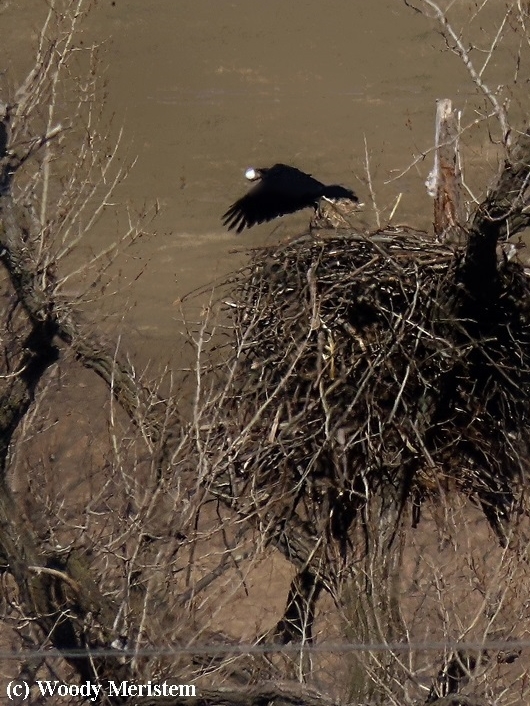
the adult female swept in with food for the young one –
She
stayed for less than five minutes before departing. The young eagle
then spent some time moving around the nest and at one point balanced
precariously on the edge before settling down and surveying its world
–
While
adult bald eagles can be said to look regal, that’s not a good
description of the young one – especially when it expels
a pellet of indigestible material (as do all raptors) –
Shortly
afterwards it began to exercise its wings with much flapping, a
necessity to build the muscles used in flight –
That
done the eaglet proceeded to preen it’s new feathers –
Next
came a hike around the nest during which it rearranged some of the
nest’s structure and furnishings –
And
more wing exercises and flapping –
All
that activity on a hot day must have been pretty tiring, so the
eaglet settled down, panting and spreading its wings to dissipate
heat –
Suddenly
the eaglet lay down flat in the nest, looking skyward –
The
alarm was apparently caused by two turkey vultures riding the breeze
along the steep sidehill. The vultures soon rode the breeze
downstream and out of sight. But still the young eagle lay flat,
looking up. So I too looked up and saw nothing for quite some time –
until my merely human eyes picked up a dot high in the sky. The
camera’s telephoto lens revealed the dot to be a third-year bald
eagle soaring on a thermal (a rising column of warm air) –
By
now the nest was in deep shadow while the far side of the valley was
in bright sunlight so the opportunities for photography were very
poor. I’d been there for about two hours and it was time to pack
up; I put the good camera in its pack and had the pack on my back
before glancing at the nest once again – just as the adult female
swept in again, bringing more food for her eaglet –
Time
to leave and head south. About fourteen miles away as the eagle
flies, but much further by road I stopped to photograph another eagle
nest – this one on a smaller creek and much further from the road,
and not on the official inventory of eagle nests in the state. One
adult was in the nest, as was at least one eaglet, while the other
adult perched above them –
The
eaglet in this nest appears to be somewhat younger than the first one
pictured in this post –
In
February 2020 I photographed a common raven taking an egg from this
eagle nest while both adults were occupied with driving an immature
from their territory –
Onward
says I, and so back on the road and past yet another bald eagle nest,
this one in a huge sycamore and almost obscured by the new spring
foliage on adjacent trees –
That
foliage is a portent of things to come and the rapidly diminishing
chance of getting good photos of these nests’ new generation of
bald eagles.


.jpg)
.JPG)
.JPG)
.JPG)

.jpg)
.JPG)
%20-%20dead%20from%20fungus.JPG)
%20-%20gypsy%20moth%20parasite.JPG)
.JPG)
.JPG)
.jpg)
.JPG)
.JPG)
.JPG)
.JPG)
.JPG)
.JPG)
.JPG)
.JPG)
.JPG)
.JPG)
.JPG)
.JPG)
.JPG)
.JPG)
.JPG)
.JPG)
.JPG)
.JPG)
.JPG)
.JPG)
.JPG)
.JPG)
.JPG)
.JPG)
.JPG)
.JPG)
.JPG)
%20a.JPG)
.JPG)
.JPG)
.JPG)
.JPG)
.JPG)
.JPG)
.JPG)
.JPG)