Wednesday, December 2, 2020

Traveling Through

Those of you who regularly visit In Forest and Field may recall previous posts with photographs from a camera trap at a small cave. That cave was difficult of access, it was located on on a very steep slope that was covered with basket-ball sized rocks, some of which were not well anchored. An old leg injury and advancing age prompted abandonment of that camera trap site.

Not far from that small cave there’s another, more easily accessed, opening in the hillside, a cave that appears even smaller but which has a narrow passage off to one side that disappears further into the earth, to depths unknown. It’s on the approach to this cave that I placed a camera trap; it’s on the approach because there’s no suitable spot with a view of the cave’s entrance.

This new location has captured a few interesting photos and videos. Some of the wildlife was just traveling through on the way somewhere else, others seem to have taken up residence in the cave. Watch closely at the beginning of the video as the tail end of a bobcat disappears into the cave –


The video twice captured something I’d been told about but never believed – an opossum carrying bedding material with it’s tail. That an opossum might use its somewhat prehensile tail to carry leaves or grass was something I’d always thought was an “old woodsman’s tale” meant to fool gullible city slickers. Well, I was wrong – for here were two videos taken ten days apart of an opossum carrying oak leaves to the cave. The things a camera trap reveals or confirms ...

Wednesday, November 25, 2020

It's Turkey Day !

It is time now to sing of my gratitude: For legs and hills and trees and seasons … and for all the roads I walked on, for the hills I climbed and descended, for trees and grass and sky.”                                                                                                                            Andre DuBus

It’s Thanksgiving for those of us who live in the United States, a day to be grateful for all we have and remember that not everyone is so fortunate. With COVID-19 raging throughout the country 2020 has been a terrible year for many people, those of us who still have our health and our homes and our income should be especially thankful.

We won’t be joining family and friends for Thanksgiving, some of us have risk factors of age or health, or live in states that require a quarantine, or have jobs that would require quarantine. But we’ll still enjoy turkey and squash, stuffing and gravy, fresh baked rolls and apple cider. While some may enjoy ham on Thanksgiving as part of the tradition of butchering hogs in the fall, far more families, ours included, enjoy turkey on that day.

Turkeys are birds of the Western Hemisphere. Early European explorers found that Native Americans had domestic turkeys and sent some back to the old country where their meat quickly gained favor.

So here we are, in the native range of the wild turkey, seeing them in forest and field and enjoying their meat (domestic or wild)


Hopefully you’ll have an enjoyable Thanksgiving Day and remember to be thankful for all you have.

Wednesday, November 18, 2020

Brook Trout

Not far from where I sit writing this blog post there’s a small stream. The stream originates in a high valley underlain by sandstone, flows steeply through a narrow rocky gorge and emerges into another valley where it flows into a much bigger stream. For most of its length its a high gradient freestone stream with a fairly low pH – meaning it’s acidic and quite infertile. Beneath its final quarter mile there’s a layer of shale which is much less acidic and the stream is more fertile.

This is the type of stream that's the historic home of the brook trout, the only native trout of the eastern mountains and Pennsylvania's state fish. Except the brook trout isn’t actually a trout it’s a char, a group that’s different from but related to, trout.

Brook trout require clear cool (below 65°F) water and, in streams such as this, seldom grow to be more than 12 inches in length. This is a heritage strain of brook trout; no exotic trout have ever been released in this stream – no brown trout, no rainbow trout and no brook trout from other streams.

Brook trout breed in the fall and it was on a beautiful, although far too warm, day in early November when I looked into a pool in the stream and saw a pair of trout spawning. 


On the stream’s bed was a small area of fine gravel, a suitable spot for the female to deposit her eggs and the male to release his sperm. The female then covers the eggs with gravel.

After spending the winter in the gravel, the eggs hatch in spring; the young fry remain in the gravel until the egg yolks are absorbed, then the small fish emerge from the gravel and begin feeding. Brook trout feed on insects, small crustaceans and small fish. The fish in the video (male darker and more colorful, female smaller with a hollow belly after releasing most of her eggs) were about as large as brook trout ever get to be in this stream, the female about eight inches long, the male an inch longer.

Thus, the strain of brook trout, which may have resided in this particular stream since shortly after the last glacier melted, carries on.  

Wednesday, November 11, 2020

The Raccoon and Me

It was crisp and cool with a gentle breeze – a beautiful fall day, a great day to be walking in the Big Woods. And that's where I was, slowly making my way along when, about 20 feet ahead of me there was a patch of moving fur. The fur turned out to be a raccoon that was twisting and turning as it groomed itself –


Apparently the raccoon hadn't seen or heard me (dressed in full camouflage) walking toward it, but it soon realized something was wrong and began walking away –


Then it turned and headed straight my way –


Raccoons in broad daylight are a reason for caution since they're normally nocturnal and raccoons acting out of character are sometimes ill. Because raccoons are frequent carriers of the rabies virus (which is fatal to humans), I backed away as the raccoon approached. Seeing my movement, the raccoon veered to the side and headed for a tree. It passed up several large oaks and began to climb a small red maple –


Up and up it went until finally settling where a small limb branched off the tree's main stem –


There it appeared to go to sleep –


Was the raccoon sick with rabies or, more likely, canine distemper, some other disease or just plain tired?

Wednesday, November 4, 2020

Under the Apple Trees

Because of COVID-19 we haven’t seen our son and his family since before the beginning of 2020, they live far to the north where the incidence of the virus is much lower than in Pennsylvania. Who knows how long it will be until we see then again. Every few months our son changes the memory cards in the camera traps at their place and sends them to me. Videos from earlier in the year were posted here

One of the cameras is in a spot that had once been an open field, whether it had been a pasture or an orchard is a matter of conjecture since no records of its former use exist and the people who lived nearby are long gone. There's no way to determine the past use of this area other than to read the land. In any event, the old field has been occupied by wild apple trees, as are many other old fields in the general area, those apple trees have been joined by a few red and sugar maple, hawthorn and white birch.

In late summer, fall and winter many species of wildlife come to feed on fallen apples and travel beneath the trees on their way somewhere else. The summer just ended was exceptionally dry, which caused an almost total failure of the apple crop – so wildlife use was much diminished from other times. Nonetheless, here are the best videos from summer 2020 –

The camera trap at the fallen log further up the hill failed after taking one video – not an unusual occurrence with camera traps. Maybe, just maybe, there will be videos from the fallen log next time.

Wednesday, October 28, 2020

A Sapsucker & A Kinglet

'Twas a dark drippy day bringing much needed rain to northcentral Pennsylvania. I was sitting on the sofa and occasionally glancing out the front window at the rain dripping from the few leaves remaining on the apple tree.

There it was, a sapsucker on the trunk of the apple tree. As evidenced by the rows of small holes in the apple tree's bark, this wasn't the first time a yellow-bellied sapsucker had been on the tree. Sapsuckers have favorite tree species on which to feed, here those are apple, black and yellow birch, mockernut and pignut hickories and sugar maple. And they also seem to have favorite individual trees where they feed from year to year, generation to generation; why and how they pick one tree from among many of the same species is unknown – at least to me.

A close look revealed this bird to be an immature male yellow-bellied sapsucker.

His colors were pale and the day dark, but I grabbed the camera and went outside. Although the bird quickly hitched to the other side of the tree, he soon returned to the row of old holes and resumed his work and eating. He would gradually work his way up the apple's trunk until he was obscured by the tree's small branches and twigs and then work his way down again.

Because the thick clouds made the day quite dark, the photos are anything but good as is the video –


While the sapsucker worked on the holes and fed on the sap and any small insects the sap attracted, a ruby-crowned kinglet also visited the holes to snatch small insects. There was no red crown on the kinglet, females don't have the small patch of red on the crown and males' red patch is often covered by other feathers. In any case, there it was, feeding at the sapsucker holes, quickly moving up, down and around the tree. 

The photographs are very poor since it was dark and they were taken at 1/30 of a second, these are the "best" of several hundred that were taken, they are what they are - poor. One day a sapsucker will return to the apple tree and, hopefully, there will be better photos.

Wednesday, October 21, 2020

Fall at the Bear Wallow

It's late fall, autumn if you prefer. Late summer and early fall had been extremely dry in northcentral Pennsylvania and the vernal pool that I call the bear wallow had been gradually shrinking, drying through evaporation since it has no inlet or outlet. This pool, like many similar vernal pools, appears to be a pingo scar

Black bears often visit these pools to bathe in the water that accumulates in the depression, thus the name “bear wallow” which in this area is the traditional name for these pools. In Forest and Field has a number of earlier posts about the goings-on at this bear wallow, too many to list here but they're all in the blog archive (to the right).

So here we are late in 2020 when human society has been turned topsy-turvy, but the species that visit the bear wallow carry on with their lives unconcerned about our problems.

Omitted from the video are most of the videos the camera trap recorded of raccoons, which were frequent visitors, and all of the hundreds of videos of gray squirrels dashing back and forth across the scene.

Gnawing and pawing by black bears, gray squirrels and raccoons damaged the camera case so it's been brought in for repairs. Come spring it will be back.

Wednesday, October 14, 2020

It's Fall !

It's mid-fall, leaf-peeper time. If you're not familiar with the term, “leaf peeper” relates to the tourists who flock to a handful of states in the northern United States to see the colors of the tree leaves in the fall. Sugar and red maples are the trees that are the primary bringers of fall colors – orange, yellow and red.

Those species are joined by white ash; the sumacs; four species of birch; aspen, both bigtooth and quaking; and a host of other less common species. In some areas they're also joined by the many species of oaks, but the colors of oak leaves aren't normally as vibrant as those of the maples and birches.

Many of the tourists come for the grand vistas painted with reds, yellows and greens, others come to drive the quiet country roads and marvel at some of the individual trees. Me, in many ways I find the individual leaves, fungi, flowers, a feather or perhaps a single branch of a tree the most eye-pleasing of the fall colors.

In celebration of fall's riot of color, here's a sample of those smaller treats for the eyes –

Poison Ivy

Purple-stemmed Aster


Wingstem              

Sugar Maple


Small White Aster

Sassafrass


Sugar Maple

Honey Mushroom

Sugar Maple

Cinnamon Fern

Flowering Dogwood

Great Lobelia

Red Maple

Blue Jay Feather

Black Maple

Black Birch

Virginia Creeper


So, yes indeed, fall is a treat for the eyes before the drab days of November. Go forth and enjoy the season.


Wednesday, October 7, 2020

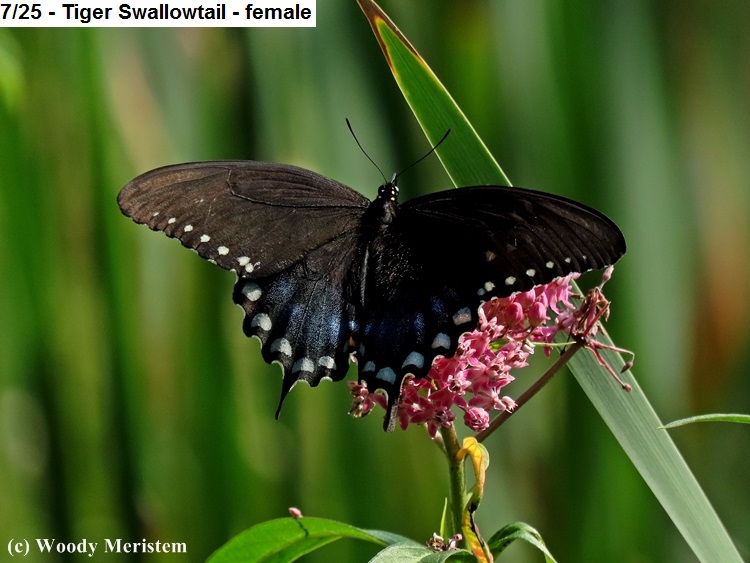
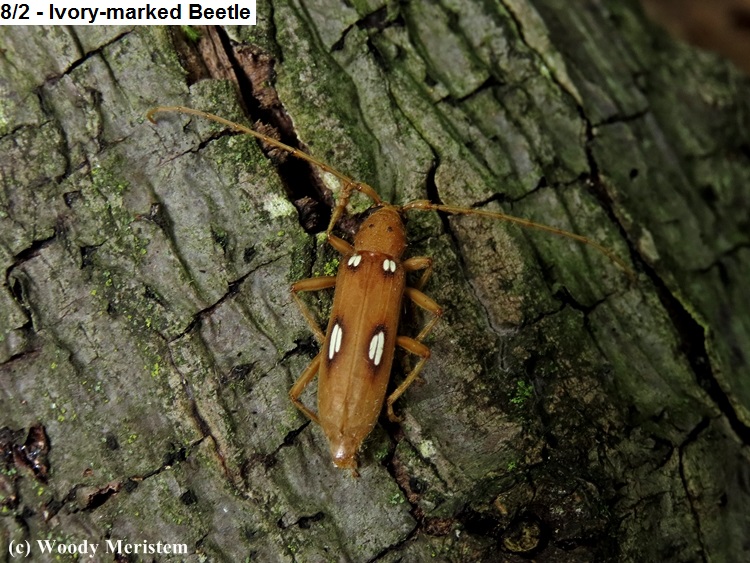
A Naturalist's Year - 3rd Quarter

The days were getting shorter and the days were getting hotter as the third quarter of the year began. By the time the third quarter ended the days had become noticeably shorter and, thankfully, cooler. At the beginning of this quarter the incidence of COVID-19 had diminished to a low level in Canada and many countries in Europe due to the steps they had taken to limit its spread; however, across much of this country the disease has been increasing dramatically and setting records. So H and I have continued to socially isolate, gone to stores only when absolutely necessary and stayed away from other people – but we haven’t stayed away from the natural world: its beauties and marvels and creatures.

Day by day photos from the year’s third quarter begin here –


This natural world we enjoy is a dynamic system yet it operates in a reasonably ordered manner, and we live in what we hope is an organized society. Just as in the natural world where species are interdependent, we humans are interdependent; we depend on others for things we cannot do ourselves, and they depend on us in the same way.

Unfortunately, wishful thinking has trumped science and common sense for those who think they should be free to do whatever they want, no matter how foolish. But freedom can go only as far as it impacts the freedom, or lives, of others. It’s many people’s attitude of  “I've got a right to ...” that has led them to act irresponsibly and help lead our country into the crisis, now turned into a catastrophe, in which the nation finds itself as the year’s third quarter ends.

COVID-19 has revealed the gap between what the United States has promised to its citizens and what it has delivered. Without wise leadership this land of ours has yielded to COVID-19. Wear a Mask!