Thursday, April 5, 2018

Elegy for Jacoby Hollow


Jacoby Hollow is a bit of a gem for naturalists. Except for fields at the mouth of the valley, the entire watershed is on the Loyalsock State Forest. The only view of the valley is from a road through those fields.


There’s a decent trail into the hollow that generally parallels the stream; in the beginning a small wetland is crossed on a boardwalk, but from then on it’s a woodland trail –


The valley generally trends north-northeast as a hiker walks upstream, so the hillside to the right faces northwest and is generally cool and moist while the hillside to the left faces southeast and tends to be warmer and drier. The valley's vegetation reflects those different aspects and the environments they create.
 
The trail passes some large white pine and through stands of hemlock –


My first visit to the hollow was in 1974 with a hiking buddy whose mother and sister had been killed in the gas chambers during World War II; in later years our oldest granddaughter and a group of hiking friends also visited the valley and its falls in winter; I’ve taken hikes into Jacoby Hollow in other seasons as well –


The real highlight of Jacoby Hollow is Jacoby Falls, at 29 feet the highest waterfall in the county


One distraction from the beauty of Jacoby Hollow has always been the pipeline that follows the stream, crosses it multiple times and is even beneath the streambed in places –


The pipeline is old, appearing in an aerial photo taken in 1938 –
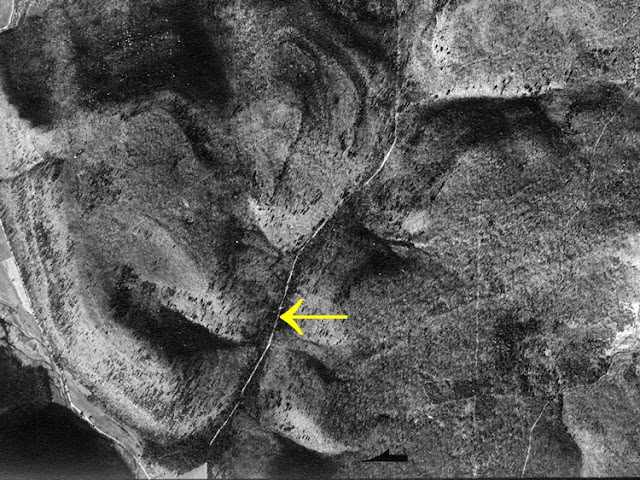
Then on the night of October 21, 2016 between six and ten inches of rain fell in less than six hours. The stream roared down the valley, as did all the nearby streams, and into a larger stream which the pipeline also followed and crossed several times. The “high water event” tore out a road bridge, uncovered the buried pipe in many locations, and ruptured the pipeline that, according to PennLive, spilled 52-55,000 gallons of gasoline into the water.

I’d not been to Jacoby Hollow since that event but recently decided to go back. The route of the old pipeline is now the equivalent of a road –


Apparently repairs to the pipeline are still underway since sections of new pipe are laid out awaiting installation –


Shortly before reaching the waterfall the pipeline leaves the stream and from there the stream is still beautiful –


As are the falls; because the watershed above the falls is only about 500 acres, the waterfall can be a mere trickle 


But then there are the heavily disturbed stream and the pipeline right-of-way

The question of why the damaged pipeline wasn’t moved out of the valley arises; surely a major storm event will occur again – especially as the climate changes. The scars may not heal within my lifetime and I may not go back.
 

Thursday, March 29, 2018

Deer in the Snow


This has been one odd winter, warm and spring-like, then cold and snowy, then back again to balmy temperatures with the snow all melted. In mid-March, just before the snow that was forecast began falling, we scattered a bit of corn on the ground in an attempt – futile – to keep the gray squirrels away from the bird feeders. 

Some squirrels fed on the corn but they prefer the sunflower seed in the feeders. With the snow came the white-tailed deer, the deer stayed for a while as the snow fell; they worked through the layer of snow to feed on the corn –


Four days later the snow had totally melted and the deer came back to find the few remaining kernels of corn –


For a number of reasons we don’t deliberately put out corn for the neighborhood deer, but they couldn’t resist the small amount of corn that was put out for the squirrels.

Thursday, March 22, 2018

From a Fallen White Pine


Fallen trees or logs are some of the best places to put a camera trap. At times I’ve set a camera trap at a long-fallen white pine; and sometimes place a “chirper” between the forks of the fallen tree. The chirper, which only operates at night, at random intervals produces a sound that mimics a small bird’s chirp. The chirper was used in hope of luring predators in front of the camera. Sometimes the camera trap has been positioned to look down the length of the log, other times at a right angle to the log. 


The first photos from the fallen white pine were of a barred owl –


Followed a few days later by a raccoon –


Squirrels were the animals most frequently photographed, both an occasional red squirrel –


And the ubiquitous gray squirrels –


Both species of squirrel must regularly gnaw on something to keep their incisor teeth, which grow continuously, at a proper length. Hard nut hulls are frequently adequate for gnawing purposes, but often other items are the subject of the gnawing. One of the things the gray squirrels picked to gnaw was my chirper. The white areas on the chirper are where squirrels have chewed away at the hardened construction adhesive used to help camouflage it from human eyes. 


Early one evening in January a group of white-tailed deer wandered past the log and its attending camera trap –


For anyone who thinks the white flash of a camera trap would scare deer, consider this – the camera (and its flash) took 31 photographs of this group of deer over a span of four minutes.

By far the prize of this location was the bobcat that walked the log and looked back when it heard the camera’s lens extending – 
That's a sampling of the photos from the fallen white pine, we’ll see what the future brings.

Friday, March 16, 2018

Pileated and Peregrine


It was a beautiful clear, cold winter morning – a good morning to walk along the river. The ice had gone out weeks ago so seeing some waterfowl was a possibility. But the only waterfowl to be seen were some common goldeneyes far from shore, much too far for good photos and in the shadow of a large passing cloud –


But a bit further on a loud “thunk, thunk” from a riverside tree caught my attention. There on the trunk of a silver maple was a male pileated woodpecker. He moved rapidly up, down and around the tree chipping here and there at the bark as he searched for the galleries of carpenter ants or the larva of wood-boring beetles. His movements were rapid enough that it was difficult to get a still photo of the bird – so here’s a short video of him hunting for a meal – 


As I moved for a view unobscured by tree trunks another pileated that was out of sight sounded the bird’s raucous territorial/alarm call and off he went, flying upstream and out of sight. 

Two years ago I’d seen a male pileated woodpecker along this same stretch of river; he’d also allowed a close approach and was also remarkably unwary for a pileated (posted here). Pileated woodpeckers are fairly long-lived birds, so it’s entirely possible this was the same bird. 

Most of a mile further on, in the same tree where I’d photographed them before (posted here) was a peregrine falcon. All the peregrines I’ve ever seen seemed to ignore mere humans, whether just passing by or stopping to watch them. This bird was no different as I stopped to take a few photos –


Another hundred yards along the way and there the second of the peregrine pair was perched in a riverside tree. Unfortunately, a few small branches hampered the view of the bird and there was no place from which to see the bird that was without interfering branches –


After three miles it was time to head for town to join friends for a cup of coffee and a blueberry muffin.