Thursday, January 4, 2018

Unfinished Wall


Across northern Pennsylvania there are areas that were settled in the mid-1800s by Irish immigrants, refugees from the potato famine that ravaged Ireland in the late 1840s and early 1850s. Many of those immigrants acquired land that had not yet been settled or cleared and proceeded to establish small farms.

Last summer it was on one of those properties that I came upon a beautiful stone wall in the midst of woodland, built with skill and great effort. From the height and straight sides it appears this was a wall built to confine livestock, not just to dispose of stones picked from the fields or to mark a boundary line.

The current landowners know some of the history of the property – it was cleared and the house was built by Irish immigrant Joseph Farley in 1854. Joseph died at 88 in 1873; his grave is in the cemetery of the Catholic church which lies two miles from the farm. Walking through the cemetery it quickly becomes evident that all of the names on the older stones are of Irish origin.

Apparently the farm’s prospects faded fairy quickly and it was abandoned by 1936. It stood abandoned until the current owners bought it for a weekend getaway. The original house still stands, although modified over the years, and must have looked like one that still exists in more original form not far away –

The beautiful wall continues for quite a way until it steps down to a section that was begun but never completed.

There, adjacent to the low wall is a long pile of stones – the raw material to complete the wall to its full height. That pile enabled the builder to readily select just the right stone to put in place next – or as one old wall builder told me years ago: in some places you need a right-handed rock, in others a left-handed rock.


Further on the low wall gives way to a long pile of stones that are in line with both the completed and uncompleted wall –
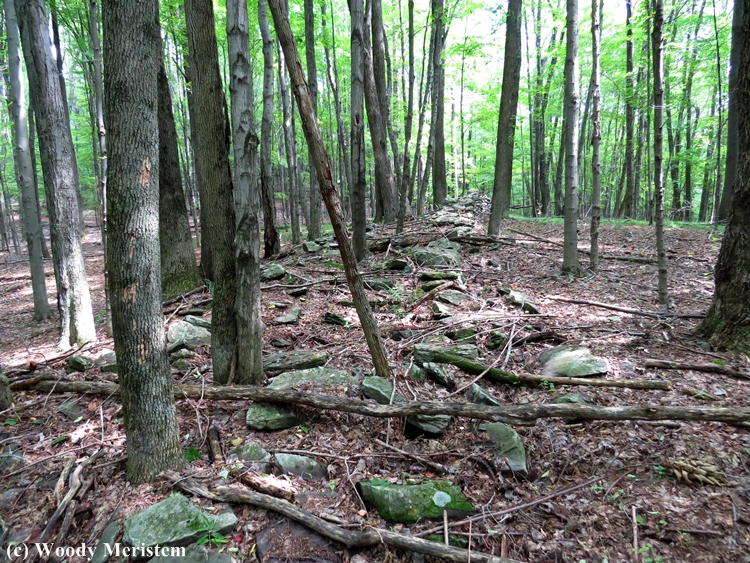
As so often happens in forest and field, this incomplete wall has an aura of mystery. Who built the wall, when, and why wasn’t it finished? The general consensus is that settlers could clear roughly ten acres of woodland a year. Often this would be done by girdling and thus killing the trees and then burning them in the next few years, after they had dried. As the farmers planted crops, they would gather and pile interfering rocks until they could be moved to the route of planned walls. On this property the rocks were often mounded on large boulders until the rocks could be moved –

When Joseph Farley settled this land he was in his late 60s and almost certainly would have needed help, probably from family or neighbors, in clearing the land and building the wall. Barbed wire became widely available in the 1870s; setting posts and stringing wire is much less labor intensive than building stone walls. Although there is no longer any evidence of barbed wire along the route of the unfinished wall, it’s probable that Joseph’s successors decided to use wire instead of finishing the wall.

And then the fields on either side of the wall were abandoned and reverted to forest –

Well over a century after it was built, the wall stands as a monument to the unending back-breaking toil of the early settlers.

Thursday, December 28, 2017

Ho, Ho, Ho


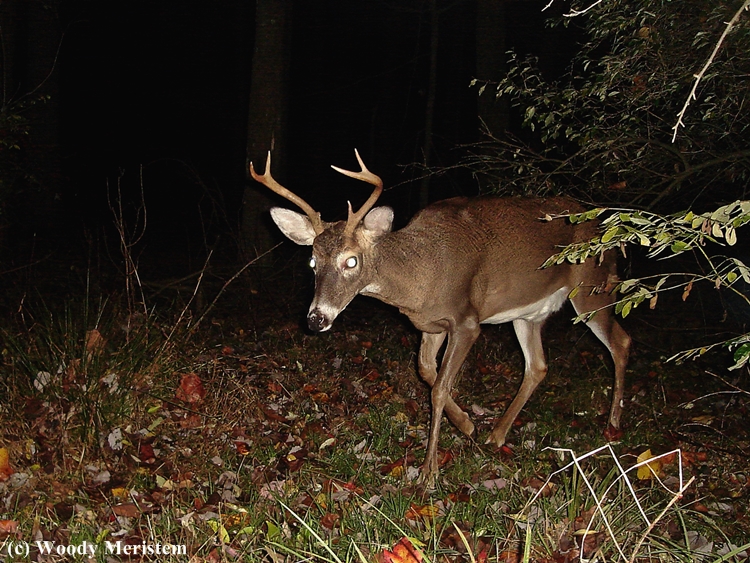
This week none of my camera traps managed to capture a photo of eight tiny reindeer or of a chubby fellow in a red suit. However, in the last few weeks they did manage to capture a number of deer – white-tailed deer, not those tiny reindeer. Here are some of the white-tail bucks that appeared on camera; while they didn’t bring wrapped presents, the photos were gifts from the natural world delivered by modern technology.


Here are those bucks:


How many of them survived Pennsylvania’s deer season may never be known, but some inhabit terrain that would inhibit all but the most determined hunters and others spend most of their time in areas that are closed to hunting. 

Given the typical home ranges of Pennsylvania deer, the bucks almost certainly left those “safe” spaces at times. But research by Penn State indicates that, although survival rates vary from place to place, in this part of the state almost 90% of antlered bucks survive hunting season -- http://ecosystems.psu.edu/research/projects/deer/news/2017/a-new-record-low

Thursday, December 21, 2017

Track of the Cat - 2017


‘Twas the week before Christmas and all through the woods lay three inches of snow. And then – the temperature rose so by the time I walked the old road in the Big Woods there was less than an inch of snow on the ground. Not far along the old road a set of bobcat tracks appeared; the bobcat had walked in the opposite direction from the way I was going and the tracks had veered from the road to disappear in a large patch of extremely thorny shrubbery.


As I walked the road, I backtracked the bobcat as it wandered from one side of the road to the other in quest of a meal. And thus it went for over a mile until the spot where the bobcat had come out of another thick brushy patch and begun to walk along the road –


On up the road I went intersecting one set of squirrel tracks after another going across the road (this year has seen one of the gray squirrels’ periodic population booms). Along the way there was an area where two wild turkeys had left tracks as they'd crossed the road.


By then it was time to turn around and head home. Because I’d been following the bobcat’s tracks and keeping an eye out for tracks indicating that it had caught something to eat (it hadn’t) I’d missed another set of tracks mixed with those of the gray squirrels, the tracks of a fisher in quest of a meal of squirrel. Unlike bobcat, fox and coyote, fishers have five toes which show in their tracks –


The fisher tracks weren’t distinct and they were soon lost amid a maze of squirrel tracks. By the next day rising temperatures had melted the last of the snow.   

Thursday, December 14, 2017

Disappointed


On a tract of public land in the Big Woods a stand of white oak has been growing on some very fertile, moist soil for well over a hundred years. The stand of white oak wasn’t very large, probably not more than ten acres in size but, because they were growing on good soil, the trees had done very well and many of them were two feet or more in diameter.


Every few years the white oak have produced a bumper crop of acorns –


Acorns that fed black bears –


And white-tailed deer –


Gray squirrels and chipmunks –


And wild turkeys –
White oak on a good growing site such as this one can reach 350-500 years of age so most of the trees in this small patch of woodland had many years ahead of them. 

A few of the trees were crooked or had decayed centers, but most of them were big and healthy –


Then, a forester I’ve known for many years mentioned that he was planning a timber sale that would include this stand of white oak. I pointed out the significance of this small stand of trees to wildlife: the seasonal pool it contains where frogs and salamanders lay their eggs, and the vast quantities of acorns it has regularly produced. In fact, the area fed wildlife during  years when nearby areas occupied by other species of oak and various hickories were essentially devoid of nuts.


He went on to mark the trees to be removed, the timber sale was sold to a large sawmill, and the trees were cut. Here are the results –


A number of the trees that were left were damaged during removal of the cut trees –

Although "the book" on best management practices for seasonal pools where amphibians breed recommends not cutting any trees within 100 feet of the pool's edge, that recommendation was not followed. 

Don't assume I'm an anti-forest management person; we live in a wood-framed house with wooden floors, doors, windows and trim; I've been a woodworker for decades, making more than 65 pieces of furniture; we utilize all sorts of paper products; there's a pile of firewood along the driveway. Wood is certainly more environmentally friendly than metal or masonry but not every wooded acre has to be managed. 


I’ve known and liked the forester who marked this timber sale for many years; he attended one of the best professional schools and, although the production of woody fiber for forest industry seems to be the sole interest of all too many foresters, this fellow has always appeared to be sensitive to the other forest resources wildlife, wildflowers, clean water, aesthetics. As soon as I saw the results of the timber sale I thought of Sir Peter Scott’s oft repeated comment, “We should have the wisdom to know when to leave a place alone.”


My disappointment is profound and these ten acres will forever color my opinion of the forester.