Thursday, June 8, 2017

Situational Ethics?


Long ago and far away I was a young 2nd Lieutenant taking a U.S. Army course for new officers. The senior officer/instructor emphatically insisted, “Don’t kill girl babies”, presumably because doing so would prompt the enemy to fight more intensely. At the same time by implication he was conveying that it was OK to kill boys.


I’ve never forgotten his statement and it frequently comes to mind in a different context. Now when I think about it, it’s in the context of hunting.


In Pennsylvania the seven species getting the most attention from hunters are cottontail rabbit, gray squirrel, ring-necked pheasant, ruffed grouse, wild turkey, white-tailed deer and black bear. Of those seven, three have restrictions of one kind or another on killing females so they can breed and increase the respective population:


Ring-necked pheasants are an exotic species native to northeast Asia and extensively introduced to North America where they have become a popular game bird. Intensive farming and the resultant habitat changes combined with more efficient harvesting of crops have led to put-and-take hunting of farm-raised birds. In some parts of Pennsylvania hunters may take only male birds –


Wild Turkeys are another bird where the sexes can be told apart, although not as readily as those of ring-necked pheasants. Male turkeys have a tuft of modified feathers called a “beard” dangling from their breast and the females do not.


In Pennsylvania, as in most other states, only male turkeys can be legally hunted during the spring. This is accomplished by restricting hunting to the morning when the males are actively seeking females and challenge other males – and many females are on their nests incubating eggs.


And then there are white-tailed deer, the most sought after quarry in the state and one over which there has been an on-going, noisy and frequently acrimonious dispute regarding hunting of females for decades. Here too it’s easy to tell the girls and boys apart, at least when they’re adults –


In the other four species that are popular with hunters it’s not so easy to tell male from female.


In the case of ruffed grouse, gray squirrels and cottontail rabbits the animal usually has to be in hand before the genders can be distinguished. Not many folks would want to grab a black bear and hold it up to check – and the bear might object a bit.


Any argument against killing of female pheasants, turkeys or deer so they can produce more offspring falls apart when it becomes obvious that it isn't important with the other four species. If a white-tail doe is necessary to perpetuate a huntable population of the species, why not a female bear? Is that because it’s inconvenient to protect female bears? 


What ever happened to “Don’t kill girl babies”? – looks like it depends on the situation. Ahh, situational ethics.
Thursday, June 1, 2017

Phoebe At Home


State Game Land #252, often called “The Ordinance" (the subject of a future post) has an interesting and complicated history and is a wildlife hotspot. A variety of habitats: wetlands, cultivated fields, reverting fields, young forests and mature forests within its 3,000 acres assure a comparable variety of wildlife. It’s a place I’ve been visiting since 1973 to view and photograph birds, mammals, trees and wildflowers.


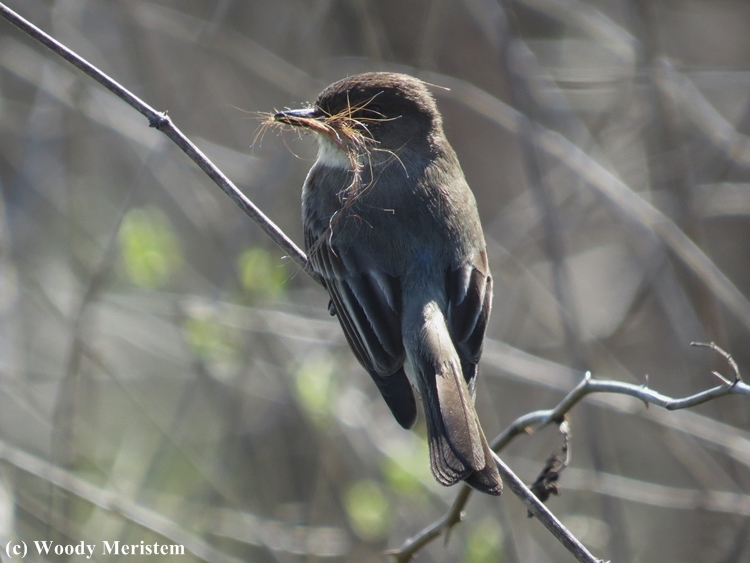
Several weeks ago as I was walking one of the many old roads on SGL 252 an eastern phoebe caught my attention and became the subject of several photos. At first it appeared that the bird had caught a large insect, but in actuality it was carrying nesting material.


Phoebes are well known for their tendency to nest on the I-beams beneath bridges and the beams supporting the roofs of porches on houses and cabins. Traditionally phoebes nested on rock ledges and outcrops along streams, but they readily adopted man-made structures.


This phoebe with its nesting material was nowhere near a rock ledge nor a bridge nor a structure. Other than a small wetland, the old road, a wooded fencerow and an old field there was nothing nearby except one of the gates closing SGL 252’s old roads to unauthorized motor vehicles. Suddenly the bird flew down to the “lock box” on the gate and paused on the edge –


Inside, behind the lock, was the nest the bird was building –


Although the gate is seldom used, a lot of human visitors to SGL 252 walk past. Here’s hoping the birds can raise a brood.

Thursday, May 25, 2017

The Saga Concludes


In an earlier post (here) the saga of the dead bear began. That post catalogued the species that my camera trap photographed as they came to feed on the bear’s carcass. It extended from the day we found the bear until an eastern coyote dragged away the remains. There was a lapse of a bit more than a week between the coyote’s removal of the carcass and when I found its new location.


The camera trap was moved to a spot where it could capture photos of the species visiting the new location. Fly larvae had devoured much of the carcass before the coyote dragged it to the new location and, after another week, there wasn’t much left. The first to arrive after the camera was re-located were two common crows –


That night an opossum came by –


Several days later a dog smelled the remains but only stayed long enough for the camera to take one photograph –


The ‘possum visited the carcass each night –


And on one rainy night was accompanied by a moth –


On a day in early May turkey vultures arrived –


The birds scattered the bones as they fed and squabbled over the remaining edibles –


The final photos were of two eastern coyotes when there was little if anything left for them to eat –


One of the coyotes appeared to scent roll on soil containing the odor of the carcass. All canines (wolf, dog, coyote and fox) scent roll to anoint themselves with strong odors. There are several theories about why they do this, but the actual reason(s) is not well understood.


With only a few bones and some hair remaining, it was time to remove the camera and leave the remains to bacteria and other microscopic scavengers. Thus the saga of the dead bear came to an end.


The story may have ended, but a host of questions remain: 
  • Why didn’t the large mammals in the area (bears, coyotes, bobcats) feed on the dead bear during the winter when food was scarce and the meat was fresh? 
  • Although they depend on larger mammals to open a carcass, the ravens that passed over the carcass’s location regularly apparently never even examined the remains, nor (except for two on only one day) did the locally abundant crows – why? 
  • What was the reason that it took until mid-April, when fly maggots had devoured  much of the flesh, for a coyote to finally show interest in the carcass?
  • By the time the vultures arrived the carcass was beneath rapidly expanding foliage; they apparently found it by scent - but it had smelled strongly for a while and the vultures had been back in the area for weeks - what took them so long to find it? 
  • Scavenging wildlife quickly find deer carcasses and rapidly devour the organs and muscles (see this post).  Do most species that scavenge from carcasses deliberately avoid a bear’s remains? If they do, why? 
Questions, questions and more questions. 


Thursday, May 18, 2017

A Dog in Forest and Field


The dog’s name is Trudi; although she vaguely resembles a small German Shepard, that's not what she is – she’s pure dog of undetermined ancestry. She was a shelter dog twice over, adopted once and returned until she was adopted by our son and his family. Trudi doesn’t like strangers, especially men, and really does not like other dogs. Perhaps that’s why she made two trips through the shelter. But with her family, including her “grandparents” she’s calm and apparently loving.


Each year, for a week or so, Trudi comes to stay with us and she and I spend time wandering in forest and field, and especially the Big Woods. There she hunts chipmunks, mice and voles with enthusiasm but very little success. If those small rodents had a choice about the predator by which to be hunted, they’d be foolish not to pick Trudi as their pursuer. But she enjoys the chase and puts a lot of effort into the quest.


Thanks to our son’s training Trudi won’t chase deer and will sit when I spend a bit of time photographing plants or other interesting features. While she sits she’s always alert and looking.


Trudi’s a bit over nine years old now and starting to get gray in the muzzle. She gets tired sooner than she did in her younger days (don’t we all?).


And after a good romp in forest or field takes a long nap –


Come to think of it, that’s not a bad idea.