Thursday, March 16, 2017

Der Alte


Der Alte (“the old man” in German) was, for some reason, the first thing that came to mind after the “Wow!” when I came upon this extremely large tree along a timber sale road in the Big Woods.


And so, I tagged it with the name Der Alte. It’s a chestnut oak, often called rock oak because they tend to be found on poorer growing sites that grow more rocks than trees. 
 

Looking at the trees around this one it’s clearly much, much larger than its neighbors. It’s usually not possible to determine a tree’s age by its diameter – small trees can be, and often are, older than nearby large trees. Trees’ diameter and growth rates are determined by a number of factors including their species, genetics, the availability of nutrients and water, and competition from neighboring trees. But this tree clearly pre-dates the trees surrounding it. How many winters has this tree seen, how many changes in the surrounding forest?


Standing beneath Der Alte, against its four foot diameter trunk, and looking up, the sheer mass of the tree is impressive –


Several large burls grace the tree’s trunk. Those burls would make some woodworkers drool as they thought of the bowls or other beautiful objects that could display the intricate grain usually found in burls.


At some point in the distant past Der Alte lost the uppermost part of its crown and the wound began to decay. The tree is probably hollow for much of its height, perhaps all the way to the ground.

Thirty years ago I accompanied a bear biologist on a winter day as he tracked a female black bear that had been fitted with a radio collar. He planned to replace the collar and weigh any cubs she had. When we got to the bear’s location, we found that she was denned inside a tree similar to Der Alte in that it had lost its top and was hollow all the way to the ground – and the radio collar's signal indicated that the bear was spending the winter in the base of the hollow tree.


Needless to say, we never got nearer to that bear than standing against the tree listening to the radio collar's signal and looking up. 

Perhaps there was a bear in Der Alte.

Thursday, March 9, 2017

From the North II


As related in another post, our son and his family live far to the north, on the side of a large mountain with many different habitats – the valley at its base, on its slopes and up on the peak. For several years I’ve had camera traps on their property to capture photos of the wildlife that inhabits the area. The predators are my primary interest, but there are other species of interest there as well. 


Eastern coyotes, also called coywolves because they’re a hybrid between coyotes and Algonquin wolves, are frequent visitors both winter and summer –


They sometimes come in a family group of parents and offspring that hunt together –


The eastern coyotes are attracted by a small twig dipped in beaver castoreum and placed upright in a hummock of moss in front of the camera trap. The castoreum also attracts fishers year ‘round –


Some people call these animals “fisher cats” but they’re not cats, they’re actually species of weasel. And many of those same people seem to think that fishers are a threat to man and beast. Yes they’re predators, but they’re only a threat to porcupines, squirrels, grouse and similar sized prey –


As in most places, raccoons are frequent visitors –


A species I’ve never gotten on camera in northcentral Pennsylvania is the red fox. So I’ve been glad to get quite a few photos of red fox on these camera traps even though this extensive woodland would not usually be considered red fox habitat -


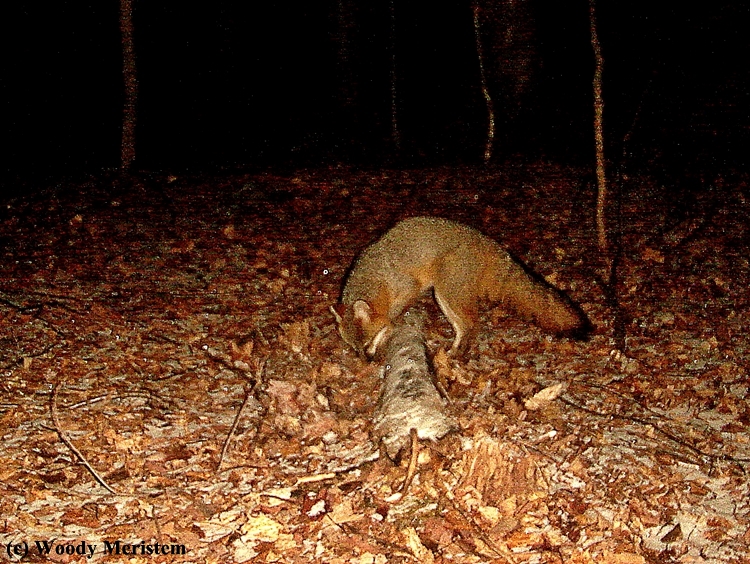
Large wooded areas are more to the liking of gray fox; which, surprisingly, have only appeared a few times -


A barred owl, that certainly hadn't smelled the beaver castoreum, landed in front of the camera –


Those cameras have also gotten photos of white-tailed deer –


And wild turkeys –


The camera traps on our son and daughter-in-law’s property have produced a lot of good photos, we’ll see what the future holds.

Thursday, March 2, 2017

This is Ridiculous!


It is absolutely ridiculous for the third week of February to be as warm as it was this year! Yes it is ridiculous! In spite of what some of our friends, the local newscasters, and many people we meet casually say about this having been wonderful weather, February in northcentral Pennsylvania should not be as HOT as the 73°F which it recently was at the house.


It was warm enough that in the ponds painted turtles had emerged to bask in the sun –

And in a vernal pool in the Big Woods male wood frogs had gathered and were calling vigorously –

Down along the river some silver maples had opened their flower buds –

And song sparrows were singing to establish their territories –


In the garden daffodil buds are standing tall -
   
And the lenten rose is in full bloom - 

All over the northeast temperature records were being set, some daily records for the date, some for the warmest February and some for the warmest winter day. 

A week before large flocks of Canada geese had been streaming north –


Although these warm February days were exceptional, there is no doubt that our climate is on a warming trend –


And that cold winter nights are becoming scarce

In spite of what members of the current regime in Washington say, there seems little doubt that humans' burning of fossil fuels is responsible for the warming trend. When 97% of climate scientists agree on something, as they do about human induced climate change, the rest of us better listen.