Saturday, October 26, 2013

Latest from the Big Woods – and the last for this year


The early hunting seasons have begun, so it was time to bring in the last of my camera traps from the Big Woods – a commercial trail camera that takes color photos during the day and infra-red photos at night. It’s been in place for a month, ever since I brought in the “homebrewed” camera trap that had been on a nearby tree. Unfortunately, the infra-red flash takes about a second to produce enough light to give proper exposure. That results in a lot of very blurry pictures – so blurred that sometimes it’s impossible to identify the animal.
But, now that the rut is beginning the older white-tail bucks with large-antlers are showing up again. The camera at this spot hadn’t gotten a picture of a buck with large antlers since June 19. Now that the older bucks have appeared only one young buck with small antlers has shown up in the pictures the other young bucks have probably been driven off by the mature bucks.
The smallest set of antlers captured on camera in the last month were on this deer –
His antlers look like those on this buck that was camera-trapped in September
but a close look shows that it’s not the same deer –
Next in size was this relatively young 9-point, notice how thin his antlers are –

Those antlers pale in comparison to the antlers worn by this buck: the thickness of his antlers shows that this is an older deer than the 9-point –
To my eye the most impressive buck the camera trap caught in the last month is this one: his antlers aren’t the thickest; with eight points, he doesn't have the most tines; his antlers don't have the widest spread. But the length of the tines, especially the brow tines, is really imposing –
The best photo taken in daylight by the camera trap last month was of a black bear –
There were no photographs of any bucks taken during the month in daylight. Similarly, there were photos of impressive bucks taken at the same location late last winter after all hunting seasons had ended – also all at night. But then, they didn’t get to be old enough to grow a large set of antlers by wandering around when hunters are in the woods.
Where do they go? Well, there are large areas with really dense patches of chest-high shrubs as well as steep, extremely rocky hillsides throughout the Big Woods; both of those conditions make walking difficult and unpleasant for humans – take it from one who knows. A buck that’s either lucky enough, or has learned to stay in those areas during hunting season has a good chance to live to see another day – and being active primarily at night helps too.  
Those of us who hunt with a gun may be frustrated by those big bucks, but those of us who hunt with a camera are glad that those bucks have the ability to survive.

Wednesday, October 23, 2013

October Gold


More than 50 years ago my freshman botany professor began a lecture by reading the essay “Smoky Gold” from Aldo Leopold’s A Sand County Almanac. Immediately after classes ended that day I hastened to the bookstore to buy myself a copy of Leopold’s book – which still resides on the shelf of my bookcase.
Leopold wrote: There are two times to hunt in Adams [County]: ordinary times and when the tamaracks are smoky gold. … The tamaracks change from green to yellow when the first frosts have brought woodcock, fox sparrows, and juncos out of the north. … I regard a phalanx of young tamaracks, their golden lances thrusting skyward. Under each the needles of yesterday fall to earth building a blanket of smoky gold …
There’s not much tamarack in northcentral Pennsylvania, it only occurs in some widely scattered wetlands that are relics and reminders of the last time a glacier came this way.
Tamarack
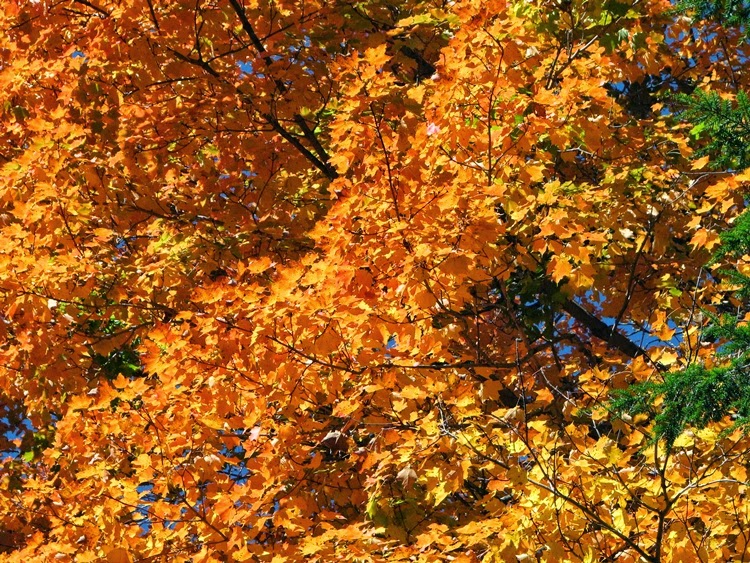
Instead, we have the October Gold of sugar maple leaves. Many of our sugar maples wear their autumn colors early in the season and then drop their leaves early. But, there are those individual trees that hold their leaves longer than most and grace the hillsides and field edges with their glorious color long after most of their neighbors display nothing but bare branches.

From a human perspective, sugar maples seem to be one of nature’s best creations – wood that is hard yet easily worked; excellent for flooring, bowling alleys, furniture, bowling pins, musical instruments and turned bowls; the provider of sap that, when boiled, becomes delicious maple syrup and maple sugar. Because of its brilliant fall coloration sugar maple is a favorite shade tree and brings hordes of leaf peeping tourists to areas where it is abundant.
In this age of rapid climate change the future of sugar maple is clouded. Sugar maple does not tolerate high temperatures well, and there are predictions that our average temperature will rise by 6-10 degrees over the next 100 years. If it does, sugar maple will be only a minor component of Pennsylvania’s forests when our grandchildren have grandchildren of their own.

Wednesday, October 16, 2013

Out Back


With the coming of hunting seasons and the folks out scouting for deer, bear and turkeys, I’ve pulled all but one camera trap out of the Big Woods. Cleaned up those cameras and put several out behind the house to join the one that’s always there.
The cameras have been out for thirteen days now and with a forecast of rain for tomorrow, temptation got the better of me and I decided to see what they’d caught – a total of 383 photos on the three cameras.
For most of the summer a doe and her twin fawns have been hanging around, feeding on fallen apples and plants in the garden. The twins are a young doe and her brother that we’ve watched grow larger and gradually loose their spots.  One of the cameras had a photo of the young buck, now with spots only on his hip. Soon even those spots will be gone and he’ll have his full winter coat.

Another of the camera traps had a photo of the only antlered buck that’s been around the house this year – just a young fellow, born in 2012

The way one camera was oriented produced several rather artistic backlit photos of the deer that passed by.

Along with the deer the camera traps caught the usual gray squirrels, rabbits, opossum –

and raccoon --

But the real prizes were a number of pictures of the gray fox that comes by several times a week 


Several of the photos portrayed two of these cat-like foxes that have semi-retractable claws, frequently travel on fallen logs and can climb trees, and not just leaning trees. 
As usual, downloading photos from the camera traps is like opening the contents of those colorful packages beneath the Christmas tree – always a bit of a surprise and always a treat.

Thursday, October 10, 2013

Charcoal Flats

Large areas of the Big Woods are seemingly deserted, only visited by an occasional hunter or hiker and of those only the most energetic. But beginning in the 1820s some parts of the Big Woods were a beehive of industrial activity. Throughout central and southern Pennsylvania iron furnaces were constructed to turn iron ore into pig iron for the burgeoning industries of the young country.
 
The furnaces were pyramidal stone structures with a central chamber which was loaded with iron ore, limestone and charcoal and then ignited. The burning charcoal produced a temperature of 2,500-3,000 degrees which was vital for extracting iron from the ore. It is estimated that an average 19th century iron furnace required the charcoal produced from one acre of woodland for each day’s production. 
 
Production of enough charcoal to fuel an iron furnace required a significant acreage of woodland and a substantial labor force.
 
Take a hike through some sections of the Big Woods and you may find remnants of that charcoal production in the form of “charcoal flats” or hearths. These are flat areas of 25-50 feet in diameter where four foot long billets of wood were stacked,
From PA DCNR
covered with a layer of leaves, then a layer of soil and ignited.
From NPS
There was a central chimney in the pile and vents around its base; these vents were opened or closed to control the burn of the smoldering stack – too little air and the fire would go out, too much air and the stack would burn leaving only ash instead of charcoal.
 
The workers that produced charcoal were called “colliers”, who, with one or two helpers, tended the smoldering wood around the clock for 10 to 14 days until it became charcoal. The collier and his helpers lived in primitive huts, often constructed of poles covered with soil or canvas, and tended a number of piles. Being a collier, although requiring considerable skill, was a dirty, lonely job and colliers were often considered among the lowest of the low.
From PA State Archives
When the collier determined that all of the wood had become charcoal the vents were closed, depriving the stack of oxygen and ending the burn. After the charcoal had cooled, which took about a week, the covering was removed, the charcoal raked out, and loaded onto wagons to be hauled to the iron furnace.
From PA DCNR
Only a portion of the Big Woods was affected by the iron industry so it’s not every day that I find an old charcoal flat.
This one was about average in size and a little poking about revealed some left-behind charcoal.
Not far away was an old pitch pine snag – pitch pine lives up to its name as the wood is filled with pitch making it very decay resistant. The snag bore the scars and charcoal of a long-ago fire. It also had an undercut made with an axe when someone in the dim, distant past had begun to cut down the tree. Was the tree burned when the charcoal stack was opened before the charcoal had sufficiently cooled and started a forest fire? Or …?

The iron furnaces that would most likely have been supplied by these charcoal flats were built in the 1820s and ‘30s. Some iron furnaces had a large land base and were able to wait 30-40 years for the areas that were cut first to once again produce trees large enough to cut for charcoal; others were forced to close after all the readily available woodland had been cut for charcoal. By 1850 coal and coke had begun to supplant charcoal as fuel for the furnaces, in part due to charcoal shortage. With the discovery of high-grade iron ore near the Great Lakes and vastly improved transportation the small iron furnaces scattered across Pennsylvania were no longer economically viable and began to close; almost all were out of production before 1900.

Friday, October 4, 2013

The colors of autumn


Those of us who live in the northeastern states and adjacent Canada are a truly privileged bunch, for there are only a few places in the world that see the forests turn color as they do here. At this time of year the forests of our area display a riot of color: from sere brown to lemon yellow, bright orange, brilliant red, maroon and port-wine purple. It’s an ephemeral display, lasting but a few weeks before wind, rain and gravity strip the trees of their leaves.
The display of fall colors brings a parade of leaf-peeping tourists that are always in search of the “peak” of the display. On TV the weather folks announce the southward progression of the peak of fall color; and communities publicize their foliage festivals. Earlier this week as my son and I drove through the valley in which he and his family live we were treated to one of the most brilliant displays of fall color I’ve ever seen. Tongue-in-cheek we decided that the “peak” occurred at 10:38 am on Tuesday, October 1.
We happen to live on the transition between the northern hardwood beech-birch-maple forest and the southern oak-hickory forest. Although named for their dominant species, these forests have scores of associated varieties of trees, shrubs and vines, many of which also display colorful foliage . The commonly used names for the predominant forest types are really simplifications since they contain numerous species of maple, birch, oak and hickory. Because we live in the transition zone, we enjoy a longer foliage season than most people as the different species turn color in a general north-south progression. 
First to turn color are the birches, which typically turn pale yellow and lose their leaves early. Next come the leaves of red maple, which unsurprisingly, turn bright red
and those of sugar maple that may vary from yellow through orange to red – often on the same tree and sometimes on the same leaf.
In the oak-hickory forest all the hickories turn bright yellow,
while the oaks vary from yellow to dull red
and some of the associated species are real treats: the orange-gold of sassafras,
and the color spectrum of staghorn sumac
The final fling is the bright yellow of tulip-poplar that grows on the moist fertile soils of the hillside valleys.
For a readable, easily understood explanation of the complicated process leaves undergo to change color visit http://northernwoodlands.org/outside_story/article/the-causes-of-fall-color

Wednesday, September 25, 2013

More from the camera traps


As the season progresses the white-tail bucks have lost the velvet from their antlers
 
and are beginning to spar with their rivals (too far from the camera to make a worthwhile photo)
But this bear wasn’t too far from the camera; it was way too close
Just right was this young coyote that paused to check the odor on a small tree before proceeding on its way

The camera trap at another location caught photos of coyotes on two different days
 
With all due respect to deer and turkey hunters who often hate them, coyotes happen to be one of my favorite mammals - smart, adaptable and real survivors
That camera trap also produced a photo of the fattest bear I’ve ever caught on camera 
 
Bears are very inquisitive and frequently bite, lick and/or maul cameras. With their tremendous strength a bear examining a camera trap can easily damage it. Raccoons also bite, lick and/or maul cameras, but usually don’t damage the camera. Humans are another matter, although most folks finding a camera trap just peer at it and move on.
But, there are those people who just can’t leave things alone. Some of them break stuff they find just for the heck of it; others decide to make off with whatever they find. Anyone who leaves a camera trap out in the forest or field runs a risk, and not infrequently returns to find their camera trap damaged or missing. Last year one of my camera traps had several photos of someone looking at it. Fortunately he was an honest fellow and left the camera alone.
Since various hunting seasons are just around the corner, I decided to bring my camera traps in from the Big Woods. With more people in the woods the chance of one of them being a vandal or thief and finding one of the cameras goes way up. The camera traps near the house will stay out, capturing the critters that spend time nearby. 
'nuf of that – back to sorting the photos on the cards in the other camera traps I brought in.

Saturday, September 14, 2013

Pennsylvania Elk


Since the 1970s I've made occasional trips to see and photograph the elk of Elk County, Pennsylvania. Back then both elk and tourists were scarce and those of us who visited the area didn't see many of either. Things have changed in recent years -- there are more elk (around 800) and, since the promotion of the elk herd as a tourist attraction, many more people.The increase in elk-tourism has made it much less pleasant to visit the area, but as long as the effort is made to get several miles from a road and the tourist-jams it's still a very worthwhile experience.

With the recent change in the weather from hot and humid to more autumnal conditions, it was time to go in search of elk. By arriving just after dawn, people were scarce and the elk tended to be out feeding in openings before retreating to denser cover. Then, toward dusk, a walk of several miles got me away from humans and closer to a number of elk.


The breeding bulls are every bit as impressive as their western counterparts -
 These two young bulls spent quite some time sparring -


Once upon a time -- before the arrival of European settlers -- elk inhabited all of what was to become Pennsylvania. The elk's primary habitat was probably extensive meadows along major rivers and streams that were created and maintained by Native American agriculture and the fires they set to improve hunting. With the coming of European settlers elk were intensively hunted with the last individuals apparently being found in Cameron County and (the appropriately named) Elk County -- before 1880 they were totally eliminated from the state.

The burgeoning interest in conservation in the early 1900s led to the re-introduction of elk to Pennsylvania in 1913; with most of the original stock coming from Yellowstone. Abandoned farms and regeneration of forests following the extensive logging of the late 19th and early 20th centuries provided excellent habitat and the animals appeared to prosper, leading to hunting seasons from 1923 until 1931. Then the population collapsed until only a few animals survived – once again in Cameron and Elk counties.

By the early 1970s the population numbered about 65 animals that appeared to be a nuisance to authorities as some were shot by farmers for crop damage, other were shot by poachers or “in mistake for deer”. But finally there was a change of heart and the elk were seen as an asset: a magnet for tourists and potential game animals. Forest management on public land was altered to improve elk habitat and open fields were created; with the improved habitat the herd has increased to about 800 animals and has spread beyond its core range.

 But, as the population increased so did the publicity surrounding the animals which were seen as opportunities for both "eco-tourism" and hunting. And so, viewing areas have been created for those who can't, or won't, view the elk in a more natural setting and a limited hunting season has been instituted.

Wednesday, September 4, 2013

Latest from the Camera Traps

Checked several of my camera traps and found that they've been disappointingly unproductive in the last few weeks. But, they continue to produce some nice photos:

of a young white-tail buck -

and a young black bear -

It's been really dry here for the later part of the summer, with only an occasional small evening thunderstorm. One of those storms apparently caught a black bear when it was near one of the camera traps and the bear proceeded to shake itself as would a dog. The shake was in front of a camera - its flash stopped the water droplets in mid air.

And then there was the camera that only managed to get photos of the webs that spiders had spun in front of the flash and lens. The spiders apparently went to work immediately after the last time I'd changed the card and batteries because all 40+ photos were blurred images of the webs.

Thursday, August 22, 2013

Where are they now?

Various species of wildlife obviously change their routines with the seasons and as the pressures of breeding and finding food and cover vary. And those changes become a challenge and a learning opportunity for naturalists and biologists and anyone interested in wildlife.

In checking one of my camera traps the mystery of those changing routines was brought home. Last winter, long after the end of deer season, a large 8-point buck appeared in several photos at a new camera location which has since become one of my favorite spots. He was an impressive deer and must have avoided hunters for several years.

What was probably the same deer was caught by the camera a number of times in the spring, the last being in mid-May as his new antlers were already showing their potential.

The same camera location also provided photos of a piebald deer beginning in early March as the winter's snow melted. The piebald was a young buck that had just survived his first winter and traveled with his mother and sister.

He showed up repeatedly until early June and hasn't appeared in a photo since then.

In fact, this is the most notable deer that has been caught by that camera since the piebald's last appearance.

 
So, the question is -- Where are the big buck and the piebald now? White-tailed deer usually have a home range of about a square mile; young bucks typically disperse from their mother's home range, while young does tend to stay at home. The young bucks often travel four to six miles from where they were born before establishing their own home range, although some go much further. So, the piebald may well have traveled far beyond the area where he spent the spring of 2013. But, that doesn't explain the non-appearance of the older buck. Several researchers have found that adult males increase the size of their home ranges from late spring until the end of the fall breeding season, so the large buck is probably just spending more time further from the camera location.

Of course, either deer may have succumbed to injury or disease, been taken by a poacher or been hit by a vehicle -- the camera trap may catch them again, or it may not. That's one of the joys of having a camera trap, each time it's checked it opens the door to a mystery.