Wednesday, September 25, 2013

More from the camera traps


As the season progresses the white-tail bucks have lost the velvet from their antlers
 
and are beginning to spar with their rivals (too far from the camera to make a worthwhile photo)
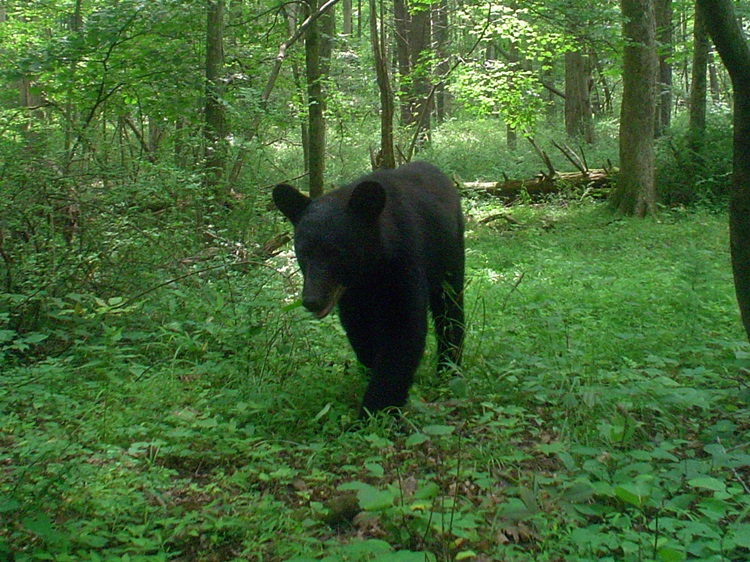
But this bear wasn’t too far from the camera; it was way too close
Just right was this young coyote that paused to check the odor on a small tree before proceeding on its way

The camera trap at another location caught photos of coyotes on two different days
 
With all due respect to deer and turkey hunters who often hate them, coyotes happen to be one of my favorite mammals - smart, adaptable and real survivors
That camera trap also produced a photo of the fattest bear I’ve ever caught on camera 
 
Bears are very inquisitive and frequently bite, lick and/or maul cameras. With their tremendous strength a bear examining a camera trap can easily damage it. Raccoons also bite, lick and/or maul cameras, but usually don’t damage the camera. Humans are another matter, although most folks finding a camera trap just peer at it and move on.
But, there are those people who just can’t leave things alone. Some of them break stuff they find just for the heck of it; others decide to make off with whatever they find. Anyone who leaves a camera trap out in the forest or field runs a risk, and not infrequently returns to find their camera trap damaged or missing. Last year one of my camera traps had several photos of someone looking at it. Fortunately he was an honest fellow and left the camera alone.
Since various hunting seasons are just around the corner, I decided to bring my camera traps in from the Big Woods. With more people in the woods the chance of one of them being a vandal or thief and finding one of the cameras goes way up. The camera traps near the house will stay out, capturing the critters that spend time nearby. 
'nuf of that – back to sorting the photos on the cards in the other camera traps I brought in.

Saturday, September 14, 2013

Pennsylvania Elk


Since the 1970s I've made occasional trips to see and photograph the elk of Elk County, Pennsylvania. Back then both elk and tourists were scarce and those of us who visited the area didn't see many of either. Things have changed in recent years -- there are more elk (around 800) and, since the promotion of the elk herd as a tourist attraction, many more people.The increase in elk-tourism has made it much less pleasant to visit the area, but as long as the effort is made to get several miles from a road and the tourist-jams it's still a very worthwhile experience.

With the recent change in the weather from hot and humid to more autumnal conditions, it was time to go in search of elk. By arriving just after dawn, people were scarce and the elk tended to be out feeding in openings before retreating to denser cover. Then, toward dusk, a walk of several miles got me away from humans and closer to a number of elk.


The breeding bulls are every bit as impressive as their western counterparts -
 These two young bulls spent quite some time sparring -


Once upon a time -- before the arrival of European settlers -- elk inhabited all of what was to become Pennsylvania. The elk's primary habitat was probably extensive meadows along major rivers and streams that were created and maintained by Native American agriculture and the fires they set to improve hunting. With the coming of European settlers elk were intensively hunted with the last individuals apparently being found in Cameron County and (the appropriately named) Elk County -- before 1880 they were totally eliminated from the state.

The burgeoning interest in conservation in the early 1900s led to the re-introduction of elk to Pennsylvania in 1913; with most of the original stock coming from Yellowstone. Abandoned farms and regeneration of forests following the extensive logging of the late 19th and early 20th centuries provided excellent habitat and the animals appeared to prosper, leading to hunting seasons from 1923 until 1931. Then the population collapsed until only a few animals survived – once again in Cameron and Elk counties.

By the early 1970s the population numbered about 65 animals that appeared to be a nuisance to authorities as some were shot by farmers for crop damage, other were shot by poachers or “in mistake for deer”. But finally there was a change of heart and the elk were seen as an asset: a magnet for tourists and potential game animals. Forest management on public land was altered to improve elk habitat and open fields were created; with the improved habitat the herd has increased to about 800 animals and has spread beyond its core range.

 But, as the population increased so did the publicity surrounding the animals which were seen as opportunities for both "eco-tourism" and hunting. And so, viewing areas have been created for those who can't, or won't, view the elk in a more natural setting and a limited hunting season has been instituted.

Wednesday, September 4, 2013

Latest from the Camera Traps

Checked several of my camera traps and found that they've been disappointingly unproductive in the last few weeks. But, they continue to produce some nice photos:

of a young white-tail buck -

and a young black bear -

It's been really dry here for the later part of the summer, with only an occasional small evening thunderstorm. One of those storms apparently caught a black bear when it was near one of the camera traps and the bear proceeded to shake itself as would a dog. The shake was in front of a camera - its flash stopped the water droplets in mid air.

And then there was the camera that only managed to get photos of the webs that spiders had spun in front of the flash and lens. The spiders apparently went to work immediately after the last time I'd changed the card and batteries because all 40+ photos were blurred images of the webs.

Thursday, August 22, 2013

Where are they now?

Various species of wildlife obviously change their routines with the seasons and as the pressures of breeding and finding food and cover vary. And those changes become a challenge and a learning opportunity for naturalists and biologists and anyone interested in wildlife.

In checking one of my camera traps the mystery of those changing routines was brought home. Last winter, long after the end of deer season, a large 8-point buck appeared in several photos at a new camera location which has since become one of my favorite spots. He was an impressive deer and must have avoided hunters for several years.

What was probably the same deer was caught by the camera a number of times in the spring, the last being in mid-May as his new antlers were already showing their potential.

The same camera location also provided photos of a piebald deer beginning in early March as the winter's snow melted. The piebald was a young buck that had just survived his first winter and traveled with his mother and sister.

He showed up repeatedly until early June and hasn't appeared in a photo since then.

In fact, this is the most notable deer that has been caught by that camera since the piebald's last appearance.

 
So, the question is -- Where are the big buck and the piebald now? White-tailed deer usually have a home range of about a square mile; young bucks typically disperse from their mother's home range, while young does tend to stay at home. The young bucks often travel four to six miles from where they were born before establishing their own home range, although some go much further. So, the piebald may well have traveled far beyond the area where he spent the spring of 2013. But, that doesn't explain the non-appearance of the older buck. Several researchers have found that adult males increase the size of their home ranges from late spring until the end of the fall breeding season, so the large buck is probably just spending more time further from the camera location.

Of course, either deer may have succumbed to injury or disease, been taken by a poacher or been hit by a vehicle -- the camera trap may catch them again, or it may not. That's one of the joys of having a camera trap, each time it's checked it opens the door to a mystery.

Sunday, August 18, 2013

Dragonflies Galore

A few days ago I took my lightweight canoe up to the lake and paddled around the perimeter, about six miles. A beautiful morning it was, clear and cool -- more like northern New England in mid-August than Pennsylvania usually is at this time of year.

There was an abundance of dragonflies in the vegetation along the water's edge. The Odonata (dragonflies and damselflies) is an ancient group of predatory insects and one of those dragonflies is reported to have been the largest insect that ever lived. Dragonfly adults are fast fliers that feed on other insects, while the nymphs are aquatic ambush predators.


Many adult dragonflies are very colorful insects and their common names tend to be as colorful as the insects themselves. Among the lake's most abundant dragonfly denizens were:


 Spangled Skimmers -


Halloween Pennants -


and Widow Skimmers - 

But not even predators are immune from predation; this golden garden spider, which had spun its web in the vegetation in shallow water, had gotten itself a meal of a dragonfly of undetermined species --


Sunday, August 11, 2013

Stiltgrass - UGH!

Not far from the house is the edge of the "Big Woods", several hundred thousand contiguous acres of publicly-owned woodland. Although almost all of the Big Woods has always been forested, there is a scattering of former farmland - some has been planted with tree seedlings but most has been allowed to revert to woodland naturally.

Yesterday I walked through some of the reverting fields that haven't been farmed in almost 100 years. Trees were slow to seed into those acres where the soil was depleted of both nutrients and organic matter, so many of the trees are small in diameter and widely scattered. Because trees still don't fully occupy the site, many exotic plants have invaded the fields: the Asiatic honeysuckles, multiflora rose, autumn olive and Japanese stiltgrass are the common invaders. The most abundant and pernicious of these exotic plants is Japanese stiltgrass.


Stiltgrass is an annual plant that appears to prefer moist, fertile soils but will grow in many situations, especially sites that have been disturbed. Because it creates thick mats of stems and leaves and totally dominates the site's herbaceous layer, stiltgrass easily suppresses native plants - and the fact that white-tailed deer won't eat the stuff compounds the problem. Stiltgrass is gradually (in some areas not so gradually) spreading in the Big Woods and so threatens to reduce or eliminate desirable native plants and adversely impact wildlife as food sources are eliminated.

Any type of soil disturbance increases the likelihood of stiltgrass spreading through the forest. The miles of logging roads that have been built in the Big Woods in the last 40 years have certainly helped spread stiltgrass. The thousands of miles of access roads and pipelines that many expect to be constructed to extract natural gas from the Marcellus shale beneath northern and western Pennsylvania will probably hasten the spread of stiltgrass.


Controlling the spread of stiltgrass is difficult, but possible given enough time, effort and funds. Responsible forest managers will take steps to control or eliminate stiltgrass -- unfortunately, others will not.

Tuesday, August 6, 2013

Camera Traps

Camera traps (some folks call them trail cameras or game cameras) open a new window into the world around us. Hunters use them to scout before hunting season; wildlife managers and scientists use them to determine the species or individuals in an area; and other folks find using them a fascinating hobby.

One of the best aspects of using camera traps is the surprise gift of photos you never expected. I keep a trail camera at one spot that has proven to be a great location; it's yielded pictures of seven different bears so far this year, a bobcat at least once a week, a piebald deer, many different bucks, a mouse and an occasional coyote.


Most of my camera traps are "homebrews" combining an out-of-date digital camera with an infrared sensor and external batteries to provide extended power for the camera.


In the last few days I've changed the cards and batteries on most of my cameras. The camera closest to the house had 167 pictures. Beside the usual photos of squirrels, rabbits, opossum, raccoon and white-tailed deer, there were two photos of a gray fox in the rain. The gray fox first showed up last winter and has since been captured on camera at about two week intervals; once in late winter there were two in one picture, presumably a courting pair.


Beside the fox, the camera near the house had photos of several deer, including a fawn and three different does. The fawns hit the garden fairly hard as they try many different possible foods, browsing on plants the adults never eat.

The cameras further from the house had a greater variety of wildlife including:

 bear:


a bobcat:


and several photogenic deer:


But not all photos from a camera trap are worth keeping --


Thursday, August 1, 2013

I am in love with this green earth

For as long as I can remember I've wandered the fields and forests of the northeast. My father introduced me to the forest and instilled in me a love for the natural world. The English essayist Charles Lamb (1775-1834) once said, "I am in love with this green earth." And so am I, all these many years later "In love with this green earth." Here will be the observations and opinions of an aging nature lover. 
 
For the last few weeks a white-tailed doe with twin fawns has been visiting the yard. They're all pretty tame and typically just stand looking at anyone who comes out the door; only leaving if a human gets too close (less than about 20-30 feet) or moves suddenly. Yesterday the doe and her fawns were under the apple tree feeding on drops. Most of the fallen apples are those that the gray squirrels have cut and then dropped. Except for the squirrels, we'd get a lot more apples for ourselves from the tree -- but the deer sure do enjoy them.